This is where you can follow the important socio-economic, geopolitical and security developments, going inside the Republic of Somaliland and Horn of Africa region
Search This Blog
Monday, May 12, 2014
To ALL-please help-
Mr. Dallas Peavey and Jaime Lopez were arrested and placed into prisonin Djibouti this past month (14 March-22 April 2014) and held for 40 days for no cause.They need your assistance to motivate the US State Department to work on our behalf to allow us to return to the USA as soon as possible.
I would like to provide you with a brief on the events that transpired and current status:
1.The President of Djibouti and Minister of Finance highly suggested the transfer of 30% (15/15) of their electric power project to be transferred to two companies owned by the elected officials.This request was refused.Written documentation is available (Sept 2013).
2.The President’s secretary highly suggested that 10% of the project be transferred to a group he suggested.This request was refused. Written documentation is available (Sept 2013).
3.They filed embezzling charges against the Minister of Finance’s brother-in-law for theft $165,000 (USD) from their company. Documentation of the embezzling, as well as documentation of this man taking money from the Djiboutian government.They informed and requested advice of the US Embassy in advance of filing, with a no response. This case has been swept under the Djiboutian judicial rug. (July 2013).
4.The Djiboutian secret police abducted Jaime Lopez off the streets of downtown Djibouti, and took him to a undisclosed location (14 March 2014).
5.The Djiboutian secret police arrested Mr. Peavey.
6.Djiboutian police refused them the following:
a)Not allowed to contact the US Embassy (violation of international treaty)
b)Not informed of the charges against us (violation of Djibouti law)
c)Not allowed to have legal representation (violation of Djibouti constitution)
d)Not allowed to have a translator (violation of Djibouti law)
e)Attempted to force Jaime to sign a statement written in French (He does not read French).They were told they would be put into prisonif not signed.
7.Djiboutian prosecution officer refused to present charges (violation of Djibouti legal procedure)
8.Both were put into prison without any formal charges or complaints
c)US Consulate’s office stated the US Government does not get involved in health care
d)US Consulate’s office stated they would request the Djiboutian government to force feed
10.US Consulate stated that 3 complaints (Dip-Notes) would be immediately filed (unclear if occurred)
11.US Consulate’s office suggested that US Senators, Congressmen, or media not be contacted as this could cause a international incident that would negatively impact their situation
12.The Djiboutian court issued a release order after 28 days, but the prosecuting office called the prison to block their release (violation of Djiboutian law and procedures)
13.US Consulate continuously stated that the only assistance available from that office was to ensure that Djiboutian law/treaties are equally and fairly applied to US citizens
14.US Consulate continuously stated that the US Embassy has no legal expertise for Djibouti
15.US Consulate stated that they were taking legal advise from the Djiboutian prosecution office
16.US Consulate told their case was not serious
17.US Consulate told a translator would be provided (never happened)
18.US Consulate cc’d prosecution office of emails to Washington
19.They remained in prison for 40 days without resolution (violation of Djibouti law)
20.US Embassy provided derogatory written and verbal information to US military base (Camp Lemonier) that was not accurate, causing the US military base commander to declare us to be persona non-grata at the base (liable and slander)
21.US Consulate office provided, in writing, to the Djiboutian court false information regarding Mr. Peavey being wanted by the FBI
22.US Consulate office will not return Mr. Lopez’s passport, which heasked the Consulate to hold to prevent Djiboutian government from taking, until the Djiboutian government agrees
23.US Consulate has stated that 10 Dip-Note complaints have been issued to the Djiboutian government with no responses
24.Mr. Lopez and Mr. Peavey have informed the US Consulate they wish to return to the USA
25.US Consulate has stated they are no longer involved in the legal matters even though:
c)There have been no responses to the Dip-Notes issued by the US Consulate
d)US Consulate is not assisting with ensuring equal and fair application of Djiboutian law/treaty
26.Djiboutian government has made in the past, and continues to make unverifiable allegations, which the US Consulate has accepted and presents as fact.Examples:
a) Djiboutian Foreign Minister submitted a Dip-Note claiming that Djiboutian investors wanted their $175,000 (USD) returned.Later the US Consulate learned that the accusation was based on hearsay and rumors
b) Djiboutian Foreign Minister claimed that their company owes the Djiboutian government $300,000 (USD), but has failed to provided documentation
c) Djiboutian government claims there are many commercial complaints against their company, but does not recognize the complaints they have regarding these commercial entities (we have documentation, not verbal)
d) Djiboutian judges stated to their attorney that one of the causes of this situation was the Djiboutian government wanting to have leverage over the US Government
It is a matter of opinion, but it is readily apparent that the failure for the US Consulate’s office to immediately and appropriately respond early in this situation is what caused Mr. Peavey and Mr. Lopez to be left in the Djiboutian prison for 40 days.The Djiboutian government was allowed to violate their rights as prescribed by Djiboutian law, constitution, and international treaty.And based on recent events with President Obama meeting with the President of Djibouti and praising him for his help it is readily apparent that their situation was hushed for political expedience.Now that the politics of ‘friendship’ with a dictator is over, perhaps the State Department could consider getting them released from in-country detention?
There is currently a case pending which could be criminal, but there are NO associated charges or complaints.This case has all the human rights violations associated with it.The prosecuting office has argued that the human rights violations have nothing to do with the case.
There are commercial supposed complaints, but nothing to date.
Although they have invested all of their own capital (over $1.8 million USD) in this project in Djibouti, which will be lost, they have determined that there is no option to try to continue to remain in Djibouti.
Then to prove that the report is correct Djibouti perpetuated these abuses against US Citizens. Read the report and compare it to what happened to us, line item by line item.
Now your President has the nerve to meet with the president of the country that violates the human rights of its citizens as well as those of the US, and to PRAISE the government for their ‘security’ cooperation.
So the USA is now in the business of trading the human rights of people, to include its own citizens, for a land lease with a government that violates human rights. When did it become okay to do a deal with the devil? Why do we bother criticizing the North Koreans or others for their violations?
I am requesting assistance from your office and the Global Justice Clinic to coordinate with the US State Department towards expediting our ability to leave Djibouti as soon as is practical, and be returned to the USA.
I want to thank you for all your efforts to support Mr. Lopez and Mr. Peavey,
Michael Maren has lived an Indiana Jones kind of life: Peace Corps volunteer, war correspondent from Africa, kidnap victim of a Somali warlord, author, and now filmmaker.
However, anyone expecting a hard-hitting documentary exposing the troubles of foreign aid (the subject of his book, “The Road to Hell”) is in for a surprise. In fact, if his film, “A Short History of Decay,” exposes anything, it is the frailty of life and the importance of family.
Nathan Fisher (Bryan Greenberg) is a blocked Brooklyn writer in a blocked relationship who heads to Florida when his father Bob (Harris Yulin) has a stroke and his mom Sandy (Linda Lavin), is suffering from early signs of Alzheimer’s.
Maren, 58, spoke to The Forward about why he went to Africa, why he left, and the genesis of the film.
Curt Schleier: You joined the Peace Corps and taught in rural Kenya after you graduated from college in the late 1970s. What prompted that?
Michael Maren: I couldn’t get there fast enough. I had taken a year off in school and gone to India. I got course credit for walking around India, sleeping in the streets of Bombay. I loved the whole feeling of being in a place so different from where I grew up and exotic and challenging. I think it was because I have ADD and need this constant barrage of new stimuli. Also, I worked for Senator Paul Tsongas, and he talked a lot to me about his experiences in the Peace Corps and how they were a life-changing matter for him.
You were in the Peace Corps for three years and then a couple more working for international aid organizations, also in Africa. What did your parents have to say about that?
I honestly didn’t get what you’d expect to get from the prototypical Jewish mother. My parents never said a word. They were always supportive of whatever I wanted to do, whatever I wanted to try. I never got one drop of “what you’re doing is dangerous and killing your mother” sort of stuff. My grandparents weren’t too happy with it.
You came back to the States and went to grad school, got your master’s degree in International Affairs from Columbia University, intending to go into international development and went back to western Africa and reported for a number of major national magazines. As it turned out, your grandparents may have been right. It was pretty dangerous. You were kidnapped once, weren’t you?
I was working with 60 Minutes, producing a piece on Somalia. It was very dangerous at the time. The U.S. had left. There was a lot of upheaval. One of the warlords had been killed. And I was abducted for a couple of days. I knew who [the kidnappers] worked for. I wasn’t worried. It might have been delusional on my part. People knew who I was, I was fairly well known in Mogadishu. The war came in the early ‘90s and I was one of the people who’d been there in the ‘80s. People had a lot of respect for me, I think. I wrote honestly and I felt a lot safer around some of the Somalis than some of the U.N. guys. That’s an exaggeration, but I was never in a Daniel Pearl situation.
Did you being Jewish ever come up?
In face, one of the top warlords know I was Jewish. When the U.N. was there, Israelis ran the canteen at the U.N. Compound. One of the warlord’s gunmen showed up at my hotel and said he wanted to see me. I went to his place and we sat down and he said, “So, you are a Jew?” I said yes, though I’m not really practicing that much. He asked me, “Do you know the Israelis. I want you to put me in touch with them. I want to do business.” That’s one of life’s lessons: people stop hating each other when it comes to business.
After finishing the 60 Minutes assignment you came back to the States and met your future wife, Dani Shapiro, at a Halloween party. Love made you turn down future assignments.
Right, after we got back from our honeymoon I got a call from a magazine asking me to go back to the Congo. My first reaction was, Yeah!! But I had turned 40 and I knew there weren’t a lot of old guys doing what I was doing. At about the same time I got a call that a studio had optioned my book on foreign aid in Somalia. So I ended up writing a script for HBO. They loved it, but didn’t make it.
That happens a lot in Hollywood. You’ve written quite a few scripts without getting one green lit.
But I got paid. That’s the frustrating thing about it. Most screenwriters who are successful can make a living writing scripts for films that never get made. In 2008, the economy collapsed, the writers went on strike and the world sort of changed. My agent would set up a meeting and I used to be able to go to Los Angeles with a couple of ideas and someone would tell me here’s $150,000, go write a script. But after 2008, the studios shifted the burden and risk to the people who could least afford it. They’d say, “That’s a great idea. Bring us a script and we’ll think about it.” I decided if I’m going to write a script on spec I’m going to write something I can shoot on a low budget and I can direct by myself.
A lot of first-time filmmakers select a personal subject for their debut. How personal is this film?
It’s not exact, but the truth is there. My mother does have Alzheimer’s. Around the time I was thinking of writing a small film, my father had a stroke, and I got on a plane and went straight down there [to Florida]. I remember being with my mom, who used to be a powerful, no-nonsense business executive, queen-of-the-universe type and seeing her in the early stages, slightly diminished but aware that she was just starting to go down that road. Alzheimer’s made her cold and one really hot night she came out of her bedroom and turned up the heat. It was like 100 degrees in the house and she came out just a minute later and did it again, forgetting that she had just turned it up a minute ago. Meanwhile, my father was sweating his brains out but allowed my mother to do that. That’s rather touching.
Can you tell us a little about your Jewish background?
I was a bar mitzvah in a Reform synagogue in Lawrence, (Mass.) which is right next to Andover, where I grew up. There were two synagogues across the street from each other. The Reform and the Orthodox where my grandfather used to go. I remember on the High Holy Days, we used to get out at noon and I used to go across the street and spend the rest of the Orthodox ceremony with my grandfather. The service was very different. In the Reform service, everyone sat upright. But in the Orthodox people milled around and spoke. And my grandmother, sitting upstairs, would throw me kisses, and I liked that very much. That’s one of my strongest memories growing up there. I’m not a remotely religious person at this point. But there is an indelible cultural Judaism in me that is in probably everything I do.
The University of Lethbridge Senate has announced the third and fourth of its distinguished 2014 honorary degree recipients.
On Monday, it was made official, as pioneering scientist in plant biotechnology and epigenetics, Barbara Hohn, is set to be recognized later this month.
“Dr. Hohn’s influential work in epigenetics and biotechnology is especially significant to the ongoing research pursuits here at the university, and we’re thrilled that she has accepted our offer of an honorary degree,” said University of Lethbridge chancellor, Shirley McClellan.
The U of L will present Hohn with the degree of Doctor of Science, honouris causa, at the spring 2014 convocation ceremony I on May 29, at 9:30 a.m. in the 1st Choice Savings Centre for Sport and Wellness.
An influential and celebrated scientist, Hohn is a pioneer in plant biotechnology and plant epigenetics, as well as an exceptional mentor for future generations of scholars, according to a press release from the university.
In a time when society did not expect or encourage women to become scientists or biochemists, Hohn defied those expectations, the release continued. She received a degree in biochemistry from the University of TŸbingen, Germany, one of Europe’s oldest universities, and completed her post-doctoral studies at Yale and Stanford universities. She went on to establish a laboratory at the Friedrich Miescher Institute for Biomedical Research in Switzerland.
Hohn’s contributions to scientific research are significant and wide-ranging, according to the release, and have opened new directions in science. She has published research articles in high-ranking journals such as Cell, Nature, Nature Biotechnology, Proceedings of the National Academy of Sciences, Plant Cell and the EMBO Journal, among others.
As an elected member of the European Molecular Biology Organization, a founding member of Academia Europaea, a member of the Swiss National Research Council and the Austrian Academy of Sciences and a foreign member of the Royal Society, Hohn’s scientific achievements have been widely recognized. The results of her work have been applied across the globe, and many of the researchers Hohn has trained are now world leaders in various areas in the life sciences.
The fourth of the university’s distinguished honorary degree recipients will be acclaimed journalist, author and humanitarian, Amanda Lindhout.
“We are very excited that Amanda has accepted our offer of an honorary degree,” said McClellan. “Her story is one of incredible perseverance and compassion. To be able to use the traumatic ordeal she experienced as the impetus to effect change is incredible. Her attitude embodies the ideals of the University of Lethbridge.”
The U of L will present Lindhout with the degree of Doctor of Laws, honouris causa, at the Spring 2014 Convocation Ceremony III on May 30 at 9:30 a.m. in the 1st Choice Savings Centre for Sport and Wellness.
Lindhout will also participate in a book signing (A House in the Sky) at 12:30 p.m. in the University Bookstore.
Lindhout is the founder of the Global Enrichment Foundation and has devoted her life to social responsibility. Born in Red Deer, she became a journalist at the age of 24, travelling to various conflict zones. In 2008, she and a freelance photojournalist went to Mogadishu, Somalia. Two days after arriving, they were both kidnapped by religious extremists and held in captivity for 463 days. During this time, she was repeatedly tortured and assaulted by her captors. After her release, she chose to become a champion for underprivileged people in Somalia.
In 2010, she founded the Global Enrichment Foundation, which aims to provide education, counselling and community programs in Somalia. This foundation has raised millions of dollars to develop programming that empowers Somalians to create a better future.
Since her ordeal, Lindhout has gone to great lengths to share her story, through speaking engagements, a book (A House in the Sky) and other activities. She has participated in a Bill Clinton Global Initiative panel, has given an address to the United Nations Associate in Ottawa, and has moderated a panel of former extremists for the Google Ideas Summit Against Violent Extremism
In the hours after his name became known, the entire world was searching for the NSA whistleblower, and it became vital that his whereabouts in Hong Kong remained secret. In an extract from a new book, No Place to Hide, Glenn Greenwald recalls the dramatic events surroundingthe moment Snowden revealed himselfin June 2013
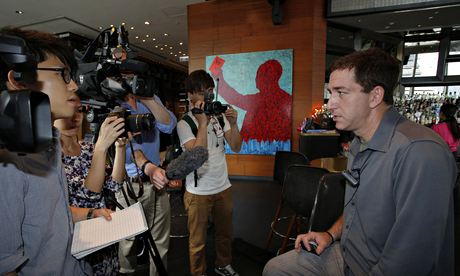
Greenwald talking to reporters on 10 June 2013, the day after Snowden revealed his identity in the Guardian. Photograph: AP
On Thursday 6 June 2013, our fifth day in Hong Kong, I went to Edward Snowden's hotel room and he immediately said he had news that was "a bit alarming". An internet-connected security device at the home he shared with his longtime girlfriend in Hawaii had detected that two people from the NSA – a human-resources person and an NSA "police officer" – had come to their house searching for him.
No Place to Hide: Edward Snowden, the NSA and the Surveillance State
by Glenn Greenwald
Snowden was almost certain this meant that the NSA had identified him as the likely source of the leaks, but I was sceptical. "If they thought you did this, they'd send hordes of FBI agents with a search warrant and probably Swat teams, not a single NSA officer and a human-resources person." I figured this was just an automatic and routine inquiry, triggered when an NSA employee goes absent for a few weeks without explanation. But Snowden suggested that perhaps they were being purposely low-key to avoid drawing media attention or setting off an effort to suppress evidence.
Whatever the news meant, it underscored the need for Laura Poitras – the film-maker who was collaborating with me on the story – and I to quickly prepare our article and video unveiling Snowden as the source of the disclosures. We were determined that the world would first hear about Snowden, his actions and his motives, from Snowden himself, not through a demonisation campaign spread by the US government while he was in hiding or in custody and unable to speak for himself.
Our plan was to publish two more articles on the NSA files in the Guardian and then release a long piece on Snowden himself, accompanied by a videotaped interview, and a printed Q&A with him.
Poitras had spent the previous 48 hours editing the footage from my first interview with Snowden, but she said it was too detailed, lengthy, and fragmented to use. She wanted to film a new interview right away; one that was more concise and focused, and wrote a list of 20 or so specific questions for me to ask him. I added several of my own as Poitras set up her camera and directed us where to sit.
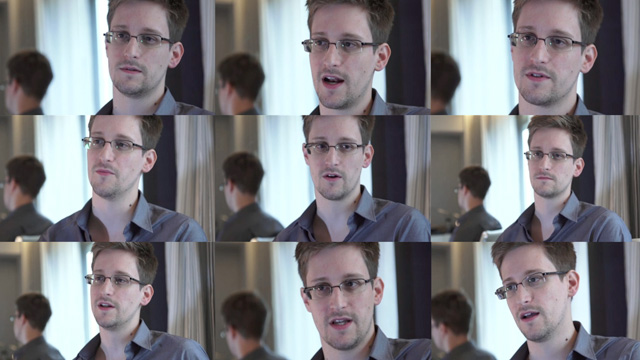
"Um, my name is Ed Snowden," the now-famous film begins. "I'm 29 years old. I work for Booz Allen Hamilton as an infrastructure analyst for NSA in Hawaii."
Snowden went on to provide crisp, stoic, rational responses to each question: Why had he decided to disclose these documents? Why was this important enough for him to sacrifice his freedom? What were the most significant revelations? Was there anything criminal or illegal shown in these documents? What did he expect would happen to him?
As he gave examples of illegal and invasive surveillance, he became animated and passionate. But only when I asked him whether he expected repercussions did he show distress, fearing that the government would target his family and girlfriend for retaliation. He would avoid contact with them to reduce the risk, he said, but he knew he could not fully protect them. "That's the one thing that keeps me up at night, what will happen to them," he said as his eyes welled up, the first and only time I saw that happen.
The relatively lighter mood we had managed to keep up over the prior few days now turned to palpable anxiety: we were less than 24 hours away from revealing Snowden's identity, which we knew would change everything, for him most of all. The three of us had lived through a short but exceptionally intense and gratifying experience. One of us, Snowden, was soon to be removed from the group, likely to go to prison for a long time – a fact that had depressingly lurked in the air from the outset, at least for me. Only Snowden had seemed unbothered by this. Now, a giddy gallows humor crept into our dealings.
"I call the bottom bunk at Gitmo," Snowden joked as he contemplated our prospects. As we talked about future articles, he would say things such as: "That's going into the indictment. The only question is whether it's going into yours or mine." Mostly he remained inconceivably calm. Even now, with the clock winding down on his freedom, Snowden still went to bed at 10.30pm, as he had every night during my time in Hong Kong. While I could barely catch more than two hours of restless sleep at a time, he kept consistent hours. "Well, I'm going to hit the hay," he would announce casually each night before retiring for seven-and-a-half hours of sound sleep, appearing completely refreshed the next day.
When we asked him about his ability to sleep so well under the circumstances, Snowden said that he felt profoundly at peace with what he had done and so the nights were easy. "I figure I have very few days left with a comfortable pillow," he joked, "so I might as well enjoy them."
Revealed to the world
At 7.27pm, British summer time on Sunday 9 June 2013, the Guardian published the story that revealed Snowden to the world: "Edward Snowden: The Whistleblower Behind the NSA Surveillance Revelations." The article told Snowden's story, conveyed his motives, and proclaimed that "Snowden will go down in history as one of America's most consequential whistleblowers, alongside Daniel Ellsberg and Bradley [now Chelsea] Manning." We quoted from Snowden's early note to Poitras and me: "I understand that I will be made to suffer for my actions … but I will be satisfied if the federation of secret law, unequal pardon and irresistible executive powers that rule the world that I love are revealed even for an instant."
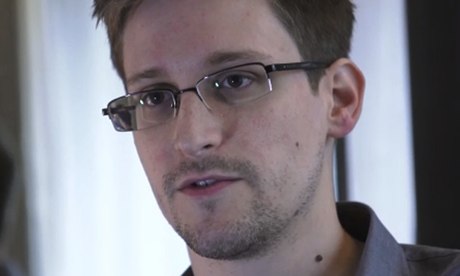
Edward Snowden, as the world first saw him in June 2013. Photograph: AFP/Getty Images
The reaction to the article and the video was more intense than anything I had experienced as a writer. Ellsberg himself, writing the following day in the Guardian, proclaimed that "there has not been in American history a more important leak than Edward Snowden's release of NSA material – and that definitely includes the Pentagon Papers 40 years ago".
Several hundred thousand people posted the link to their Facebook accounts in the first several days alone. Almost three million people watched the interview on YouTube. Many more saw it on the Guardian's website. The overwhelming response was shock and inspiration at Snowden's courage.
Poitras, Snowden and I followed the reaction to his exposure together, while I also debated with two Guardian media strategists over which Monday-morning TV interviews I should agree to do. We settled on Morning Joe on MSNBC, followed by NBC's Today show – the two earliest shows, which would shape the coverage of Snowden throughout the day.
But before I could get to those interviews, we were diverted by a call at 5am – just hours after the Snowden article was published – from a longtime reader of mine who lives in Hong Kong, with whom I had been communicating periodically throughout the week. He pointed out that the entire world would soon be looking for Snowden in Hong Kong, and he insisted that Snowden urgently needed to retain well-connected lawyers in the city. He had two of the best human-rights lawyers standing by, willing to represent him. Could the three of them come over to my hotel right away?
We agreed to meet a short time later, at around 8am. I slept for a couple of hours until he called, an hour early, at 7am.
"We're already here," he said, "downstairs in your hotel. I have the two lawyers with me. Your lobby is filled with cameras and reporters. The media is searching for Snowden's hotel and will find it imminently, and the lawyers say that it's vital they get to him before the media finds him."
Barely awake, I threw on the nearest clothes I could find and I stumbled to the door. As soon as I opened it, the flashes from multiple cameras went off in my face. The media horde had obviously paid off someone on the hotel staff to get my room number. Two women identified themselves as Hong Kong–based Wall Street Journal reporters; others, including one with a large camera, were from Associated Press.
They hurled questions and formed a moving half-circle around me as I walked to the elevator. They pushed their way into the elevator with me, asking one question after the next, most of which I answered with short, curt, unhelpful replies.
Down in the lobby, a new swarm of cameras and reporters joined the group. I tried to look for my reader and the lawyers but could not move two feet without having my path blocked.
I was particularly concerned that the swarm would try to follow me and make it impossible for the lawyers to get to Snowden. I finally decided to hold an impromptu press conference in the lobby, answering questions so that the reporters would go away. After 15 minutes or so, most of them dispersed.
I was then relieved to stumble into Gill Phillips, the Guardian's chief lawyer, who had stopped off in Hong Kong on her way from Australia to London to provide us with legal counsel. She said she wanted to explore all possible ways for the Guardian to protect Snowden. "Alan [Rusbridger, editor of the Guardian] is adamant that we give him all the support we legally can," she said. We tried to talk more but had no privacy with the last few reporters lurking. I finally found my reader, along with the two Hong Kong lawyers he had brought with him. We plotted how we could speak without being followed, and all decamped to Phillips' room. Still trailed by a handful of reporters, we shut the door in their faces.
We got right down to business. The lawyers wished urgently to speak to Snowden to get his formal permission to represent him, at which point they could begin acting on his behalf.
Snowden disappears
Phillips frantically used her phone to investigate these lawyers, whom we had only just met, before turning Snowden over to them. She was able to determine that they were indeed well-known and established in the human rights and asylum community and seemed quite well connected politically in Hong Kong. As Phillips performed her impromptu due diligence, I signed on to the chat program. Both Snowden and Poitras were online. Poitras, who was now staying at Snowden's hotel, was certain that it was only a matter of time before the reporters found their location, too. Snowden was clearly eager to leave. I told him about the lawyers, who were ready to go to his hotel room. Snowden said they should pick him up and bring him to a safe place. It was, he said, "time to enter the part of the plan where I ask the world for protection and justice".
Laura Poitras … concerned about being discovered.
"But I need to get out of the hotel without being recognised by reporters," he said. "Otherwise they'll just follow me wherever I go."
I conveyed these concerns to the lawyers. "Does he have any ideas how to prevent that?" one of them asked.
I passed the question on to Snowden.
"I'm in the process of taking steps to change my appearance," he said, clearly having thought about this previously. "I can make myself unrecognisable."
At that point, I thought the lawyers should speak to him directly. Before being able to do so, they needed Snowden to recite a formalistic phrase about hereby retaining them. I sent Snowden the phrase and he then typed it back to me. The lawyers then took over the computer and began speaking with Snowden.
After 10 minutes, the two lawyers announced they were heading over to his hotel immediately to meet Snowden as he attempted to leave the hotel undetected.
"What do you intend to do with him after that?" I asked.
They would likely take him to the UN mission in Hong Kong and formally seek the UN's protection from the US government, on the grounds that Snowden was a refugee seeking asylum. Or, they said, they would try to arrange a "safe house".
But how to get the lawyers out of the hotel without being followed? We came up with a plan: I would walk out of the hotel room with Phillips and go down to the lobby to lure the reporters, still waiting outside our door, to follow me. The lawyers would then wait for a few minutes and exit the hotel, hopefully without being noticed.
The ruse worked. After 30 minutes of chatting with Phillips in a shopping centre attached to the hotel, I went back up to my room and anxiously called one of the lawyers on his mobile phone.
"He got out right before journalists started swarming the floor," he said. "We met him in his hotel room and then we crossed a bridge into an adjacent mall" – in front of the room with the alligator where Snowden had first met us, I later learned – "and then into our waiting car. He's with us now."
Where were they taking him?
"It's best not to talk about that on the phone," the lawyer replied. "He'll be safe for now."
I was immensely relieved that Snowden was in good hands, but we knew there was a strong chance we might never see or speak to him again, at least not as a free man. Most likely, I thought, we would next see him on television, dressed in an orange prison jumpsuit and wearing shackles, inside a US courtroom, being arraigned on espionage charges.
As I digested the news, there was a knock on my door. It was the general manager of the hotel, who had come to tell me that the phone was ringing nonstop for my room (I had given an instruction to the front desk to block all calls). There were also throngs of reporters, photographers, and camera people down in the lobby waiting for me to appear.
"If you like," he said, "we can take you out a back elevator and through an exit nobody will see. And the Guardian's lawyer has made a reservation for you at another hotel under a different name, if that's what you want to do."
That was clearly hotel-manager-ese for: we want you to leave because of the ruckus you are creating. I knew it was a good idea anyway: I wanted to continue to work with some privacy and was still hoping to maintain contact with Snowden. So I packed my bags, followed the manager out the back exit, and then checked into a different hotel under the name of the Guardian's lawyer.
The first thing I did was sign on to the internet, hoping to hear from Snowden. Several minutes later, he appeared online.
"I'm fine," he told me. "In a safe house for now. But I have no idea how safe it is, or how long I'll be here. I'll have to move from place to place, and my internet access is unreliable, so I don't know when or how often I'll be online."
He was obviously reluctant to give any details about his location and I did not want them. I knew that my ability to be involved in his hiding was very limited. He was now the world's most wanted man by the world's most powerful government. The US had already demanded that Hong Kong authorities arrest him and turn him over to American custody.
So we spoke briefly and vaguely, expressing mutual hope that we would be in touch. I told him to stay safe.
Under attack
When I finally got to the studio for the interviews for Morning Joe and the Today show, I noticed immediately that the tenor of the questioning had changed significantly. Rather than dealing with me as a reporter, the hosts preferred to attack a new target: Snowden himself, now a shadowy figure in Hong Kong. Many US journalists resumed their accustomed role as servants to the government. The story was no longer that reporters had exposed serious NSA abuses but that an American working for the government had "betrayed" his obligations, committed crimes, and then "fled to China".
My interviews with both hosts, Mika Brzezinski and Savannah Guthrie, were acrimonious and acerbic. Sleep-deprived for more than a full week now, I had no patience for the criticisms of Snowden embedded in their questions: journalists, I felt, should be celebrating, not demonising, someone who had brought more transparency to the national security state than anyone in years.
After a few more days of interviews, I decided it was time to leave Hong Kong. Clearly, it would now be impossible to meet or otherwise help Snowden from Hong Kong, and at that point I was completely exhausted, physically, emotionally, and psychologically. I was eager to return to Rio.
I thought about flying home via New York and stopping for one day to do interviews – just to make the point that I could and would. But I was advised by a lawyer against doing so, arguing that it made little sense to take legal risks of that sort until we knew how the government planned to react. "You've just enabled the biggest national security leak in US history and gone all over TV with the most defiant message possible," he said. "It will only make sense to plan a trip to the US once we get a sense of the Justice Department's response."
I didn't agree: I thought it was unlikely in the extreme that the Obama administration would arrest a journalist in the middle of such high-profile reporting. But I was too drained to argue or take the risk. So I had the Guardian book my flight back to Rio through Dubai, nowhere near the US. For the moment, I reasoned, I had done enough.
• This is an extract from No Place to Hide: Edward Snowden, the NSA, and the US Surveillance State by Glenn Greenwald, published on 13 May 2014 by Hamish Hamilton.
Postscript
A fortnight after Greenwald left Hong Kong, Snowden fled the former British colony. Realising that he could only hold off US extradition requests for a matter of months - at best a year - he headed for Latin America but was stopped in transit in Moscow. He has been stuck in Russia since.
The three reporters who interviewed Snowden in Hong Kong - Greenwald, Poitras and Ewen MacAskill - received the Polk award last month for their Snowden coverage and are part of a Guardian team to be awarded a Pulitizer prize in New York later this month. Snowden hopes that one day he will be able to seek asylum in western Europe or, even better, be allowed to return to the US as a free man.
Booliska Kenya oo ka digay weeraro Al-shabaab u qorshaysay inay ka fuliyaan Nairobi
Nairobi - Dawladda Shiinaha, ayaa ballanqaaday mallaayiin doollar oo ay Kenya ku caawin doonto si loogu isticmaalo hawlgalka dadka Soomaalida ah lagaga mustaafurinayo gudaha Kenya, iyadoo sidoo kale Booliska Kenya ka digay weeraro khatar ah oo Al-shabaab qorshaysay inay ka fuliyaan caasimadda Nairobi, isla markaana ammaankana aad loo adkeeyey.
Ra’iisal-wasaaraha Shiinaha Mr. Li Keqiang oo booqasho ku tagay dalka Kenya maanta, ayaa sida saxaafaddu baahiyey, waxa uu ballanqaaday in wadankiisu Kenya ka caawin doono mashaariic kala duwan oo ay qayb ka yihiin dhinacyada ammaanka iyo raafka lagu hayo dadka Soomaalida ah ee loo mustaafuriyo gudaha Soomaaliya.
Dhinaca kale, taliyaha booliska Nairobi Mr. Benson Kibue oo saxaafadda la hadlay shalay, ayaa ku dhawaaqay in la adkeeyay ammaanka Magaalada Nairobi iyo guud ahaan dalka Kenya, kadib markii uu xaqiijiyey inay heleen macluumaad la xidhiidha weeraro ururka Al-shabaab doonayo inay ka fuliyaan caasimadda Kenya.
Waxa taliyuhu ugu baaqay gaadiidlayda inay u hoggaansamaan amar lagu baadhayo dadweynaha rakaabka, iyadoo laga cabsi qabo in Al-shabaab weeraro ku qarxiyaan basaska dadweynaha iyo goobaha kale ee muhiimka ah ee ku yaal Nairobi.
Taliyaha booliska Nairobi, ayaa sidoo kale mulkiilayaasha hudheellada iyo goobaha cabbitaanka ee dadku ku kulmaan ugu baaqay inay taxadar dheeraad ah muujiyaan, maadaama ay soo baxday cabsi laga qabo Al-shabaab ayna booliska degdeg u ugu wargeliyaan haddii ay arkaan dad ama waxyaabo ay ka shakiyaan oo tuhun abuuraya.
Cabsida la xidhiidha weeraro iyo qaraxyo ay Al-shabaab ka fuliyaan magaalada Nairobi, aya soo baxday, kadib markii muddooyinkii u dambeeyey qaraxyo kala duwan ka dhaceen caasimadda Kenya iyo magaalada Xeebta ah ee Mambasa.
2014 to replace the phone with a credit card cash payment applications began operations around the world everywhere, including credit card organizations, carriers, financial service providers, handset manufacturers, service providers and retail information services by way of rushing by key cross-industry alliance The block into the market, available to consumers more innovative and convenient payment services wisdom.The popularity of mobile devices and Internet services greatly changed people's lifestyles, such as more and more consumers begin to pay transaction proceeds through laptops, tablet PCs and smart phones and other mobile devices.With the changes in this wave of consumer payment behavior, Hongyang technology in addition to the ongoing introduction of various mobile payment products and services, providing consumers with a more positive way of cross-industry alliance through people-centered new consumer experience.




.jpg)