Search This Blog

Thursday, May 8, 2014

Putin Request Ignored, Starving Somalis, Cruelest Cabbie


More than 50,000 Somali malnourished children are facing death.

PUTIN REFERENDUM REQUEST IGNORED

Pro-Russian activists in the region of Donetsk announced that a referendum on the region’s status would go ahead as planned on Sunday, despite yesterday’s call from Russian President Vladimir Putin to postpone it, RT reports. Earlier Ukraine officials had said that the military operation in Eastern Ukrainewould continue regardless of whether the referendum, which the Kiev government regards as illegal, was delayed.
  • The decision from Donetsk is a blow to Putin’s step towards de-escalation yesterday, with one of the favorites in the Ukrainian presidential race, Petro Poroshenko, saying he “welcomed” the initiative “with cautious optimism.” German Foreign Minister Frank-Walter Steinmeier said that Putin’s “constructive tone” could mark “a decisive point” in the Ukrainian crisis.
  • Moscow and NATO, however, had a heated exchange, with the Russian Foreign Ministry saying that NATO’s Secretary General Anders Fogh Rasmussen was “blind” after he wrote on Twitter that, contrary to what Putin had announced, he had seen no sign that Russian troops had withdrawn from the Ukrainian border. “I have very good vision, but while we've noted Russia’s statement so far we haven't seen any — any — indication of troops pulling back,” he posted later.
  • A poll conducted by the Washington-based Pew Research Center found that 70% of the population in Eastern Ukraine want their country to keep its current borders. Even 58% of Russian speakers agree. Read more from AP.

VERBATIM

More than 50,000 malnourished children are “at death’s door” in Somalia, according to a new report from a group of aid agencies. “The problem with Somalia is that it has been a crisis for over 20 years,” says Oxfam’s Ed Pomfret. “People more or less roll their eyes and think: 'Pirates, terrorists, hunger and death. What can I do about that?”

REWARD ON MISSING NIGERIAN GIRLS

The hunt for abducted Nigerian schoolgirls continues as the U.S., the UK and France join forces with local authorities. Nigerian police are offering a reward of $300,000 to anybody providing information leading to the rescue of the 276 schoolgirls abducted by Boko Haram three weeks ago, Vanguard reports. This came after news yesterday that the Islamist group had killedat least 336 people when it attacked a town in Nigeria’s northeastern region.

HUGE EXPLOSION IN ALEPPO

A hotel used by Syrian troops as a military base in the northern city of Aleppo was completely destroyed by what local media have described as a “huge explosion” with a high number of casualties among the troops likely. The London-based Syrian Observatory for Human Rights said that rebels from the Islamic Front had “planted a huge amount of explosives in a tunnel they dug below the Carlton hotel,” which they detonated remotely. Read the full story from AP.

MY GRAND-PÈRE'S WORLD

FERRY COMPANY OFFICIAL ARRESTED

South Korean police have arrested the head of the sunken ferry’s operator, and charges against him include “manslaughter and a violation of the act on vessel safety,” Yonhap news agency reports. This comes amid mounting fears for the safety of diverssearching the wreckage after one of them died Tuesday. There are still 35 people missing, and 269 bodies have been recovered, but the searches are being hampered by poor weather conditions and high waves.

MERS DISEASE SPREADS IN SAUDI ARABIA

Eighteen more cases of Middle East Respiratory Syndrome (MERS) have been identified in Saudi Arabia, after four people died from the disease yesterday, Reuters reports. A total of 449 people in the country have now been infected with MERS, a form ofcoronavirus, causing 121 deaths since it was identified two years ago. The United States detected its first case last week, and Slate explains in a very detailed piece that the virus will be very difficult to stop.
For more on the subject, we offer this CFR/Worldcrunch article, Why A Saudi Virus Is Spreading Alarm.

ANC LEADING GENERAL ELECTION

South Africa’s African National Congress party has taken an early lead in yesterday’s general election with almost half of the votes counted. According to the Mail & Guardian, incumbent President Jacob Zuma’s party has just about 60% of the vote, while the opposition party Democratic Alliance is in second place with 23%. Although the ANC is expected to win the elections, theBBC explains that any result under 60% will be seen “as a major upset.”

CRUELEST TAXI DRIVER EVER?

The Japanese police have arrested a cab driver who nourished a bizarre sexual thrill by routinely offering his female passengers snacks laced with diuretics so he could watch and film them as they grew desperate to go to the toilet. Tip for tourists in Osaka: Don’t accept food in taxis!

source: worldcrunch.com

Kenyan teacher killed in Somalia


(Picture: AFP)
Mogadishu - Gunmen in Somalia shot dead a Kenyan teacher, police and witnesses said on Thursday, in the latest attack to target foreigners in the restive central Galkayo region.

Witnesses said two men armed with pistols shot the teacher inside a college compound late Wednesday in Galkayo, a town straddling the border between the autonomous Puntland and Galmadug regions.

"A Kenyan teacher was shot dead inside the school building last night, the police are investigating," local police officer Osman Mohamed told AFP.

"I heard gunshots inside the building, then two men came out running," said Sudi Hassan, a nearby resident. "I saw the dead body of the teacher lying on the floor in a pool of blood."

No one has claimed responsibility for the attack, and the motive for the killing was not clear.

"He was a very polite and nice teacher, I cannot imagine why anyone kills someone like him," said Ahmed Nur Isa, a student at the college.

"This was an appalling and unjustifiable act."

The lawless region is awash with guns and riven by multiple rival armed gangs.

Foreigners are particular targets. In April, two United Nations workers were executed in Galkayo.

Somalia's al-Qaeda linked Shabaab operate in the region, although unlike much of southern Somalia, it is not under their direct control.

Somalia Facing Crisis Relapse


A truck passing a partial roadblock setup by residents as a protest against the Islamist Al-Shabab insurgent group, in Tobanka Buundo in the lower Shabelle region, near the Somalian capital Mogadishu, March 6, 2014.

Joe DeCapua

According to a new report, despite improvements in recent years in Somalia, the country remains in severe crisis. A coalition of more than 20 aid groups says many Somali communities are one shock away from disaster.
 

The report -- Risk of Relapse: Somalia Crisis Update --said better conditions are not the same as success. It described “most aspects of everyday life as falling far below acceptable living standards.”

The report said nearly three-million Somalis are in humanitarian crisis – 50,000 children are severely malnourished – and more than one-million people are displaced. Those figures are actually better than they used to be. But the report warned “progress should not be measured against minimum standards.”

Scott Paul is a senior humanitarian advisor for Oxfam, one of the coalition members. He said, “Somalia is in a long-term crisis and it’s been forgotten a lot in the face of new emergencies, in particular, emergencies in Syria and South Sudan, Central African Republic. But it’s still in a very, very deep crisis. It’s really one of the worst places in the world for a newborn baby or a woman.”

Paul said that when providing assistance to Somalia, it’s important to learn from the past.

“We learned in 2011that responding late to early warnings is a bad idea. 260,000 people died in the famine in 2011and we’re trying to sound the alarm so another terrible emergency doesn’t take place again.”

While conditions are better than in 2011, the Oxfam advisor said it’s not enough.

“Things have improved marginally over the past couple of years, but most of the country is still experiencing really, really high rates of humanitarian emergency and crisis. Fewer than one in four people have access to adequate sanitation facilities and one city in the south, in Kismayo, less than 10-percent of the entire population has access to adequate facilities. Across the country about 30-percent of the people have access to clean drinking water.”

He said that there are a number of reasons why Somalia continues to be in crisis year after year.

It’s been a long, long protracted emergency. It’s been a consequence of a crisis in governance. It’s been conflict. It’s been cyclical droughts. And the international community has not done enough to really help Somalia provide the sort of long-term flexible funding that Somali communities need to build community-level resilience and work themselves out of this protracted crisis,” he said.

The Risk of Relapse report said only 12-percent of Somalia ’s humanitarian funding requirements have been met, adding that $822-million is still needed.

The report highlighted numerous areas of concern, including health and gender based violence. In the first half of 2013, the there were at least 800 cases of sexual violence.
Paul said, “The actual figure is probably much higher than what’s been reported because gender-based violence is actually very taboo in Somalia. And many women who are attacked are afraid to come forward. Either because they’re afraid of legal repercussions for what it will mean for them within their own communities.”

The livelihoods of many Somalis depend on the flow of remittances. They’re estimated to range from $750-million to two-billion dollars a year.

However, the September 11th, 2001 terrorist attacks in the U.S. have led to much tighter money transfer rules. It’s feared remittances could help fund terrorist groups. Banks in the U.S. and Britain have closed numerous accounts handling remittance transfers.

“A lot of people in the United States – Somali Americans – and members of the Diaspora have been regularly supporting people. About 40-percent of the country now relies on money sent from abroad. And the only really legal and transparent way to send money from the U.S. to Somalia are having a ton of trouble getting bank accounts both here and in the United Kingdom. The possibility of pushing these remittances underground where the flows will be reduced and where it’s more vulnerable to diversion by criminal networks is really very frightening,” said Paul.

In related news, the U.S. House of Representatives this week passed the Money Remittances Improvement Act. Supporters say the bill would make it easer for “well-regulated nonbank institutions…to provide remittances to their customers across the globe.” They describe it as a “cause for celebration for all diaspora communities.” The legislation now goes to the Senate.

The aid group coalition called for immediate action on Somalia’s humanitarian and development needs. Otherwise, it says, the world is “at risk of failing Somalis once more.”


Listern to De Capua report on risk of relapse in Somalia

HEES CUSUB OO HADDA DAAWAHA LAGA SOO QAADAY: SANADA GUURO 18 MAY - HEESTU DAREEMADA WADANIYADA DALKA SOMALILAND AYAY KICINAYSAA

Afkaga caano lugu qabay fanaanada sanadka dheh ,,waa saacadii faraxadi inoo sugnaatay sebi iyo barbaraa saqiir iyo kabiir wada sara kaca Viva somaliland


Wednesday, May 7, 2014

Al-Qaeda and Other Terrorist Groups Increasing in Africa


A Kenyan policeman stands in front of the wreckage of a bus at the site of a bomb blast in Nairobi on May 4, 2014. (Photo: CARL DE SOUZA/AFP/Getty Images/Newscom)
Terrorism is on the rise across Africa as global terror groups, including al-Qaeda affiliates, continue to overtake local insurgent organizations and transform them into regional and international threats.
The National Movement for the Liberation of Azawad began as a local movement in Northern Mali, but was successfully overtaken by The National Movement for Unity and Jihad in West Africa and  al-Qaeda In the Islamic Maghreb, threatening countries and even entire regions. . Last year, the situation became so dire in Mali that the French led a military intervention from which the country continues to recover.
According to the State Department’s recently released “Country Reports on Terrorism 2013,” al-Shabaab, a Somali-based and now al-Qaida-linked group, continues to carry out attacks and threaten governments in Somalia and in countries, such as Kenya and Uganda, that support AMISOM – the African Union’s anti-terror military force. Last Fall al-Shabaab carried out a deadly attack on the Westgate mall in Nairobi, Kenya, and demanded Kenya withdraw its defense forces from Somalia. Because of al-Shabaab’s increased regional focus, East African governments are enhancing “domestic and regional efforts to bolster border security and create integrated and dedicated counterterrorism strategies” – efforts  the United States should continue to support.
The United States needs to take seriously the rising levels of extremism and terrorist activity in Africa. The State Department’s recently released “Country Reports on Terrorism 2013”  highlighted the  “significant levels of terrorist activity” Africa experienced in 2013”  and emphasized the increased aggressiveness of al-Qaida affiliates and like-minded groups in Northwest Africa and Somalia.
Across the continent in West Africa, Boko Haram “maintained a high operational tempo in 2013 and carried out kidnappings, killings, bombings and attacks on civilian and military targets in northern Nigeria, resulting in numerous deaths, injuries and destruction of property in 2013.” As recently as last week, this group staged a car bomb attack in the capital, Abuja. Spillover violence in Chad, Niger and Cameroon is equally disturbing given the porous borders and large swathes of ungoverned space in the region.
Ungoverned space also enables al-Qaeda-linked groups in North Africa and the Sahel, such as Ansar al-Sharia and AQIM to operate freely, causing problems for the governments of Morocco, Tunisia, and Algeria.
This year likely will see an even greater increase in terrorism in Africa as vulnerable Muslim refugees flee the Central African Republic because of violent sectarian conflict. As the situation in CAR continues to break down, ungoverned and lawless space also will increase terrorist operating space. The breakdown of South Sudan ensures even more weapons will spread across the region.
Given the evolving threat of al-Qaeda and the new wave of global terrorism, U.S. security partnerships and engagement with African governments will become even more important in the fight against global terrorism.

The making of American foreign policy in the post-9/11 world


Source: http://www.costaricantimes.com/tag/global-war-on-terror
Let’s be honest, foreign policy making has never been democratic. The label of national security has offered governments around the world the power to hide information from their citizens. Aside from this statement, the making of American foreign policy has completely shifted since 9/11. Not only this shift was abrupt and made under intense emotional stress, but it has also created a precedent in the way the U.S. engages in the world. Additionally, American foreign policy has become much more militarized than in the past. A series of recent articles (here and here), documentaries (here and here), and radio show (here) have been produced looking back at the way the U.S. has conducted itself these last 13 years on the international stage.
Since 9/11, the U.S. has been fighting “evil” – to adopt a very Bushian expression – with evil. The U.S. has used a wide array of instruments considered by international law as illegal such as: rendition, torture — known as an “enhanced interrogation technique” — use of force against countries without legal jurisdiction, drone strikes in countries wherein the U.S. is not at war, mass snooping on American and world citizens, cover-up operations, and so forth. The “Global War on Terror” has been the longest war in American history. Since 2001, the U.S. has invaded two countries – Iraq and Afghanistan – launched an undisclosed numbers of drone strikes in countries with which the U.S. is not at war – Yemen, Pakistan, and Somalia (here are the numbers of drones strikes as of April 2014) – and all this in complete impunity.
The real question is: Has it made America safer? It is a very difficult subject to answer in all impartiality. Members of American intelligence community and other departments of the U.S. government would most likely say yes. Not only, I would tend to answer, not really, but I would also argue that American democracy has progressively been the main collateral damage of this endless war.
The starting point in the shifting in decision-making in American foreign policy was the approval of the Authorization for Use of Military Force, of what is known as the AUMF. The famous sentence, as reported by Gregory E. Johnsen and which inspired the Radiolab podcast posted below, that changed it all were these 60 words from the AUMF drafted on Sept. 12, 2001:
That the President is authorized to use all necessary and appropriate force against those nations, organization, or persons he determines planned, authorized, committed, or aided the terrorist attacks that occurred on September 11, 2011, or harbored such organizations or persons in order to prevent any future acts of international terrorism against the United States by such nations, organizations or person.

In French, we would say that the president has now carte blanche, meaning unlimited power. This sentence taken from AUMF pretty much gives unlimited power to the executive branch without any supervision by the Congress, as it gave it up soon after 9/11. Such legal piece was approved by Congress on Sept. 13, 2001 at the exception of only one elected official, the California Representative Barbara Lee, opposing it. In the excellent podcast of Radiolad, Barbara Lee takes us throughout her reflection process about taking
such decision. At the time she was under intense pressure, and was even called unpatriotic, a terrorist, and so forth. Today, she seems like a visionary as she not only understood the consequences of taking swift decisions under stress and emotions, but also foresaw the legal implications embedded in these words.
For instance, during a 2013 Senate Armed Service committee hearing chaired by Carl Levin – as reported in the Radiolab podcast – about the use of military force, DOD officials argued in favor of the continued use of the AUMF. Throughout the hearing the officials never named one enemy, but only referred to “associated forces.” Senator Angus King responded to these statements by DOD officials, saying: “you guys have essentially rewritten the Constitution here today.” King’s argument is that the DOD is using the concept of associated forces, not present in the AUMF, in order to justify the use of force against pretty much anyone. The AUMF has in fact changed the entire institutional design of use of force. “The Declaration of War is kind of a dead instrument of national law,” argued Ben Wittes, a senior fellow at the Brookings Institution in the Radiolab podcast. “But the modern incarnation of the Declaration of War is the Authorization for Use of Military Force (AUMF).”
Such comments fall under the fact that the list of American enemies and the people that the U.S. is in war against is secret. American citizens do not have and cannot have the information about the enemies. The absolute lack of supervision by one branch of the government over the other will undeniably lead to extreme decisions and situations. The Gulf of Tonkin Resolution is the perfect example, as it led the U.S. to a lengthy and costly war in Vietnam. Additionally, without a clear enemy, it implies that the U.S. could be at war indefinitely. At the distinction with Vietnam, Iraq and Afghanistan, this war seems foreign, remote, distant, and impersonal, making it even more dangerous to American democracy and political system.
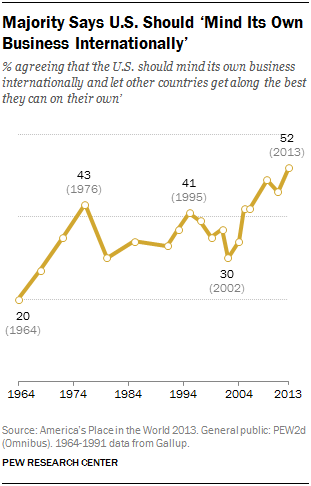
Two core problems are at the heart of this nonexistent debate in America. One of the most worrisome dimensions is not the degree of secrecy, but rather that American public opinion simply does not care about the way the two most recent presidents have used forces and extended the power of the executive branch. The lack of interest by American public opinion is worrisome as they do not ask for accountability. In the case of the U.S., the latest numbers illustrates the progressive desire by American citizens for a more isolationist foreign policy. After the 2007 financial crisis, Western public opinion, and principally American public opinion, has started to believe in the “end of foreign policy,” a concept utilized by Richard Youngs in his 2014 book The Uncertain Legacy of Crisis. European Foreign Policy faces the Future, considering the lack of discussions and reflections on foreign policy. Such statement materialized public opinion feelings towards foreign policy making.
PEW-isolationism
Second, with the polarization of American democracy and political system, the making of foreign policy is now more about avoiding a political crisis triggered by a failure to stop an attack than actually making the homeland safer. How can foreign policy be made given that, in the case that an attack occurs after restricting the power of the intelligence community and cutting the defense and intelligence budgets, there could be serious consequences for the political legitimacy and the future of a party and/or individual politicians. When politicians base their foreign policy and national security choices on the fear of losing an election, the overall democratic machine and political system are seriously broken. For instance, the politicization of the Benghazi bombing by the Republican party in order to attack Hillary Clinton and other high level Democrats is quite shameful. Unlimited power and budget without democratic supervision do not translate into greater security.
How can such a problem be solved? First, American foreign policy shall be understood as what it is, a policy. Emotions must be removed from decision-making. The decisions made right after 9/11 were irrational, considering the trauma caused by such a horrific event. Americans must reflect on the policies and rules implemented soon after 9/11 and decide on their future and their application and implementation.
Second, American citizens ought to start understanding that foreign policy matters more than before. In a globalized environment, a policy decision undertaken by a group of experts ought to be discussed. When the U.S. deploys drones against countries to kill alleged terrorist, the image of the U.S. is tarnished. How would American citizens react if China were to use drone strikes over the Silicon Valley in order to limit the power and influence of corporations advancing the freedom of social media? In the last political debates – both for presidential and legislative elections – foreign policy suffered from a lack of interest by voters. Furthermore, most American politicians have a weak understanding international relations.
Third, 13 years later, it is time to de-securitized the global war on terrorism. The U.S. cannot perpetually wage war. Neither the “Global War on Terror” or the drug war have solved their respective problems. Terrorism and drugs still exist and will continue to exist. Believing that both can be eliminated is quite foolish.
Last but not least, the AUMF is one among many current shifts in American democracy caused by a progressive implementation of laws removing transparency and accountability. National security, campaign financing, and other important segment of American politics are being striped away of transparency. This is a slippery slope for American democracy.
Source: foreignpolicyblogs.com

HALKAN KA AKHRISO KHUDBAD SANADEEDKII MADAXWAYNAHA SOMALILAND SIILAANYO KA HORJEEDIYEY GOLAYAASHA WAKIILADDA IYO GUURTIDA KANA DAAWO SAWIRADII MUNAASIBADAASI MAANTA


Waxaana hubaal ah in maanta Somaliland marayso meel aan indhaha laga qarsan-karin, iyadoo buuxisay shuruudihii looga baahnaa. Waxaase jirta in cadawga Somaliland ku hawlanyahay hagardaamooyin uu ku waxyeelaynayo himilada

Bismilaahi Raxmaani Raxiim Al-xamdu-lilaah, Ilaahaybaa mahad leh, Shirgudoonka Baarlamaanka, Mudanayaasha Labada Gole, Wasiirada, Xisbiyada Qaranka,

Marti sharafta, dadweynaha iyo saxaafadda, waxan idinku salaamaya salaanta islaamka:“Assalaamu calaykum waraxmatullaahi wa barakaatuhu”.

Ugu horeyn, waxan salaan iyo mahadnaq u dirayaa dhamman shacbiga Somaliland gudo iyo dibedba, meelkasta oo ay joogaan.

Mudanayaal iyo Marwooyin,

Waxa sharaf iyo maamuus ii ah in aan sannadkii 4aad hor imaado aqalka Baarlamaanka Somaliland ee Guurtida iyo Wakiiladda, taas oo aan ka hor jeedinayo khudbad sannadeedka uu Dastuurkeenu igu waajibiyay, waxaanan khudbadayda kaga hadlayaa warbixinta sannadkii tegey iyo Qorshaha Xukuumadda ee sannadka cusub, iyada oo aan si gaar ahna ugu tilmaamo wixii xaalad daruuri ah in laga waramo.

Somaliland waa qaran saddex iyo labaatan jirsaday oo qaangaadh ah, waa qaran ay dadkiisa iyo dawladdiisuba mar kasta iyo goorkastaba u soo jeedaan. Labaatankaa sannadood ee ay Somaliland jirtayna shacbi iyo dawladba, Somaliland, waxay halgan ugu jirtay, dadaal ay ku xaqiijinayso qaranannimadeeda, adkaynta nabadgalyada, kor u qaadidda adeegyada aasaasiga ah ee waxbarashada, caafimaadka, biyaha iyo horumarinta kaabayaasha dhaqaalaha.

Waxaan jecelahay in aan sannadkan warbixintayda ku saleeyo heerka aynu ka joogno dhinacyada kala duwan ee Nabadgelyada, Siyaasadda iyo adeegyada bulshada.

Waxaana hubaal ah in maanta Somaliland marayso meel aan indhaha laga qarsan-karin, iyadoo buuxisay shuruudihii looga baahnaa. Waxaase jirta in cadawga Somaliland ku hawlanyahay hagardaamooyin uu ku waxyeelaynayo himilada umadeena oo ah Dawladnimo iyo Qaran cagihiisa ku taagan oo beesha caalamka ka mid ah.

Warbixinta Xukuumada

Ballanqaadkayagii iyo Barnaamijkii Siyaasadeed fulintooda waxaanu u soo kala horreeysiinay sidii ay u kala muhiimsanaayeen ee ay baahida dalku ahayd, isla-markaa ay awoodda dhaqaale inoo saamaxaysay. Waxaanan idiin sheegayaa in balanqadayadaa qiyaas ahaan %85 ka mid ahi qabsoomeen, oo ay sidii loogu talo galay u fuleen, halka %12 gacanta lagu hayo oo aanu ku rajo weynnahay inay maalmaha soo socda dhammaadaan, %3 keliya ayaan filaynaa waxa aan noo qabsoomin ku talogalkayagii.

1. Nabadgelyada:

Nabadgelyadu waa aasaaska nolosha aadamaha, waana halbawlaha dal ku tamariyo ee aanu la’aanteed jiri-karin amase aanu horumar higsan-karin, haddii aan nabadgelyo jirin. Waa wax Ilaahay loogu mahad naqo inuu dalkeenu maanta ku sugan yahay nabadgelyo aad u heer saraysa oo aynu ka mid nahay dalalka Africa ugu nabad gelyada fiican.

Waxaanay nabadgelyadu ku dhisantahay dedaalka Ciidamada ammaanka, soo jeedka iyo feejignaanta bulshada iyo tacabka iyo joogtaynta ay ciidammada qaranku ugu jiraan heeganka illaalinta dalka iyo dadka.

Sida aad wada dareensan-tihiin, waxa jira cadow badan, oo u quudhiwaa iyo xiqdi dartii, doonaya inay wiiqaan degenaanshaha, dimoqraadiyadda iyo horumarka aynu ku talaabsanay, iyagoo adeegsanaya tabo iyo xeelado qarsoon. Waxa hubaal ah in aanu cadawgu kelidii waxyeelo inoo gaysan karin, haddii aanu helin qaar inaga mid ah oo dhagaraha cadawgu inala beegsanayo gacan ka geysanaya.

Anagoo ku dedaalayna sidii aan kor ugu qaadi lahayn tayada, tababarka, dhaqaalaha iyo mooraalka Ciidanka, waxaanu kordhinay mushaharooyinkii, waxaanu siinay Derajooyinkii, waxaanu u samaynay Kulliyado iyo Dugsiyo-tababar oo aqoontooda kor loogu qaado. Sidoo kale, waxaanu idiin soo gudbinay shuruucdii ay ku shaqayn lahayeen (Xeerka Sirdoonka Qaraka, Xeerka Booliiska iyo Xeerka La-dagaalanka Argagixisada). Waxaanan idinka codsanayaa in aad gacan naga siisaan.

2. Siyaasadda Arrimaha Dibedda iyo Ictiraaf Raadinta:

Waxaanu u guntanay xaqiijinta iyo taabo-gelinta madax-bannaanida Jamhuuriyadda Somaliland, sidii ay uga mid noqon lahayd bulshada caalamka, una heli lahayd aqoonsi buuxa.

Illaahay mahaddii, Somaliland waa Dawlad ku timi rabitaanka bulshada, dadkeedu aqoonsanyahay, dadkeedu illaashanayo, buuxisay dhamaan shuruudihii dawladnimo, waa hubaal dunidu way inala macaamishaa, waanay ina ixtiraamtaa balse inama aqoonsan weli.

Siyaasadda Arrimaha Dibedda ee Somaliland waa mid cad oo haysata jidkii loogu talo galay. Waxa dunidu si aan mugdi ku jirin u qirtay, marar badan iyo goobo badan kaalinta aan la dafiri karin ee JSL kaga jirto mandaqadda Geeska Afrika iyo beesha caalamkaba.

Wada-hadaladii inoo dhexeeyey inaka iyo Somalia way socdaan, waxaanay ku xusan yihiin nuxurkii ka soo baxay buugtaa laydiin qaybiyey, waxaanan soo jeedinayaa in goluhu ka doodo wixii dan-qaran loo arko la ansixiyo, si joogto ahna warbixinteeda waan idiinla wadaagi jiray oo waxaaba markasta Guddiga Wada-hadalada idiinku jiray xildhibaano iyo shirgudoonka golayaasha.

Waxaan maalmahan iyo maalin horeba warbaahinta kala socday Madaxweynaha Somalia Xasan Sheekh oo sheeganaya xidhiidh noo dhexeeya iyo waraaqo aanu is waydaarsanay, waxaan leeyahay Madaxweynuhu wuxuu ku cusubyahay saaxada siyaasadda waana dhalinyaro, waa nasiib daro haddii uu sheegto oo wax-qabad ka dhigto waraaqdii tahniyada madaxtinimada aan ugu diray.

Ma jirto wax aan ka waydiinayo Xasan Sheekh dalkayga iyo xuduudihiisa-toona, waxaa noo dhexeeya wada hadal dunidu inoo golaysay ee si nabadgelyo ah ma u kala boqoolaa ayaan leeyahaya. Qaranimada Somaliland waa mid ku timi codka shacabka waanu difaacaynaa, waa u dagaalamaynaa, waana u dhimanaynaa.

3. Waxbarashada iyo Caafimaadka:

Waxbarashada iyo caafimaadku waa labo shay oo aan kala maarmin kuwaas oo saldhig u ah nolosheena, waa waxa bulshooyinka dunidu ku kala horeeyo ama isku dhaafo taas oo eynu la’aantood qiimo yeelan karin.

Waxbarashadu waa xuquuq aasaasiga ah oo ay leeyihiin dhammaan muwaaddiniinta Somaliland, angoo ogsoon in dhammaan muwaadiniintu xaq u leeyihiin inay helaan waxbarasho lacag la'aan ah, tayo leh ayaan tacab badan gelinay waxbarashada.

Dawladdaydu waxay mudnaan siinaysaa horumarinta, baahinta iyo fidinta waxbarashada dadweynaha. Waxay dhiirigelineysaa sare-u-qaadidda cilmi-baadhista, hal-abuurka iyo farshaxanka, horumarinta ciyaaraha hiddaha iyo dhaqanka, isboortiga iyo dhaqanka suuban ee dadka Somaliland. Waxaana xaqiiqo ah in maanta waxbarashadu ay marayso meel fiican oo aynu ka horayno dalal badan oo Africa ku yaalla.

Waxaad wada ogtihiin muhiimada caafimaadka iyo fayadhawrku dadka u leeyahay, anagoo ogsoon xilka iyo waajibaadka naga saaran umaddayada, waxaanu caafimaadka ka qabanay waxyaabo muuqda, haddii ay noqon lahayd dhinaca dhismayaasha xarumaha caafimaadka, hadday tahay qalabka caafimaadka iyo kor u qaadidda aqoonta hawl-wadeenada caafimaadka iyo hadday tahay ololeyaasha lagu cidhibtirayo cudurada dilaaga ah iyo kuwa faafa.

Iyadoo aanu dedaal badan gelinay caafimaadka guud ahaan, waxaan si gaar ah ula tacaalay xanuunka HIV/AIDs oo dunida faro-xun ku haya, “dabcan inakuna dunida ayuun baynu ka mid nahay”.

Xukuumadaydu waxay xil weyn iska saartay si walba oo xanuunkan wax looga qaban karo, Somaliland ahaan si aynaan u gaadhin heerka loo yaqaan "marxaladda uu xanuunkani baahsanyahay" iyadoo nasiib wanaag aynu joogno marxalad aanu baahin oo wax laga qaban karo, waxaanu si buuxda isu barbar-taagnay Komishanka qaranka u qaabilsan hawshan. Markii aan ogaaday in uu jiro culays maaliyadeed oo ku soo kordhay Global-Fund-ka oo ah Hay’addii Somaliland iyo waddamo badan oo dunida ka mid ah ka caawin-jirtay dhinaca dhaqaalaha; waxaan Miisaaniyada qaranka ugu daray taageero maaliyadeed anigoo baaqna u diray bulshada Somaliland iyo Beesha Caalamka guud ahaan kaas oo ku wajahan sidii aynnu gacan buuxda u siin lahayn Komishanka Qaranka ee Xakamaynta AIDs-ka sidii loogu horjoogi lahaa shanta sano ee soo socota heerka ugu hooseeya ee aynnu gaadhsiin karno, intaa wixii ka danbeeyana aynu u cidhibtiri-lahayn xanuunkan.

4. Xoolaha iyo Illaalinta Deegaanka:

Xooluhu waa laf-dhabarta dhaqaalaha dalka, sidaa darteed waxa lagama maarmaan ah in lagu dadaalo caafimaadkooda iyo daryeelka iyo deegaanka ay ku nool yihiin.

Waxaana Wasaaradda iyo hawl-wadeenadeedu dedaal badan geliyeen caafimaadinta Xoolaha, waxaana la daweeyey in ka badan 12,000,000 oo adhiya 1,500,000 oo Geel ah iyo 1,500,000 ka badan Lo’ ah. In kastoo tacabkaa la geliyey, haddana waxaa jirtay labo markab oo geel ah oo laynagu soo celiyey kuwaas oo markii la baadhay laga helay %2, dhibtuna waxay noqotay 40 neef oo geel ah.

Iyadoo xooluhu muhiimadaas leeyihiin ayaa waxaa ka muuqda dayac iyo dedaal la’aan taasoo deegaanadii xooluhu daaqayeen weerar badan lagu hayo iyadoo aad maqasheen tuulooyin, Oodo iyo xidhmooyin dhulkii xooluhu daaqayeen lagu xayiray. Waxaan labada gole ka codsanayaa in aad arrintaa gacan naga siiyaan, xeerka hortiina yaala ee Illaalinta Deegaanka idinkoo waajibkiina sharci ka gudanaya aad dedejisaan si ay noogu suurtagasho illaalinta iyo xakamaynta deegaanka.

5. Waddooyinka:

Wadooyinku waxay muhiim u yihiin dhinacyada kala duwan ee nabadgelyada, dhaqaalaha, isku xidhka gobolada iyo Degmooyinka, waana lafdhabarta horumarka, anagoo arrintaa ka shidaal qaadanayna waxaanu dayactir balaadhan ku samaynay waddada Hargaysa–Berbera, waxaa la dhameeyey Wadada Boorama, waxaanu dhawaan xadhiga ka jaray Waddada Wajaale, sidoo kale waxaa la bilaabay waddadii Ceerigaabo.

Sanduuqa Somaliland Development Fund waxaa laga bixinayaa kharashka dhamaystirka Wadada Berbera ee Xamaas illaa Sheekh oo ay ku bixi doonto $4 Million oo U.S Dollar iyo Waddada Kala-baydh illaa Dilla oo loo qorsheeyey $2 Million oo U.S Dollar.

6. Horumarinta Madaarada iyo Dekedaha:

Maddaarada iyo dekeduhu waa albaaka laga soo galo dalka, waana xidhiidhka waddamada iyo dariiqa ganacsi ee sahla macaamilka nololeed ee ina dhexmaraya dalalka caalamka, anagoo arrintaa ka shidaal qaadanayna, waxaan u hawl-galay sidii loo dhisi lahaa Madaarada Caasimada Hargeysa iyo Berbera, waxaana socota dhismaha lagu dheeraynayo Dhabaha diyaaaradaha ee Caasimada, kaasoo marka uu dhamaado noqon doona Madaar ay nooc-kasta oo diyaaradeed kasoo degi karto.

Dekedda Berbera oo ah marsada ugu muhiimsan dekedaha geeska taasoo leh waxyaalo dabiici ah oo ay dheertahay dekedo badan, waxaanu muddo ku hawlanayn sidii loogu heli lahaa maalgelin iyo dhaqaale lagu horumariyo si ay u noqoto deked soo jiidata, qayb-libaaxna ka qaadato xarakada ganacsi ee mandaqada (World Class Facility). Waxaa wada hadallo noo socdaan shirkado badan oo ay ugu mudantahay shirkad Faransiis ah oo lagu magacaabo Bollore.

Horumar-badan ayaa dalka ka socda, “Cudurku waa soo boodaa, Caafimaadkuna aayar aayar ayuu u yimaadaa”, waxyaalaha badan ee la qabtay iyo inta socotaa cayaar kuma iman ee waxaa la geliyey deddaal iyo tacab. Haddii aynu yara milicsano maanta iyo maalintii aan xukunka la wareegay waxaa kuu soo baxaya faraq aad u badan, tusaale:

• Askarigu wuxuu qaadan jiray mushahar: SL.SH/=265,200 taasoo u dhiganta ($44)

• Maanta wuxuu qaataa mushahar: SL.SH/=636,000 + Gunnada Derjada taasoo u dhiganta ($106 + Gunnada Derajada)

• Wasiirku wuxuu qaadanayey: SL.SH/=4,800,000 taasoo u dhiganta ($800)

• Maantana wuxuu qaataa: SL.SH/=14,100,000 taasoo u dhiganta $2,350

• Garsooruhu wuxuu qaadanayey: SL.SH/=2,097800 taasoo u dhiganta $349.6

• Maantana wuxuu qaataa: SL.SH/=8,100,000 taasoo u dhiganta $1,350

• Xildhibaanada Golayaashani waxay qaadanayeen: $421 (SL.SH/=2,526,000)

• Maantana waxay qaataan: (SL.SH/=8,125,000) taasoo u dhiganta $1,354


Waxaan shaki ku jirin in Xukuumadani tahay Xukuumadii Horumarka iyadoo aanu qabanay wax badan, balse qabyada iyo baahida dalka ka jirta ayaa ka badan, waxbase kala hadhimayno intii awoodi noo saamaxdo.

Waxaa Sannadkan 2014-ka noo qorshaysan dhamaystirka mashaariicda faraha badan ee socota, Xoojinta Ammaanka iyo Fidinta maamulka, Diwaangelinta Muwaadinka, Kor u qaadidada Adeegyada Caddaalada iyo Horumarinta Xeebaha iyo khayraadka badda.

Ammaanka iyo Fidinta Maamulka: Waa ogtihiin oo Ciidamadu waxay joogaan duleedka Taleex oo u dhow xuduudka Somaliland, Wasiirkii Caafimaadku wuxu joogaa Buuhoodle, waxaanu ka wadaa horumar iyo maamul fidin. Xagga Laasqoray iyo Barina waxa ka socdaa dedaallo.

Horumar kasta waxaa aasaas u ah nabadgelyada, waxa aan shacbiga JSL ku boorinayaa in ay nabadgelyadooda ilaaliyaan, kana fogaadaan wax kasta oo dhaawici kara xasilloonida aynu muddadaa badan ku soo caano-maallay.

Diwaangelinta muwaadinku: waxay salka ku haysaa in la sugo muwaadinkasta oo xaq u yeeshay muwaadinimo, laguna yeeshay waajibaadka iyo xuquuqda ka laasimaysa muwaadin Somaliland u dhashay, waxaana saldhig u ah Dastuurka JSL iyo xeerarkii golayaashani ay dejiyeen oo ay ka mid yihiin Xeerka Jinsiyadda iyo Xeerka Diiwaangelinta Codbixiyayaasha, iyo Xeer-nidaamiyayaasha Diiwaangelinta muwaadinka ee aan Xeer Madaxweyne ku soo saaray.

Cadaaladda iyo Garsoorka: Waxaanu hore u qaadanay tallaabooyin badan oo aanu ku taageerayno, dhiirigelinayno kuna kobcinayno bahda garsoorka iyo cadaaladda. Waxaan mar labaad iyo mar sadexaadba xooga saaridoonaa xoojinta iyo ka midhadhalinta garsoorka iyo cadaaladda, kana daalimayno illaa inta bulshadu helayso adeegii loo baahnaa.

Horumarinta Xeebaha: Waxaad dhamaan ka warhaysaan safarkii dheeraa ee aan ku soo maray dhamaan xeebaha Somaliland si aan u ogaado duruufaha nololeed ee bulshada, si aan ugu kuurgalo waxna uga ogaanno qaabkii loo horumarin-lahaa loogana faa’iidaysan lahaa xeebaheena iyo khayraadka ku duugan. Sannadkan waxaanu samayn doonaa daraasad dhamaystiran oo ku wajahan horumarinta xeebaha iyo khayraadka badda. Waxaanan hay’adaha dawliga ah iyo kuwa maxaliga-ahba ugu baaqayaa in xooga la saaro horumarina xeebaha.

Gebogebadii

Culimada

Maadaama aynu 100% dad muslima nahay, waxa culimada door weyn iyo masuuliyadi ka saarantahay ilaalinta Diinta Islaamka, dhaqanka suuban iyo ammaanka. Waxaa lagama maarmaan ah in aynu ka midowno iskana kaashano duruufaha jira si aan da’yarteena loogu marin-habaabin fikrado xag jir ah oo aan diinteena waafaqsanayn.

Anigoo xoojinaya doorka culimadu ku leedahay bulshada iyo illaalinta dawladnimada, anigoo ogsoon in culimadu yihiin birma-gaydo, isla markaana ka shidaal-qaadanaya Dastuurka Qodobkiisa 115 illaa 121, waxaan soo saari-doonaa Guddiga Culimada ee Dastuuriga ah.

Beesha Caalamka

Waxaanu diyaar u nahay in aanu kala shaqayno beesha caalamka danaha guud ee la wadaago, sida ammaanka, la dagaalanka budhcad-badeeda, argagaxisada iyo deegaan-dhawrista. Waxaanu u soo jeedinaynaa dawladaha caalamka in ay garwaaqsadaan rabintaanka iyo xaqqa ay u leeyihiin shacbiga Somaliland aayo ka tashiga madax-banaanidooda. Sidoo kale, waxaanu ka codsanaynaa Qaramada Midoowbey, dalalka deeq bixiye-yaasha iyo hay’adaha samafalka in ay si mug leh noogala qayb-qaataan dib u dhiska iyo horumarinta dalka.

Haweenka: Waxaan hore labo-jeer idiinku soo gudbiyey kootadii haweenka, anigoo qadarinaya qiimaha ay haweenku bulshada u leeyihiin iyo kaalinta ay kaga jiraan horumarka dalka, waxaan mar saddexaad idinka codsanayaa in golaha la horkeeno oo aad ka gudataan waajibkiina dastuuriga ah.

Dhamaan Golayaasha Qaranka, Qurbajooga Somaliland iyo guud ahaanba bulshda reer Somaliland waxaan ugu baaqayaa in si mug leh loogu diyaargaroobo xuska maalinta qarannimada Somaliland ee 18-ka May.

Aad baa u mahadsantihiin,

Wassalaama calaykum wa raxmatulaahi wa barakaatuhu.


5 things to know for your New Day


Now 40, Monica Lewinsky writes about her affair with President Bill Clinton


By Ed Payne and Dorrine Mendoza

A Nigerian father recalls the night his daughters were kidnapped. The head of U.S. Veterans Affairs says he won't resign in midst of a scandal. And Monica Lewinsky says it's time to ditch the beret and blue dress.

It's Wednesday and here are the 5 things to know for your New Day

1. NIGERIA GIRLS

Families torn apart:

A father recalls with anguish the night his two daughters were snatched from their beds at an all-girls school in rural Nigeria. Boko Haram militants bombed the school compound and loaded the girls into waiting trucks. The militant leader says he'll sell the more than 200 girls into slavery. The Nigerian government says they're searching for them, but the father says he's seen no sign of the military. Recovery of the girls seems a distance hope right now.

2. STOWAWAY VIDEO

Let's look at the tape:

Remember our teen stowaway from last month. Yahya Abdi hopped a flight from California to Hawaii inside the wheel well of a Boeing 767. We had an earlier video of him at San Jose International airport. Now we have new video showing the stunned 15-year-old stumble onto the tarmac in Maui. He told investigators he was trying to get to Somalia to see his mother and had no clue which plane went where. Police say he's lucky to have survived the flight.

3. VA HOSPITALS

Won't resign:

Veterans Affairs Secretary Eric Shinseki says he still has work to do at the VA and isn't going anywhere in the midst of accusations of deadly delays in providing health care at some of its hospitals. An investigation has been launched and the White House continues to back its man. "The President remains confident in Secretary Shinseki's ability to lead the department," press secretary Jay Carney said. Two veterans groups have called for Shinseki to step down.

4. UKRAINE CRISIS

Pro-Russian activists die:

The turmoil bubbles in eastern Ukraine. There is mounting violence comes amid an escalation of tensions as Ukrainian forces seek to regain control of administrative buildings seized by pro-Russian separatists in about a dozen towns and cities across the south and east. Five pro-Russian activists were killed by Ukrainian forces overnight, outside the southeastern city of Mariupol, according to the pro-Russian camp.

5. MONICA LEWINSKY

Speaking out:

Say goodbye to the beret and the blue dress. Former White House intern Monica Lewinsky is moving on nearly two decades after the affair with Bill Clinton. In the upcoming issue of Vanity Fair, the 40-year-old Lewinsky says she deeply regrets "what happened between me and President Clinton," but insists it was a consensual relationship. The full article will be online tomorrow.

Special Operations: In A Secret Desert Base


The United States is spending nearly a billion dollars to expand its operations in Djibouti (northeast Africa). There is one official U.S. military base in Africa, the one in Djibouti. France and the United States SOCOM (Special Operations Command) have had special operations forces (commandos and special aircraft) stationed in Camp Lemonnier, which is next to the main airport outside the Djibouti capital since 2002. The U.S. recently agreed to a ten year lease for Camp Lemonnier with the annual rent payment going from $38 million to $63 million a year.

There are actually a number of satellite camps around Lemonnier, including one on the coast for training Somali coast guard personnel. Most of the details of the new construction and refurbishment of the existing stuff is classified. A lot of it obviously (via cell phone photos taken by anyone passing by) involves a basic stuff like roads, air strips and buildings as well as training areas. But a lot of new equipment is coming in and discreetly installed.

Djibouti is next to northern Somalia. France had commandos there until the 1990s, when they left and abandoned Camp Lemonnier. The U.S. moved in after September 11, 2001 and French commandos soon joined them. But you don't hear much about this corner of the War on Terror, despite the numerous terror groups in the region (especially Yemen and Somalia). Why is that? Well, it's complicated.

France has been building up their special operations capability in Djibouti since 2006, in anticipation of problems in Eritrea and Somalia, both of which are involved in disputes with Ethiopia. 

The Addis Ababa (Ethiopia)-Djibouti railroad is pretty lucrative for Djibouti and France because it is Ethiopia's main outlet to the sea, and fighting between Ethiopia and either of its neighbors could create problems there. American and French Special Forces facilities in Camp Lemonnier are pretty easy to spot on Google Earth. Less easy to spot is the fact that France and SOCOM also have access to one or more Ethiopian air bases. 

American UAVs operate from Ethiopia and Djibouti, while U-28s SOCOM air transports are seen in many other airports (Kenya and Uganda) in the region. The UAVs are sometimes armed with missiles. Some of these armed UAVs are believed to have also operated out of Yemen air bases. When not attacking al Qaeda targets in Yemen, these UAVs are sometimes seen across the Gulf of Aden in Somalia.

U.S. forces in Djibouti were increased after resistance collapsed in Iraq in 2008 and are now the command post for a network of American operations through the region. That includes a UAV facility on the Seychelles Islands (1,500 kilometers to the east) and permission to move troops and aircraft through countries like Kenya and Uganda. There is even a small, and unofficial, CIA base in Mogadishu, the traditional capital of Somalia. 

The CIA, and similar outfits from other nations, also work from Djibouti. But most of the effort is directed at monitoring what is going on in the region (mainly Somalia and Yemen but also Eritrea, Nigeria, Mali, Libya, Kenya, and Ethiopia) not at interfering with the local terrorists. Not much, anyway. The Djibouti base also supports operations throughout the Sahel (the semi-desert strip between the North African desert and the Central African jungles, which stretches from the Atlantic to Somalia).


One minor part of the expansion project involves moving American UAV operations away from the main French/American military base that is next to the international airport outside the capital. The UAVs will now operate from another airstrip far away from the capital. 

This is to prevent any accidents involving the American UAVs (mainly 1.1 ton Predators and 4.6 ton Reapers) shutting down Djibouti’s main airport. There have been five accidents involving these UAVs in the last two years and Djibouti officials fear it’s only a matter of time before an airliner or transport using the international airport collides with one of the UAVs. 

The Americans pointed out that this has never happened, but it seemed the most diplomatic thing to do was just move the UAVs to another airstrip, 10 kilometers from the current one, that the French and Americans were already using. The move will cost the United States about $13 million.

Source: strategypage.com

Facing Al Shabab attacks, some Kenyans call for Somalia withdrawal

The Kenyan government is committed to keeping troops in lawless Somalia. But opposition parties want troops to come home soon, arguing the extended deployment in Somalia has brought terrorism to Kenya.


In this 2011 file photo, hundreds of newly trained al-Shabab fighters perform military exercises in the Lafofe area about 0 miles south of Mogadishu, in Somalia.Farah Abdi Warsameh/AP/File
By Correspondent
NAIROBI, KENYA
Amid a high-profile and unprecedented government crackdown here that is widely seen as targeting Somali refugees and Muslims, leading Kenyan opposition parties are calling for the withdrawal of the country's troops from Somalia where they have been since 2011. 

The call comes in the wake of twin bombings in the cities of Nairobi and Mombasa on May 4 and 5 that security officials here blame on Al Shabab, the Somali-based militant group that attacked the upscale Westgate shopping mall here last September.
In the past month, Kenyan security forces have arrested more than 4,000 youth in sweeps in Nairobi's Eastleigh or "Little Mogadishu" neighborhood alone, and have cracked down on mosques and conducted emergency raids around the country looking for foreigners without visas. 
Recent blasts in Kenya targeted public transport, with two buses blown- up Sunday along the newly Chinese constructed Thika Super Highway. The evening blasts left three people dead and more than 80 injured. Blasts on Saturday night hit a bus terminal and a hotel in Mombasa, the coastal city.
The Orange Democratic Movement (ODM), Kenya’s main opposition, argues that the human cost of the attacks is too high and the Kenyan component of the African Mission in Somalia (AMISOM) should return to concentrate on protecting Kenya's borders. Similar calls to withdraw came from the United Republican Party (URP) today.
However Kenyan officials including Vice President William Ruto laughed off the calls to withdraw and said that is what extremists want. Mr. Ruto said that Kenyan forces had damaged Al Shabab inside Somalia and also in Kenya -- and said terrorist attacks on Kenyan "soft targets" were acts of "desperation." 
Anyang Nyong’o, acting leader of the ODM, demanded the government unveil a road map for withdrawal. ODM has clout and influence and is linked to former Prime Minister Raila Odinga.
According to Mr. Nyong’o, any Kenyan military exit plan should include the training of Somali forces to help police groups like Al Shabab from inside Somalia, one of the world's least stable states. 
 “It is our position that as country, Kenya has done its bit in Somalia and we have suffered enough for it,” said Nyong’o in a press statement.
According to Nyong’o, the Kenyan deployment in Somalia is taking place with little realization among ordinary Kenyans about the full costs involved, extending to the human cost of Kenyan families "losing bread winners.”
Somalia temporarily recalled its ambassador to Kenya after a Somali official was arrested and detained in a police station in Nairobi as part of the on-going crackdown on illegal migrants in Eastleigh following the Al Shabab attacks. 
“There (is) no cordial relationship between the two countries ...I don't see why the forces should stay in the country in the name of keeping peace,” said the ambassador, Mohammed Ali Nur. 
The longer the force stays in Somalia, the more it is seen as an occupying force, warns Abdiwahab Sheikh Abdisamad, a Nairobi-based Horn of Africa specialist.
“That will surely continue to trigger more attacks in Kenya. I think they need to come back and Kenya (needs to start) thinking of other measures to protect her citizens. It could think of fencing the Kenya-Somali border,” he says.
Mr. Ruto said today that Kenya, "will not relent and we will not withdraw until Somalia has a stable government. We will face them, confront them, deal with them and defeat them.”

Rwanda: Al-Shabaab Wants Kenyans to Abandon Somalia, Please Don't


OPINION

On Monday morning I beat the Chinese Internet police by using a proxy website and logged into Facebook (which is banned in China; as is Twitter, YouTube, Wordpress and a host of news websites including my favourite, The Guardian).
One of the first posts I read on my timeline was written by a Kenyan journalist friend; it said, "Now Mr. President and all the relevant security apparatus in this country...this is no time to issue speeches, threats and the likes...if the solution to peace in Kenya is withdrawing our troops from Somalia, so be it! People are dying every week and the perpetrators are laughing their lungs out somewhere."
She was reacting to the bombs that went off in commuter buses in Nairobi on Sunday. This tragedy followed similar outrages that occurred in Mombasa on Saturday. The Somali based Al-Shabaab is thought to be behind the spate of attacks.
Following the most recent attacks on innocent civilians, President Uhuru Kenyatta said, "The terrorists would like a war of religion, bringing to an end our history of tolerance. This country will not allow it. The terrorists will be treated as the vicious criminals they are, and our tradition of easy coexistence will be maintained".
The President's assessment of Al-Shabaab's motives in launching a war against the common man is correct.
This group is indeed attempting, through targeted attacks, to tar the entire Somali community with the same brush. Their goal is to ensure an equation that states Somali=Terrorist.
When one examines the 9/11 Twin Tower attacks in the United States, you realise that one of the outcomes of this attack by fanatical men was an increased number of cases of racial profiling and religious discrimination. All of a sudden, a community that was part and parcel of the American melting pot became the 'other'. A people who weren't really American. A people who you were scared, to date, be friends with and share a plane seat with.
An African-American comedian joked that after 9/11, the Moslem-Americans took the heat off the black community. They were the ones that everyone now hated. While he said that in jest, the sad truth is, there was some validity in the sentiment.
The attacks that the terrorist cowards are launching against civilians in Kenya constitute a strategic move.
These fellows are trying to turn Kenyans against their government's involvement in pacifying Somalia. And as my friend's Facebook post shows, they are becoming successful.
I can't even begin to imagine just how scary those random bomb blasts are for my Kenyan brothers and sisters. They are random and cruel. I too would want my government to do anything to make it stop.
And if those terrorists were reasonable human beings, perhaps one could negotiate with them. Sadly, however, they are not reasonable people. They are cold, inhuman people who've lost the part of themselves that is human. You cannot negotiate with animals.
I mean, what assurances would the Kenyan government have that if it left Somalia Al-Shabaab wouldn't continue launching attacks on Kenyans? After all, their ideology of international jihad doesn't end in Somalia's borders.
Their ideology dictates that as long as there is land that isn't under fundamentalist Islamic rule, their religious war continues. Kenya isn't Al-Shabaab's only target. So is Tanzania, Uganda, Burundi and, yes, Rwanda as well.
Al-Shabaab's problem with Kenya is that it hasn't allowed it free rein in Somalia. But free rein in Somalia isn't Al-Shabaab's endgame.
Their endgame is to see the rest of the region become a place where women are hidden under a veil, children are banned from watching television and where men cannot play football.
In other words, they want to turn our beautifully diverse East Africa into a Taliban-style territory. We mustn't allow that to happen.
I stand with Kenyans. Be strong. Be resolute. We are behind you.
The writer is a journalist with The New Times currently in China pursuing a post-graduate degree in international communications.