Search This Blog

Thursday, April 10, 2014

Taiwan’s ‘sunflowers’ bloom

EDITORIAL


With most international attention focused on events in Ukraine and Crimea, relatively little attention has been given to mass protests in Taiwan. A student-led movement has occupied the government’s legislature and taken to the streets to demonstrate against a cross-strait trade agreement that is the centerpiece of President Ma Ying-jeou’s political and economic agenda.

The protests draw on the uneasiness felt throughout Taiwan brought about by the increasingly tight cross-strait economic relationship. Ma must address that unease, but he should not do so in a way that sends the wrong signal about extraparliamentary activity. Taiwan has a working democracy. Indeed that is one of the island’s greatest accomplishments. Its processes must be respected.

Since Ma was first elected president in 2008, the cornerstone of his platform was strengthening the faltering Taiwan economy, and to do that he sought to build a stronger economic relationship with the mainland.
While the business community supported that approach, the idea was controversial for many Taiwanese who worried about China gaining increasing influence and leverage over Taiwan. Independence-minded activists in Taiwan bitterly opposed the proposal, and feared that it was a subterfuge that would ultimately undermine Taiwan’s independence (de facto, not de jure). In the zero-sum atmosphere of Taiwanese politics, this demanded complete opposition to the Ma agenda, and to greater cross-strait linkages in particular.

Undaunted, the Ma government concluded an Economic Cooperation Framework Agreement (ECFA) with Beijing in 2010. Subsequently the two governments agreed on a Cross-Strait Services Trade Agreement (CSSTA), which was signed in Shanghai in June 2013 and opens 80 of China’s service sectors to Taiwan and 64 Taiwanese sectors to China, among them banking and finance.

Given the intense disagreements surrounding the services trade pact and Ma’s plummeting popularity — last year, his support rate plunged to 9 percent in opinion polls — he agreed to a clause-by-clause review of the deal in Taiwan’s legislature, known as the Legislative Yuan (LY).

Last month, however, legislators from Ma’s party, the Nationalist Party, or Kuomintang (KMT), grew frustrated over the slow pace of the review process and forced the deal out of committee in hopes of winning quick approval. That triggered student protests, which resulted in the occupation of the LY. Several days later, the protesters occupied the executive offices of the government, the first time that has happened in Taiwanese history. That prompted the police to forcibly evict them; more than 150 people were reported injured in the melee.

Occupation of the LY continues. A rally held by protesters, who dub themselves the Sunflower Movement, drew 100,000 (police estimate) to 500,000 people (organizer estimate), who called on the government to withdraw the agreement and to create some form of legislative oversight to ensure that future deals do not jeopardize Taiwan’s “independence.”

The Ma government refuses, insisting that the island’s international credibility would be damaged if the government cannot guarantee that the trade deals it signs will be honored. The government has said, however, that it will create a task force to assess the prospects for a meeting of all civic groups. The protesters have no desire to talk with the president himself, convinced that he does not take their complaints seriously.

The depth of unease felt by many Taiwanese as a result of the strengthening of cross-strait ties cannot be ignored. Many Taiwanese genuinely fear for the future of their island and worry that the cross-strait deals are exchanging Taiwan’s status for economic growth (and the stature Ma will win if he gets his long cherished meeting with China’s leadership.)

Ma may hold the presidency and his party has a majority in the LY, but effective democracy is built upon compromise. Tyranny of the majority is still a form of authoritarianism.

The protesters too must be prepared to compromise, however. The KMT claims that it was forced to abrogate the deal regarding the review of the CSSTA because the opposition in the LY was not acting in good faith either. Rather than an honest review of the services trade agreement, opposition members were stalling and blocking any progress.

The speed with which the students occupied the LY after the KMT pushed the bill through the committee has led some to believe that opposition members were working with the protest leaders from the start, challenging that idea that this was a “grass-roots” protest. Such behavior is all too common in the zero-sum, take-no-prisoners mentality that dominates Taiwan politics.

Both sides must take a step back. Ma and the KMT should offer again a review of the services trade agreement, and the opposition must respond with a commitment to review it in good faith. Both sides must reaffirm their commitment to parliamentary democracy and ensure that disputes are resolved at the ballot box and in the formal processes of government.

Neither side should engage in obstructionism nor encourage its followers to resort to extraparliamentary activity. Taiwan’s democracy is its greatest achievement and the best guarantor of its status in the world.

Britain hailed as 'the Mo Farah of the global race' as IMF predicts fastest growth in G7 of 2.9% in a vindication for Osborne


  • World Economic Outlook predicts UK will grow faster than G7 countries
  • Now expects Germany to grow by only 1.7%, Japan 1.4% and France 1%
  • Comes just a year after IMF warned austerity was 'playing with fire'


Britain is storming ahead of all other major economies, with a new prediction for faster growth leading to claims the UK is now the 'Mo Farah of the global race'.

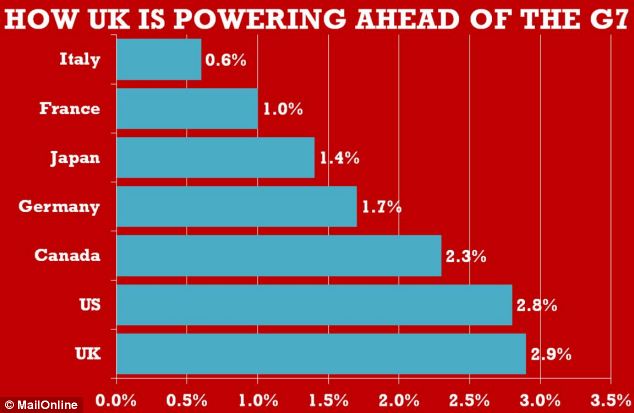
The International Monetary Fund said it now expects a 2.9 per cent rate of growth in 2014, a major u-turn after previously warning George Osborne his austerity programme was 'playing with fire'.

It means Britain is now on course to grow faster than any of the G7 richest countries, including the US, Germany and France, leading to the comparison with Olympic gold medalist Farah.

The International Monetary Fund said the UK economy was on course to grow by 2.9 per cent this year, faster than any other G7 country


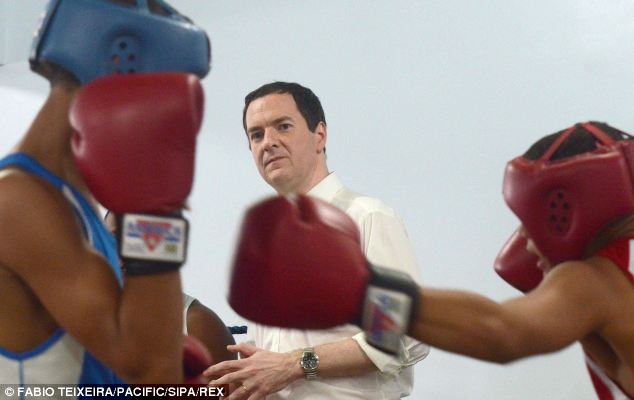
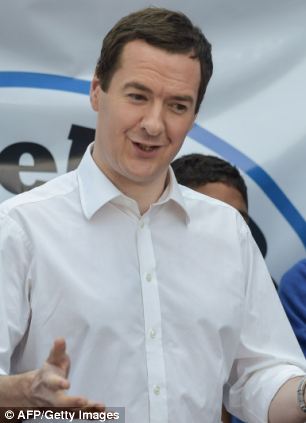
Chancellor George Osborne, on a visit to Brazil this week, is delighted to see Britain punching above its weight

Chancellor George Osborne, on a visit to Brazil this week, is delighted to see Britain punching above its weight


Only a year ago, the IMF heavily criticised the Chancellor’s economic plans and said he was ‘playing with fire’ by pressing ahead with austerity policies. It cut its UK forecasts to 0.7 per cent for 2013 and 1.5 per cent for 2014.

But in a highly unusual mea culpa yesterday, its chief economist, Olivier Blanchard, admitted that the IMF’s earlier prediction was ‘too pessimistic’. He conceded that the UK economy grew by 1.8 per cent in 2013 and raised growth forecasts to 2.9 per cent for 2014.

The latest World Economic Outlook gives its backing to policies pursued by the Chancellor and Bank of England governor Mark Carney.

It puts Britain ahead of the US on 2.8 per cent, Germany on 1.7 per cent and Canada at 2.3 per cent. The new figures also upgrade UK growth for next year though they still predict it will be slower than this year.

‘Consumption and residential investment looked like a rather unbalanced way of growing but I think forward-looking investment seems to be coming back and growth is going to be more balanced, so indeed that is very good news,’ Mr Blanchard said.

Charts in the IMF’s report suggest that US interest rates will start to rise in 2015 and that those in Britain will not be far behind.

The bright forecast came as Britain’s Office for National Statistics produced data showing manufacturing rose strongly in February by 1 per cent, after losing some momentum in January because of the effect of heavy rain and flooding.

In a further boost, the National Institute of Economic and Social Research said total economic output grew by 0.9 per cent in the first three months of this year – the strongest performance since the second quarter of 2010.

The IMF forecast is a major vindication for Mr Osborne after being warned he was 'playing with fire'
Mr Osborne, who is on an export drive in Brazil, was clearly elated by the IMF projections.

'It is good news that the IMF forecasts that Britain is to grow faster and has been upgraded by them by more than any other Western economy this year, and that record numbers of jobs are being created,' he said.

‘It is proof that the economic plan is working. But we need to do more to get exports and investment going. That is what the Budget was all about and that is what I am doing in Brazil this week.

'And it is clear today that the growth deniers in the Labour Party are intent on talking down the British economy - and that is the greatest risk to recovery.'

The IMF forecast is a major vindication for Mr Osborne after being warned he was 'playing with fire'
Remarkably, the IMF believes that the main risk to its new forecast is that the UK will do even better than expected.

It expects the UK’s economic renaissance to continue into 2015, with gross domestic product – the total output of the economy – expected to power ahead by a further 2.5 per cent.


James Sproule, Chief Economist at the Institute of Directors, said: 'The IMF’s previous economic forecasts have been too pessimistic because they were convinced that cuts to state spending would have a serious negative effect on GDP growth. Fortunately for Britain, this fear has proved to be misplaced.'

And Ruth Porter, head of economic and social policy at Policy Exchange, said: 'Britain is now the Mo Farah of the global race.

'We are leading the rest of the developed world in terms of economic recovery but the race is a marathon not a sprint.

'The flexibility of our labour market has enabled us to weather the economic downturn better than most other countries. But the challenge now is to raise our ambition still further.'

But Labour's shadow chancellor Ed Balls said: 'These forecasts are welcome news after three damaging years when the economy flatlined and growth forecasts were repeatedly downgraded.

'Yet millions of working people, who are on average £1,600 a year worse off since 2010, are still not feeling any recovery at all.'


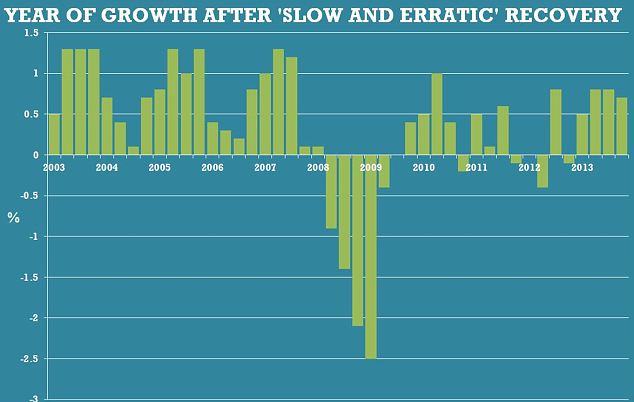
Official figures showed the economy grew by 0.7 per cent in the last three months of 2013, the fourth quarter of growth in a row.

Official figures showed the economy grew by 0.7 per cent in the last three months of 2013, the fourthquarter 
of growth in a row.

Another estimate of UK GDP released today by the respected think tank the National Institute for Economic and Social Research suggested economic output grew by 0.9 per cent in the three months ending in March.

The NIESR said the robust growth was relatively broad based. It forecast economic growth for this year of 2.5 per cent and 2.1 per cent for 2015.

But it added that even though the level of economic output had almost regained its pre-recession peak, a sizeable negative output gap remains.

The pound surged again on the news, having already seen a boost today from strong official manufacturing figures. Sterling ticked higher versus the dollar to $1.675 - close to a 51-month high of $1.680 set in February - having opening London trading at just $1.661.

Remarkably, the IMF believes that the main risk to its forecast is that the UK will do even better than expected.

The Fund expects the UK’s economic renaissance to continue into 2015, the election year, with gross domestic product – the total output of the economy – expected to power ahead by a further 2.5 per cent.

The upbeat IMF assessment of Britain’s prospects will provide a boost to the Chancellor, who is due to arrive in Washington on Thursday.

The World Economic Outlook reports says: ‘Downside risks continue to dominate global growth outlook, notwithstanding some upside risks in the United States, the United Kingdom and Germany,’

The Fund says the main risks are from ‘low inflation and the possibility of protracted low growth especially in the euro area and Japan’.

Nevertheless, the IMF forecasts that the recovery from the Great Recession will continue across the globe this year with output strengthening from 3 per cent last year to 3.5 per cent in 2014 and 3.9 per cent in 2015.

Exclusive: My Secret Struggle with Asperger's, By Susan Boyle


Ovation TV

The bestselling singer and Britain’s Got Talent alum writes about her battle with the disorder. Her documentary Susan Boyle: Her Secret Struggle airs Wednesday, April 9 at 10 p.m. ET on Ovation.

Simple Susan, mad, odd, bizarre. Names I have been called over the last 53 years of my life. 
Born in a small Scottish village at a time where medicine and diagnosis was in its infancy and hadn’t made the great advancements that we see today, my parents were told not to expect much from me as they were led to believe I had been brain damaged at birth. 
But you see I’m not mad or simple or any of the other names that I have been called over the years. I have Asperger’s and it doesn’t define me, it gives a greater understanding of who I am.
In brief, Asperger’s is a developmental disorder that falls within the autistic spectrum. It’s lifelong and experts believe that about 1 in 200 people have a form of Asperger’s in varying levels. People with Asperger’s normally have an above average intelligence. The difficulties that people with Asperger’s have lies within social interaction and communication as well as having sensory, motor and organizational difficulties. Many people with Asperger’s experience isolation and a lack of understanding which affects their everyday lives, which often results in frustration, anger, depression and a low self-esteem.
For over 50 years I struggled not understanding what was wrong, feeling that I had been unfairly labeled but at 51 when I was diagnosed with Asperger’s it was a huge moment of relief, understanding and acceptance.
For just over a year I kept my diagnosis private. After all, how could I discuss a diagnosis that I was just learning about and understanding why in situations I react the way I do? After a year of learning and gaining knowledge I finally felt comfortable to speak of my diagnosis and allow people to share an important part of my life.
It was carefully managed. It had to be. This was so important to me and also to all those with Asperger’s that I needed to ensure that it was my words, my story and not twisted or ridiculed by those less understanding.
It was incredibly important to convey this very personal diagnosis in exactly the right way. I did not want people getting carried away and making judgments or headlines spinning out of control making a mockery. So I decided that the only way to show what life with Asperger’s is like was to show people and I was lucky enough to be afforded the opportunity to do just that with a documentary. I wanted to stop being an outsider and show people what my life was like, bring them in to my world and hopefully give people a greater understanding of what Asperger’s is and the day to day struggles that will always exist and the reactions to situations. 
My show follows the journey in the lead up to my first live shows that I performed in Scotland in the summer of 2013. A dream of mine, I had been desperate to perform on my very own tour but it comes with pressures and uncertainties and for someone with Asperger’s this magnifies the condition.
It was and still is a relief. Of course there are still the ignorant who regardless will name call because they don’t understand or won’t take the time to understand but for me and the people around me who I care about it has given us all a better understanding of who I am and why I do what I do and why my reactions to situations are different to others. 
140407-susan-boyle
Robert Ormerod/Statement/Redux
It shouldn’t be a taboo subject. Quite the opposite. We need to become more perceptive and embrace the difference and gain a greater knowledge of what Autism and Asperger’s are and why it occurs. 
I have not written this with a view to evoke pity. Quite the opposite. Don’t pity me. Understand me.
I have a blessed life. The past five years have afforded me experiences I could never have imagined and met some of the most fantastic people. I have been unbelievably fortunate and every day I am so grateful that this is what my life has become. No one, least of all me, can quite believe how my life has transformed for the better. I completed the Scottish tour successfully and am currently touring England performing 19 dates around the country. Life is going from strength to strength and nothing is holding me back!  
Which is why it’s so incredibly important that the label of Asperger’s doesn’t define me—it gives a greater understanding of who I am. In fact it gives society a greater understanding of all of us diagnosed and living life with Asperger’s.
The exclusive U.S. premiere of Susan Boyle: Her Secret Struggle will air on Wednesday, April 9 at 10 p.m. ET on Ovation. Visit ovationtv.com for more information. 

Ex-head of MI5 Stella Rimington: Independent Scotland could have own secret service.. but setting it up would be complicated

THE former spying boss believes the process of setting up a national security service is possible but says key sources of information may take a long time to trust the new agency.

Geraint Lewis
Stella Rimington, from director of the MI5


  • By Jenny Morrison
THE former head of MI5 says there is no reason why an independent Scotland could not set up its own security and intelligence service.
Dame Stella Rimington, the first female director general of MI5, admits the SNP’s plans to set up a new Scottish agency to fight
terrorism and cyber security threats would be “quite complicated.”
But she said a precedent had already been set by the UK Government in helping newly independent countries set up their own security services.
The former spy chief also warned intelligence would only be shared with nations that can be trusted to know how to deal with it.
And she said key sources of information may take a long time to trust any new Scots agency.
Dame Stella, who led MI5 for four years until 1996, said: “I think setting up a new security and intelligence service would be pretty huge, but there were precedents set at the end of the Cold War.
“When countries in Eastern Europe came out of the former Soviet Union we gave them an enormous amount of help.
“But setting up a new security and intelligence service is obviously quite complicated.
“There will be many things to sort out – from relationships with police, to where responsibility begins and ends.
“Importantly any new service has to establish confidence – both within the UK and internationally – and that will take a certain amount of time.
“It has to be worked at, it is not something you can do on the back of a fag packet.
“A lot of intelligence comes from people whose situation is very dangerous – it might be from a terrorist inside a terrorism
organisation – and that information is only shared if those people have confidence in the receiving party.”
As part of the White Paper on independence, the Scottish Government have outlined plans to set up a “single security and
intelligence agency for Scotland”. But their estimate that it will cost £206million a year – the same amount Scotland contributes to the cost of UK-wide agencies – has been ridiculed by critics.
Last week, national security experts the Royal United Services Institute said an independent Scotland would face “significant resourcing, capability and legislative hurdles” to replace the security currently provided by MI5, MI6 and GCHQ.
Dame Stella said: “The modern day security world depends enormously on an exchange of high level intelligence and confidence in those who are giving the information and receiving it.
“Of course there are lots of Scots living in London working in the security services.
“Whatever happens I will watch with interest.”
Dame Stella, 78, who retired from the security services 22 years ago, says she continues to “watch with interest” high profile security-related matters across the world.
But rather than wishing she was still involved, she has a new motive.
She is now a successful author who has just completed her eighth spy thriller.
Her books centre on fictional spy Liz Carlyle who, Dame Stella admits, shares many of her own characteristics.
Her career as a “spook” started after moving to India with her diplomat husband.
She said: “I had gone with no intention of being anything other than a diplomat’s wife, but while there I got ‘tapped on the shoulder’ as they say.
“At that time MI5 were responsible for helping Commonwealth countries with their security and I was approached by the man who was the MI5 rep in the New Delhi office.
“I was asked if I would do a very low level, part-time job, just typing and filing.
“It was only a very small office, so I got to know exactly what was going on.
“It was at the height of the Cold war – a great time to be a spy. When my husband and I came back to London I had to decide what I was going to do next – hang around the house, go back to my previous job of being an archivist, or apply for a full time job at MI5.
“I decided joining MI5 would be the most interesting thing to do, and never looked back.”
Dame Stella, a mum of two daughters, admits her first few years were not what she had imagined.
She said: “In those days no one thought women could do the sharp end work of gathering intelligence.
“But things started to change in the 1970s and women finally started to break through.”
Dame Stella’s career progressed dramatically until, in 1992, she became the first public Director General of MI5.
Among the cases she worked on were the Lockerbie bombing in 1988.
She said: “Our people were working very closely with the Scottish police and the Americans trying to find out what happened and who was responsible.
“Questions about Lockerbie still go on, but as far as I’m concerned it was more or less settled.”
While any of the investigations Dame Stella has worked on would be a thrilling plot for her books, she says her novels are based on more recent events.
She said: “My plots are based partly on my experience, but I mainly try to keep my plots very current and each of my books has to go through clearance with MI5.
“They occasionally ask me to change a name, or a place, or a small detail where maybe, inadvertently, I have got too close to something.”

TRAC Briefing: AQAP's New Mini Series Highlights the Life and Times of its Architect


Sa'eed al-Shehri (aka. Abu Sufyan al-Azdi)

Dear reader/s,
In August 2008, Sa'eed al-Shehri (aka. Abu Sufyan al-Azdi) trekked the hard way out of Saudi Arabia, traveling through rough terrain to neighboring Yemen, where a new "journey of jihad, sacrifice and generosity" began for him. Abu Sufyan was the mastermind of AQAP's recruitment strategy, "collecting manpower, gathering fighters and directing the helm of the struggle." Though his journey came to an end as the result of a July 2013 US drone attack in Yemen, his influence within AQAP is as prominent as ever.

Jihad Journey: The Mini-Series

In March 2014, AQAP's "Al-Malahem Media" released a mini-series documentary on Abu Sufyan's progression into radicalization. The first part of "Journey of Jihad" traces Abu Sufyan's rise to become the mastermind of the group as he played the role of propaganda guru, military strategist, top deputy commander, and fundraising superstar. Without al-Shehri, one might argue, AQAP would have been a failed al-Qaeda project.

TRAC brings this 30-minute video to you with an exclusive synopsis by TRAC contributor and senior consultant for Flashpoint Partners, Laith Alkhouri, of the life of the architect of modern day AQAP.


This content will be available to non-subscribers only for a limited time. For additional questions about any of TRAC's 1000s of pages of content, 4,324 terrorist group profiles, or subscriptions, contact Hylda Fenton at hfenton@tracterrorism.org.

Cordially,
Veryan Khan
Editorial Director / Associate Publisher
Beacham Publishing

Church mediates Egypt-Ethiopia dispute over Renaissance Dam

Summary

The head of Egypt’s Central Auditing Organization, Hisham Geneina, denied reports that the Muslim Brotherhood was supporting his candidacy in the presidential elections, while other officials talked about the necessity of an electoral law to guarantee fair elections, in light of a church mediation between Egypt and Ethiopia on the Renaissance Dam issue.

Orthodox Christians attend prayers in preparation for Easter at St. George church in Addis Ababa, April 18, 2009. (photo by REUTERS/Irada Humbatova)

In an exclusive interview with Azzaman, Hisham Geneina, head of Egypt’s Central Auditing Organization, denied reports that the Muslim Brotherhood would support him in the presidential elections, and stressed that he was not affiliated with any particular movement and he is not considering running for president.


Hisham Kamal, a member of the National Alliance to Support Legitimacy (NASL) and spokesman for the Salafist Call, denied allegations that the alliance intends to support Geneina or any other political figure, because it does not trust in the situation on the scene and is still committed to acting on the basis of legitimacy.

On the news that the Brotherhood might support Geneina in the upcoming presidential elections, Kamal said that these were mere rumors that might have originated from the intelligence services or the Ministry of Interior. He noted that there had been previous attempts to impose conditions on the alliance for a so-called reconciliation. Yet, he said, the alliance has refused to comply with these conditions and would not accept any future reconciliation unless it were based on legitimacy, and was accompanied by the trial of those who killed peaceful demonstrators and the restoration of rights.

Additionally, political activists have started to collect signatures supporting the candidacy of Geneina to the post of president in several provinces. Maj. Gen. Adel al-Qala, head of the Egyptian Arab Socialist Party, described the Brotherhood’s moves in this regard as an attempt to confuse the political scene. On the other hand, sources tied to the campaign of Field Marshal Gen. Abdel Fattah al-Sisi revealed that Sisi would probably accept the invitation of the Orthodox Church to attend the Mass celebrating the Resurrection on April 19, while sources tied to the campaign of Hamdeen Sabahi said he would also accept the invitation of the church to attend these celebrations. Observers in Cairo described that as an attempt by the candidates to win the votes of Copts. Informed sources said Sisi would more likely get the majority of votes of the Copts as a result of his support for the June 30 Revolution. In the same context, a number of political forces called for the adoption of an electoral code of conduct to ensure the integrity of the electoral process.

George Isaac, a political activist, said the climate that currently prevails in the country requires an electoral code of conduct and the enforcement of the law to ensure integrity and impartiality of the elections.

He added that the most prominent article in this code of conduct should be to ban the use of the state’s apparatuses to publicize a candidate at the expense of another. He stressed that every citizen has the right to run in the elections without anyone delving into the details of his personal life. Safwat el-Nahas, secretary-general of the Egyptian Patriotic Movement, said it would be better if all candidates, campaigns and supporters commit to the electoral code of conduct in terms of publicity or any other electoral matter for the benefit of Egypt and for the success of the electoral process. Amr Ali, a member of the Free Egyptians Party, described the idea of ​​the electoral code of conduct as mere ink on paper, given the political atmosphere in the country and the prevailing turmoil, which does not allow its implementation.

He pointed out that the application of the electoral code of conduct would be possible after a high level of political awareness was reached.

On another note, Patriarch Abune Mathias of the Ethiopian Orthodox Church will arrive and spend five days in Cairo late this month, at the invitation of Pope Tawadros II, pope of the Coptic Orthodox Church, to visit the Egyptian church, after Mathias was elected head of Ethiopia’s church.

Sources within the church told Azzaman that Tawadros will try to persuade Mathias that the Ethiopian church assume a role in resolving the crisis between Egypt and Ethiopia over the Renaissance Dam, given the historical relations between the two churches. Tawadros will be asking the patriarch for the church to exert pressure on the Ethiopian government to make concessions to preserve the historical relations between the two peoples.

In the same context, a conference titled “The Nile is a Cooperation not a Clash” was held on April 5 by the Arab Healthy Water Association. During the conference, international water-law experts offered an integrated vision of the dangers that would emanate from the Renaissance Dam and the ways to prevent them.

Maghawri Shehata, an international water expert and president of the conference, told Azzaman that the experts taking part in the conference will clarify the reality of the water situation, the water crises and shortages in Egypt’s share of the Nile's waters.

Shehata noted that for the first time, the conference would discuss the report of the tripartite technical committee on the assessment of the environmental and technical impact of the dam on the two downstream countries, and on the danger of Ethiopian plans to build a series of dams on the security of Egypt's water. This issue will be discussed by Mohamed Nasr Allam, former Minister of Water Resources and Irrigation, in a working paper — which will be submitted to the conference — in a technical and neutral way, so that facts will be clarified without exaggeration or underestimation.

He added that in a study conducted by Mufid Shehab, head of the Egyptian branch of the International Law Association, the conference would present the legal aspects and the chronology of the issue. He will also talk about how Egypt can apply its legal rights to use the waters generated by the Renaissance Dam and to secure its share of water in general, according to the documents, conventions and treaties that Egypt has signed, and under the Law of Non-Navigational Uses of International Watercourses.

He noted that the conference would be discussing a study on the political dimensions of Egypt’s water security within the framework of Egypt's water policy in the Horn of Africa. The study will be presented by Mohammad Salman Taya, a professor in the Faculty of Economics and Political Science at Cairo University.

He added that the conference aims at finding solutions to ensure a win-win situation — namely to ensure Ethiopia has the power and Egypt the water — by developing a map that would allow the upstream and downstream countries to reap the benefits of the Renaissance Dam. He pointed out that the conference will prepare a report that consists of the suggested solutions to the crisis of the Renaissance Dam and will submit it to the relevant authorities and institutions, most notably the presidential and governmental institutions.

On the other hand, the statements on the Renaissance Dam issue and water crisis, which were made by the Minister of Foreign Affairs Nabil Fahmy and the Minister of Water Resources and Irrigation Mohammed Abdel Matlab, have sparked angry reactions. National and political forces have demanded that the minister of foreign affairs stop making statements such as the one in which he revealed that Egypt was ready to take part in the financing of the Renaissance Dam. Nader Noureddin, a professor of water resources and agricultural land at the University of Cairo, described the statements made by Fahmy that Egypt offered to finance the Ethiopian Renaissance Dam as catastrophic. Noureddin said that Fahmy’s statements are dangerous and wrong, and his remarks are incomplete and unclear. They may be exploited in a bad way by Ethiopia, since Ethiopia has refused Egyptian participation in financing construction of the dam, which has a 14 billion cubic-meter capacity and other specifications that guarantee the sharing of Nile water by Egypt and Sudan.

In the meantime, political forces condemned the statements of Matlab in which he said that the water reserve in the Aswan Dam will serve Egypt for two more years. They stressed that these statements would harm Egypt's negotiating position. Sovereign sources revealed that high-level parties have asked Matlab to stop making such statements without first referring to the intelligence services or the Ministry of Foreign Affairs, which are currently managing the Renaissance Dam file.

Wednesday, April 9, 2014

The Italian commitment to health care in Somalia


The Italian involvement in Somalia is strong, particularly in the health sector: on the occasion of World Health Day ', and' an event was organized in Nairobi to present the documentary filmed by RAI correspondent in Mogadishu, Enzo Nucci and exhibition artist Massimo Grimaldi, with photographs taken at the children's hospital 'Mohamed Aden Sheikh' Children Teaching Hospital (Mas Cth) of Hargheisa, the capital of Somaliland. This structure, a center of excellence for the entire country only in 2013 that guaranteed health care to 15 thousand children, and 'was made with a co-funded by the Italian Cooperation of 500 thousand euro.

Just the Italian Cooperation is funding 18 initiatives in Somalia, with a total value of almost € 15 million. To these, went on to add almost € 11.8 million as a result of Novation Agreement signed between the Italian government and the authorities 'federal Somalia, thanks to which' was possible to bring forward the construction of two additional programs, one as part of the infrastructure and the other in health care.

Security downturn in Mogadishu


A crowd gathers in aftermath of an explosion in front of Mogadishu’s national theatre in March 20130

MOGADISHU, 9 April 2014 (IRIN) - Three years after Al-Shabab insurgents withdrew from the city, security in Mogadishu remains a serious problem for residents and aid workers, with threats from Al-Shabab incursions, criminals and militia.

Often-deadly attacks attributed to Al Shabab or its sympathizers involving mortar rounds, rocket propelled grenades and improvised explosive devices occur with great frequency in the capital.

Some 624 weapons-related casualties were treated in four hospitals in Mogadishu in January and February, according to the UN Office for the Coordination of Humanitarian Affairs (OCHA) February Humanitarian Bulletin, a 20 percent increase on the previous two months.

Recent months have also seen a flurry of terror attacks against key government and international organizations in the city. On 21 February the presidential palace was attacked and senior government officials killed.  A week earlier a UN convoy was targeted, leaving six dead. 

“In Mogadishu, the security situation has deteriorated since… December,” Nicholas Kay, the Secretary-General’s special representative to Somalia, toldthe UN Security Council on 11 March. “Times are tough, and in the short term they may get tougher. Insecurity in Mogadishu poses challenges for Somalis, for the UN and the international community.”

“The risk of further attacks against Somali government and international targets remains high,” he added.

Fear

For many Mogadishu residents, fear of attack and crime prevents them from leading normal lives. Neighbourhoods such as Heliwaa, Yaqshiid and Dayniile have been particularly hard-hit, forcing people to flee to more peaceful districts within the city.

“The latest face-to-face clashes between Somali government troops and Al-Shabab have badly affected our way of life and many people lost their lives. In this place nobody rules, so residents live under constant fear,” one resident of Heliwaa who preferred anonymity told IRIN. “I never thought that this sort of thing could be happening three years after Al-Shabab was defeated militarily.”

Security fears are forcing businesses to close at 4pm, and also affecting rents.

“Here [in Heliwaa] the cost of rent of [a] five-room villa is US$35-70 depending on the condition of the house. However, in more peaceful areas the rent is expensive. For example, a five-room home in Waberi is $300-400,” he said. “Some of my neighbours fled but we are just staying behind for financial reasons.”

But across the city, people don’t feel safe. “Rarely a night passes without a phone being robbed at gunpoint,” English teacher Ahmed Aden Ibrahim, who lives in the Hamarjadid neighbourhood, told IRIN.

Inept government, security forces

Abdullahi Adan Hussein, a security analyst and former colonel in the Somali army, told IRIN political infighting within the administration was to blame for the deterioration in security.

“The predecessors of the current administration had enough time to understand the psychology of their enemies and respond accordingly, but they were replaced by the current government,” he said. “The new guys needed more time to adapt to the new situation. However, the Council of Ministers lost confidence and a security gap was created.”

“There is a real continuity problem. Al-Shabab exploited the status quo and launched these daring attacks,” he added.

Amnesty International also blamed the security forces. “Lack of discipline and command control within Somalia’s armed forces and allied armed groups means that they not only fail to provide civilian protection, but are actually contributing to the overall insecurity,” it noted in a press release. “State security forces continue to be infiltrated by criminal, radical or insurgent elements,” it said.

Many of the capital’s 17 districts have their own armed militia under the authority of that district’s commissioner. In many cases these groups operate as private armies whose loyalty to the central government varies.

Abdinasir Hashi Jimale, a Mogadishu-based political analyst, believes the attack on Villa Somalia (theoretically the country’s most protected building) was aimed at demonstrating just how vulnerable the government remains.

“The presidential palace is the country’s symbol and it seems Al Shabab wants to send a loud message: `We are still here and we can strike you any time,’” he said.

Al Shabab has already targeted UN installations and personnel - most notably in July 2013, when the UN compound in Mogadishu was attacked and has recently declared some NGOs as enemies, although none have been attacked by the insurgent group.

“To bring a degree of confidence and stability, the government has to undertake a number of important measures such as adopting more inclusive politics that bring all clans on board, because shift of clan loyalty has the potential to reverse government gains; it should also nominate competent officials for the top security posts, provide good pay for the soldiers and build a working justice system,” Jimale added.

The humanitarian community is particularly affected by the insecurity, which besides Al Shabab attacks includes various crimes - muggings, extortion at checkpoints, kidnapping, and the diversion of aid. 

Foreign UN personnel are largely confined to a base at the airport and international aid workers generally require protection when travelling around the capital.

“The fact that we have to go around with armed escorts undermines the principles of `do no harm’ and ‘neutrality’,” one foreign aid worker who asked not to be named told IRIN.

All this reduces access to people in need and greatly increases the cost of humanitarian operations, notably for the 370,000 internally displaced people in Mogadishu

amd/aps/am/cb

IRIN