Search This Blog

Wednesday, April 9, 2014

"They Are Slaughtering Us Like Chickens"

Somalia: The more “moderate” government—as it is often portrayed in comparison to Al Shabaab (“The Youth”) opposition—banned Christmas celebrations. Hours before Christmas Day, the Ministry of Justice and Religious Affairs released a directive banning any Christian festivities from being held in the east African nation.  In the words of one ministry official: “We alert fellow Muslims in Somalia that some festivities to mark Christian Days will take place around the world in this week. It is prohibited to celebrate those days in this country.”  All security and law enforcement agencies were instructed to quash any Christian celebrations.


 "The songs of praise to God are banned here." — Police officers to Christians, Turkmenistan.

"Meanwhile, an increasing number of people are being incarcerated for crimes of opinion and defense of religious freedom." — Asia News
As happens at Christmas every year throughout the Muslim world, Christians and their churches were especially targeted—from jihadi terror strikes killing worshippers, to measures by Muslim authorities restricting Christmas celebrations.  Some incidents follow:
Iraq:  “Militants” reported the Associated Press, “targeted Christians in three separate Christmas Day bombings in Baghdad, killing at least 37 people, officials said Wednesday.  In one attack, a car bomb went off near a church in the capital’s southern Dora neighborhood, killing at least 26 people and wounding 38, a police officer said. Earlier, two bombs ripped through a nearby outdoor market simultaneously in the Christian section of Athorien, killing 11 people and wounding 21.”
Iran:  Five Muslim converts to Christianity were arrested from a house-church during a Christmas celebration. Plain clothes Iranian security authorities raided a house where, according to Mohabat News, “a group of Christians had gathered to celebrate Christmas on Tuesday, December 24.” Before arresting the five apostates, authorities “insulted and searched those in attendance, and seized all Christian books, CDs, and laptops they found. They also took the Satellite TV receiver.”  The original report received by Mohabat stated: “These Christians had gathered to worship and celebrate [the] birth of Jesus.”
Indonesia: Muslims in the Aceh provinceprotested against Christmas and New Year celebrations and called on authorities to ban them. Days earlier, an influential Islamic cleric organization, the Ulema Consultative Assembly, issued a fatwa, or edict, “prohibiting Muslims from offering Christmas wishes or celebrating on New Year’s Eve,” said the Associated Press.  Aceh is the “only province in predominantly Muslim Indonesia that is allowed to implement a version of Islamic Shariah law.”
Kenya: “Youths,” reported Reuters, “threw petrol bombs at two Kenyan churches on Christmas day … in the latest bout of violence against Christians on the country’s predominantly Muslim coast.”  The attacks occurred “in the early hours of December 25 after churchgoers held services to usher in Christmas.”  The churches were located in Muslim-majority regions. One church was “completely destroyed.”
Somalia: The more “moderate” government—as it is often portrayed in comparison to Al Shabaab (“The Youth”) opposition—banned Christmas celebrations. Hours before Christmas Day, the Ministry of Justice and Religious Affairs released a directive banning any Christian festivities from being held in the east African nation.  In the words of one ministry official: “We alert fellow Muslims in Somalia that some festivities to mark Christian Days will take place around the world in this week. It is prohibited to celebrate those days in this country.”  All security and law enforcement agencies were instructed to quash any Christian celebrations.
Pakistan:  During Christmas Eve services, “Heavy contingents of police were deployed around the churches to thwart any untoward incident.”  In some regions, “prayer service at major churches focused on remembering the Pakistani Christians who lost their lives in terror attacks.” For example, three months earlier, Islamic suicide bombers entered the All Saints Church compound in Peshawar following Sunday mass and blew themselves up in the midst of some 550 congregants, killing some 130 worshippers, including many Sunday school children, women, and choir members, and injuring nearly 200 people.
Even in Western nations like Denmark, Christmas Eve witnessed Islamic demonstrations and cries of “Allahu Akbar” (or “Allah is greater”).
Also in December, Syria’s Greek-Catholic Church declared that it had three “true martyrs”—men from the small town of Ma’loula, an ancient Christian site where the inhabitants still spoke the language of Christ.  According to Asia News, “When the town fell [in September, to al-Qaeda linked rebels], a climate of fear was imposed… When three men refused to repudiate their religion, they were summarily executed in public, and six more were taken hostage. This was followed by a failed attempt by Syrian government forces to retake the town.”  In the words of Patriarch Gregorios III to Pope Francis in a meeting: “Holy Father, they are true martyrs. Ordered to give up their faith, they proudly refused. Three others however gave in and were forced to declare themselves Muslim, but later returned to the faith of their ancestors.”  According to the families who fled from Ma’loula, “some of their Muslim neighbors took part in the attack that devastated this historic village where people still speak Aramaic, the language of Jesus. Muslims are approximately one third of the population of the village…”
The rest of December’s roundup of Muslim persecution of Christians around the world includes (but is not limited to) the following accounts, listed by theme and country in alphabetical order, not necessarily according to severity.

Islamic Attacks on Christian Places of Worship 

Egypt: After a Coptic Christian priest from the village of Tarshoub, Upper Egypt, left to service a new location and a new priest was sent to Tarshoub, Muslim Brotherhood supporters rioted and attacked the village Christians, including by throwing stones at their homes, burning property, and calling for the closure of the village church, which has been in existence for 40 years.  The church was subsequently closed and the priest prevented from entering the village.   The Christian Post reported that Christian villagers were “getting close to the New Year celebrations and Christmas, and yet they are not able to open the church….  security authorities have not arrested the aggressors, while Copts were forced to close the church for fear of more attacks, especially in light of continued incitement by the Muslim Brotherhood.”
IndonesiaFive more churches were closed by authorities, leaving thousands of Christians without a place of worship.  First, claiming that the existence of a Protestant church in North Sumatra was illegal, hundreds of Muslims belonging to the Islamic Defenders Front attacked and disrupted its Sunday services, creating so much havoc that police had to escort Christians home.  Then, two new churches—one in West Java, the other in South Sulawesi—were sealed off.  The Sulawesi church was subsequently demolished by authorities.  A few days later, two more churches near Jakarta were forced to stop holding services. According to International Christian Concern, “The reason behind this month’s rash of church closures, especially after seven months of relative quiet, is not exactly clear. It may be that the coming Christmas holiday has ignited always simmering anti-Christian sentiment among radical groups. In 2000, 16 were killed by bomb attacks on churches over the Christmas holiday.”
Russia: In December it was revealed that seven Christian churches were torched in 2013 in a Muslim-majority republic in Russia, according to Asia News: “Churches burned, attacks foiled and increased pressure on Christians to convert to Islam. In Tatarstan—autonomous republic of the Russian Federation, with a Muslim majority—the extremism alarm is increasing.”  Although the culprits setting fire to churches are “unidentified extremists,” Father Dmitri Sizov, pastor of Pestrechinsky, said that “the whole community knows that it is the work of the Wahhabis [Islamic literalists]” who “roam, inviting the faithful to convert to Islam.” But “the priests remain silent because they are afraid of being accused of incitement to religious hatred,” added Fr. Dmitri.
Syria: Islamic rebel forces fired multiple mortar shells on a church in the southern province of Daraa, killing 12 people and injuring many others, including church volunteers who were there distributing charity aid to the locals. Separately, five young children were killed when rebels fired two rockets at a Christian school.  According to the Patriarch of the Church of Antioch, more than 450,000 Christian Syrians have been displaced from the conflict, and more than a thousand have been killed.
Islamic Attacks on Christian Freedom: Apostasy, Proselytism, and Dhimmitude
Cameroon: David Dina Mataware, a Christian missionary, was slaughtered by neighboring Nigeria’s Islamic group Boko Haram.  On the same day and in the same area that the missionary’s murder took place, a French priest, Father Georges Vandenbeusch, was also kidnapped. The slain missionary, whose throat was slit, had worked in a Nigeria-based mission agency in Cameroon for some fourteen years,bringing the Gospel to remote tribes.
Egypt: “The nation’s most well-known convert from Islam” to Christianity was arrested, including for allegedly inciting “sectarian strife,” and “is likely being tortured,” reported Morning News.  Bishoy Armia Boulous, 31—popularly known by his former Muslim name, Muhammad Hegazy—was arrested while in a café.  Authorities claim that he was working with a Coptic satellite station to create a “false image” of violence against Christians in Minya, Upper Egypt, where attack on Copts are most common. However, human rights activists close to Bishoy say “his arrest had nothing to do with any reporting work but constituted retaliation for becoming a Christian” and possibly for evangelizing to Muslims.
Iran:  While raiding their home, the Islamic republic’s feared secret police assaulted the wife and children of jailed evangelical Pastor Behnam Irani.  According to a source assisting the family with advocacy, “They confiscated her laptop computer and Christian materials… While the secret police were in her home they were yelling at her and doing their best to scare her.  This really frightened the children, Rebekah and Adriel” and was apparently meant to create enough “fear to silence them.”  The raid came after the imprisoned evangelical leader—and former Muslim—was told by a court to remain behind bars because he “did not change.”
Syria:  The anti-Christian strictures of Sharia, or Islamic law, continued to be applied onto Christians by Islamic rebels.  According to Agenzia Fides, “Kanaye [a Christian region] has been invaded by Islamist militants that terrorize the population, threaten a massacre and have imposed the Islamic law…  This has become a pattern that repeats itself and that in recent weeks has focused on a number of Christian villages: armed guerrillas penetrate into the village, terrorize civilians, commit kidnappings, kill, sow destruction.”  Father George Louis of the village of Qara, which has been devastated and burned, explained: Maalula [the aforementioned Ma’loula], Sednaya, Sadad, Qara and Deir Atieh, Nebek: armed jihadists target a village, they invade it, kill people, burn and devastate it.”
Turkmenistan: Police and Secret Service agents in Dashoguz, a northern city, raided a group of believers of the Church of the Light of the East, a Protestant community.  Forces raided two houses of prayer, seizing religious materials, including Bibles. An official of the Department of Religious Affairs, who is also an imam at the local mosque, went on to inform the pastor that his faith “is wrong” and warned him to convert to Islam, adding “Christianity is a mistake … it’s not a religion, but a myth.”  Moreover, Christians practicing hymns for Sunday service were told by officers that “the songs of praise to God are banned here.” Adds Asia News: “Meanwhile, an increasing number of people are being incarcerated for crimes of opinion and defense of religious freedom.”

Carnage of Christians 

Central African Republic: In just two days of violence, at least 1,000 people were killed in Bangui, CAR’s capital, following the chaos that has engulfed the nation after Seleka, a coalition of Muslim militia, whose members include many foreigners, ousted the Christian president—the nation is Christian-majority with a significant Muslim-minority—and installed a Muslim ruler.  Because some Christians tried to resist with violence, killing some 60 Muslim males in combat, the Islamic group “retaliated on a larger scale against Christians in the wake of the attack, killing nearly 1,000 men over a two-day period and systematically looting civilian homes. A small number of women and children were also killed,” reported Amnesty.  Tens of thousands of Christians fled from machete-wielding Muslims, many now living in desperate conditions around churches and bishoprics.
They are slaughtering us like chickens,” said one Christian.  “We have had enough of Seleka killing, raping and stealing,” said another, adding that he was not sure whether he could ever go back and live among Muslims. “We are angry,” he said.  “The Muslims should go back where they came from.”
Nigeria: Islamic Fulani herdsmen killed at least 205 Christian farmers in the latter half of 2013, while ten thousand more Christians were displaced and many of their churches destroyed or closed.   As for motive, Christian leaders, “had no doubt the Muslim assailants aimed to demoralize and destroy Christians,” said Morning Star News. Several of the attackers appear to be mercenaries from outside the area, explaining how the Fulani farmers became so heavily armed.  “Life has become unbearable for our church members who have survived these attacks, and they are making worship services impossible,” said a Roman Catholic bishop.  Another area Christian leader said that “Many of our Christian brethren have been killed. The Muslim gunmen that are attacking our Christian communities are numerous; they are so many that we can’t count them. They are spread across all the communities and unleashing terror on our people without any security resistance.”
 About this Series
The persecution of Christians in the Islamic world is on its way to reaching pandemic proportions.  Accordingly, “Muslim Persecution of Christians” was developed to collate some—by no means all—of the instances of persecution that surface each month. It serves two purposes:
1)    To document that which the mainstream media does not: the habitual, if not chronic, persecution of Christians.
2)    To show that such persecution is not “random,” but systematic and interrelated—that it is rooted in a worldview inspired by Sharia.
Accordingly, whatever the anecdote of persecution, it typically fits under a specific theme, including hatred for churches and other Christian symbols; sexual abuse of Christian women; forced conversions to Islam; apostasy and blasphemy laws that criminalize and punish with death those who “offend” Islam; theft and plunder in lieu of jizya (financial tribute expected from non-Muslims); overall expectations for Christians to behave like cowed dhimmis, or second-class, “tolerated” citizens; and simple violence and murder. Sometimes it is a combination.
Because these accounts of persecution span different ethnicities, languages, and locales—from Morocco in the West, to India in the East—it should be clear that one thing alone binds them: Islam—whether the strict application of Islamic Sharia law, or the supremacist culture born of it.
Raymond Ibrahim is author of Crucified Again: Exposing Islam's New War in Christians (published by Regnery in cooperation with Gatestone Institute, April 2013).

The girls basketball beat Al Qaeda: "If you play a hand you cut off"


Amina, the captain of the national basketball team, poses with other partners in Mogadishu stadium Wiish (A. Pampliega).

"Afraid?" He repeats softly Amina tackles while tying the laces of shoes."Afraid?" He again says the girl, this time flashing a wide smile. "Fear is what prevents us from moving forward and fight for our dreams. course we are afraid to kill us . We are afraid of telephone threats. We are afraid ... but our desire is to stay in the game, continue playing basketball. Fear has no place in the basketball court, "he says with conviction Ibarahin Amina Abukar, captain of the national women's basketball Somalia.
His words reverberate in a deserted stands. It is, as usual, the first to reach the stadium Wiish and the last to leave. Represents an example of struggle and overcoming for the rest of their companions, who see it as a leader. Amina is race and strength. It is a worthy heir to those women who were dispossessed - first by the civil war and later by Islamic fundamentalists- of their right to practice sport, but above all, of their right to choose and be free.
In 2006, the Islamic Courts Union of Somalia issued an order banning women from any sport; should skip this law, they would cut their right hand or the left footwalls of the basketball court is the best example of what has been Somalia during the past 23 years .Bullet holes everywhere. Half-destroyed buildings.But these girls are the ones who must now write the history of the country ... And along with them, a total of 75 adolescents, divided into seven teams, have again found the women's league basketball.
Strips off her chador, which lovingly placed on the steps of the stands, and follows a handkerchief in front of black color to hide her hair. "Women in Somalia 20 years and played basketball. We are not pioneers and heroines, just keep your steps. We have no more merit than other Somali women who go out every day to the streets to fight for their rights , "says this young man with passion The Confidential .  
A group of Somali women across the Shabelle River, north of Mogadishu (Reuters).A group of Somali women across the Shabelle River, north of Mogadishu (Reuters).In the crosshairs of Al Qaeda
Although try to downplay what they do she and her companions, the reality is that this basketball team is in the spotlight of fundamentalist Al-Shabab(the subsidiary of Al Qaeda in the Horn of Africa). Amina, as one of her classmates, has received threatening phone calls, but prefer to ignore the issue and focus on basketball. Girl grabs one of the balls that are scattered on the floor and begins to bounce it. Her companions, covered to the foot, begin to enter the pavilion.
'Of course we are afraid to kill us, to telephone threats ... but our desire is to continue playing basketball, "Amina account, captain of the national team of Somali women's basketballteam The girls usually come in groups of two and three to this court. Covered with their chadors so that is not recognized, try to go unnoticed in the streets of Mogadishu . They know that their head is priceless and are risking their lives coming to train. "The girls are very brave to be part of this basketball team. 've received many threats since we returned to rebuild the team and many girls left the team for fear, "says this newspaper Hussein Ibrahim Ali, president of the Somali Federation Basketball.
Basketball is the second most popular sport in Somalia after football, and one of the three sports where women have representation, along with football and handball. But this was not always so. In 2006, the Islamic Courts Union of Somalia , which ruled the country under the precepts of sharia (Islamic law) -issued an order banning women from any sport ; should skip this law, the players would be punished in an exemplary manner. " They cut off the right hand or the left foot , "says Hussein embarrassed, recalling the dark days when the country was submerged.
A displaced by the fighting inside the Cathedral of Mogadishu (Reuters).A displaced by the fighting inside the Cathedral of Mogadishu (Reuters)."Given the opportunity of attacking us, they will"
Al Shabab is now only a whisper; a bad dream. In the presence of the fundamentalist group in Mogadishu are only flashes as suicide bombings that are repeated more or less frequently. But girls selection still fear for their lives and for their safety. Proof of this is that access to the court record gunmen anyone who crosses the green doors . "While Mogadishu is now a quiet town, we can not lower our guard; know that we are a target for terrorists of Al Shabab and if they have the opportunity of attacking us they will, without hesitation, "laments Ibrahim Hussein Ali, who want the selection to be great joy back to Somalia.
The girls team usually come in groups of two and three to this court. Covered with their chadors so that is not recognized, try to go unnoticed in the streets of Mogadishu.They know that their head is priceless and are risking their lives coming to trainPossibly also take several decades to see women parading behind this selection Somalia flag in the Olympics, but after 20 years of civil war the first successes were not long in coming : these players have returned to international matches. In 2011 the team managed to win by 67-57 at the Arab Games in Qatar, was his first victory (achieved another to Kuwait), and marked a milestone in the modern history of the Somali basketball. "Beating the Qatar-host-was the greatest joy of my life. When the game was over we hugged, it seemed we had won the championship and had won just one game. But for us it was an achievement.Furthermore, defend Somalia in an international championship was a pride , "says Ali Suweys Jam, one of the team members during that game.Since 1987 Somalia had not participated in any international tournament because of the civil war.
This young woman, aged 17, is another of the stars of the team. Known for giving interviews to national and international media, his face has become 'popular' and that has earned many enemies . "Several times I have called my phone. It was always a man's voice saying to me: 'Stop playing basketball or we will kill you', "he says. Suweys pauses to reflect. "I will not cheat, I have thought often stop playing basketball. Not only for me but for my family. But in the end I always find the strength to continue. My mother is my main support and who gets mad at me when I tell him I want to stop playingbecause of the threats, "says this newspaper.
Leading the national team is Fatima Ali Abdurrahman. Player selection was in the 80s and now it has become the coach and the alma mater of this group of women. "Basketball is just an excuse to give visibility to Somali women. This sport must show that we have a role in society beyond married, have children and care for them . Somali Woman is the future of the country and as such we must prove; therefore, the value of these girls should be an example to many more "sentence.
The future is hope ... and hope is something that fills the stadium.

Brandeis Cancels Plan to Honor a Rights Activist Who Criticizes Islam


Ayaan Hirsi Ali

Facing growing criticism, Brandeis University said on Tuesday that it had reversed course and would not award an honorary degree to Ayaan Hirsi Ali, a campaigner for women’s rights and a fierce critic of Islam, The New York Times reported.
The university had announced last week that Ms. Hirsi Ali and four other people would be honored at its commencement, on May 18. But students, faculty members, and other groups, including the Council on American-Islamic Relations, mounted public protests, calling attention to her hostile commentary about Islam. In a 2007 interview with the London Evening Standard, for instance, she described Islam as inherently violent and a “cult of death.”
In a statement issued on Tuesday, Brandeis said it had been unaware of Ms. Hirsi Ali’s record of anti-Islam statements, and described some of her past remarks as “inconsistent with Brandeis University’s core values.”
“You would think that someone at Brandeis would have learned to use Google,” Rashid Khalidi, a professor of Arab studies at Columbia University, told the Times. He added that he thought Brandeis had arrived at the right position: not awarding Ms. Hirsi Ali a degree, but welcoming her to visit the campus as a speaker.
Some of Ms. Hirsi Ali’s critics say they understand her hostility to Islam, though they think she goes too far. She was born in Somalia, and has written and spoken extensively about her experience as a Muslim girl in East Africa, including undergoing genital mutilation. She later moved to the Netherlands and was elected to the Dutch parliament. She resigned from that position in 2006 amid a controversy over her citizenship and is now a visiting fellow with the American Enterprise Institute, in Washington.

Somaliland - Another news outlet bites the dust in police raid


Reporters Without Borders is very disturbed by yesterday's police raid on the headquarters of the independent daily Haatuf in Hargeisa, the capital of Somalia's breakaway northwestern territory of Somaliland, which has resulted in the newspaper's closure.

"The sudden occupation and closure of this newspaper's premises by the police is absolutely outrageous and constitutes the latest in a disturbing series of attacks on independent media in recent months in Somaliland," said Cléa Kahn-Sriber, the head of the Reporters Without Borders Africa desk.

"If the region's authorities feel defamed by a newspaper's content, they can at least adhere to the basic legal procedures instead of launching a police raid. We call on the police to immediately end their occupation and to permit the reopening of Haatuf and other regional news outlets that have been closed arbitrarily."

Ahmed Ali Egge, the editor of Haatuf's Somali-language version, said armed police raided the newspaper yesterday as today's issue was being prepared, forcing journalists to abandon their offices and flee.

The police said the Hargeisa regional court had ordered the newspaper's closure for publishing "false and malicious" information about local officials. But the newspaper's staff was unaware of any judicial proceedings.

During the days preceding the raid and again yesterday, Haatuf published articles accusing energy minister Hussein Abdi Duale and interior minister Ali Mohamed Waran Ade of corruption and embezzlement.

This is the third time that an independent media has been closed in an act of censorship in Somaliland in the past four months.

Information minister Abdullahi Dhir Ukusen rescinded the licence of Universal TV's Somaliland bureau on 3 February for "insulting" Somaliland President Ahmed Mohamed Silanyo by portraying him in cartoon during its Sunday comedy programme.

On 13 December, the police raided Hubaal News Network, closed it down and arrested two of its journalists. It remained closed for three days, with the police chief claiming that he had a warrant for all the staff. An arrest warrant had been issued in June 2013, but a Somaliland court rescinded it in September. The legality of the closure is still a matter of dispute.

A total of 11 journalists were arbitrarily arrested in Somaliland during the month starting 3 December 2013.


Somalia is ranked 176th out of 180 countries in the 2014 Reporters Without Borders press freedom index.

----------
Any views expressed in this article are those of the author and not of Horn of Africa Human Rights Wacth Committee (HORN-WATCH).

Canada Police found the anus of Somali man a 29 grams of cocaine!!!!

Surveillance video shows a vehicle in the area of Niagara Street and Elsemere Avenue. Police are investigating after shots were fired in the area on Jan. 28, 2014. (HANDOUT/The Windsor Star)
The car matched the description of the one involved in a drive-by shooting. Sure enough, there was a gun inside.

Zakaria Abdinur, 25, was sentenced Monday to 3½ years in prison for the loaded Taurus Millennium Pro nine-millimetre handgun and two additional loaded magazines found in the centre console of the 2007 Toyota Camry he was found in on Feb. 1. The gun had been reported stolen from Michigan in 2009.

When he was searched by police, Abdunir was also found to have more than 29 grams of crack cocaine in his anus and nearly a gram more in his right shoe. He also had $1,231 in his pocket.

Police on routine patrol spotted the Camry about 1:20 a.m. parked in a lot off Glengarry Avenue. It matched the description of a car captured on video three nights earlier in adrive-by shooting at Elsmere Avenue and Niagara Street. Inside were three men.

Abdinur, the driver, pulled out of the lot. Police stopped the vehicle at gunpoint at Wyandotte Street East and McDougall Avenue.

Abdunir pleaded guilty Monday to possession of cocaine for the purpose of trafficking and three weapons offences.

With credit for the two months he has already spent in jail, Abdunir was sentenced to a further three years and four months in prison.

“It’s a dangerous mix of firearms and drugs,” said assistant Crown attorney Scott Kerwin, asking Ontario court Justice Gregory Campbell to impose four-year prison term.

Kerwin noted that Abdunir has a criminal record, including a conviction for assault. But Abdunir’s DNA was not found on the grip of the handgun, Kerwin conceded.
Defence lawyer Linda McCurdy told the court Abdunir immigrated to Canada from Somalia as a child. He is a permanent resident of Canada.

His father is dead and he has no contact with his mother. He plans to attend St. Clair College to study heating and cooling.
Campbell ordered Abdunir to provide a blood sample for the national DNA databank police use to solve crime. Abdunir is also banned for life from possessing any firearms or ammunition.

The two men in the car with Abdunir also pleaded guilty to drug charges Monday.

Iman A. Galbete, 25, was fined $200 for the 0.2 gram rock of crack cocaine found protruding from his anus when he was searched the night of the arrest. He, too, has a criminal record.

Defence lawyer Kirk Munroe said Galbete was born and raised in Toronto. His dad is a truck driver for a company based in Alberta and his mother is a school bus driver.
The other passenger, Ismail Rashid Ismail, had all charges related to the traffic stop withdrawn Monday. But he pleaded guilty to drug charges from an unrelated arrest on July 31, 2013.

Drug officers were at a building on University Avenue West to raid an apartment. Ismail spotted police and began to run, hiding out behind a shed on McKay Avenue. When searched, Ismail was found carrying two baggies of crack cocaine totaling seven grams.

Defence lawyer Maria Carroccia could offer no explanation for why Ismail ran upon seeing police. The search warrant had nothing to do with him and was for an unrelated apartment.
Ismail, who has a criminal record for drug convictions, was on bail at the time.

The judge Monday sentenced Ismail to 90 days in jail. With time already served, Ismail will serve another 25 days.
“It looks like you’re choosing a life of crime here,” Campbell told the man. “I hope you can turn it around.”

None of the three men were charged in connection with the drive-by shooting, one of three that occurred in a one-month period.

Bribery claims rock MPs’ Somalia trip


MPs before the speaker of parliament
WRITTEN BY SADAB KITATTA KAAYA
A visit by MPs to Somalia last month has run into trouble, with the Uganda police at the centre of ‘bribery’ allegations.
Some MPs claim that the trip, with ‘all expenses paid’ by police, was meant to compromise the Defence and Internal Affairs committee, which plays a huge oversight role over the force.
Last Thursday, Butambala MP and Shadow Internal Affairs Minister Muhammad Muwanga Kivumbi said the trip was irregularly funded by the police.
“Although Parliament caters for our foreign travels, the police bought air tickets for the members, paid for their full accommodation on top of giving each MP $2500 (Shs 6.2m) in allowances,” Muwanga told Parliament.
Speaker Rebecca Kadaga, who chaired the House till 9pm, did not respond to the charges.

The trip

In all, seven MPs, a few police officers, the committee clerk, and journalists travelled to Somalia. The group’s air tickets, according to Muwanga, were picked from the police headquarters by Kigulu South MP Milton Muwuma.
However, Muwuma told us on Saturday that he only picked one ticket for Obongi MP Hassan Kaps Fungaroo.
“That is not true; it is mere politicking, because the only air ticket that was handed to me was that of Hon Fungaroo because he was away,” Muwuma said.
Fungaroo, the shadow minister for Defence, was the only member of the opposition who travelled. The team to Somalia included MPs Benny Namugwanya Bugembe (Mubende Woman, Chairperson), Sarah Nakawunde Temulanda (Mpigi Woman), Peter Okeyoh (Bukooli Islands), Rose Lilly Akello (Kaabong Woman) Peter Eriaku (Kapelebyong) and Muwuma.
The initial list also had Kyadondo East MP Ssemujju Ibrahim Nganda and Kibuku MP Saleh Kamba, who were dropped because, sources said, they were considered “too problematic.” However, committee boss Bugembe dismissed the “problematic” tag.
“Hon Fungaroo is more problematic than those two members… I took members that are more active, because when selecting members for any trip, there are some factors that I put into consideration, like how will a member be of benefit,” Bugembe told The Observer last week.

Purpose

Ordinarily, parliamentary committees travel abroad to benchmark (learn from other MPs) or to investigate a given matter. But this Somalia trip was premised on neither of the above. Some members of the shadow cabinet claim the police authorities initiated the trip to create allies within the committee.
“There are issues concerning the police that are before the committee; so, they [police] would need the support of the committee members,” Ssemujju said.
Bugembe rejects this, saying MPs were on supervisory duty.
“We have in the past been to Somalia to supervise the operations of our troops. We have been supervising the UPDF, and not the police,” she said.
This particular trip, Bugembe said, was intended to find out whether the police deployment and operations in Somalia were within the framework of the UN resolution on Somalia.
“The police officers there were happy about our visit, and they complained to us about the delayed payment of their salaries back home, and being passed over for promotion when on foreign deployment,” she said.

Dangerous

Bugembe confirmed that police catered for the MPs’ accommodation, but dismissed suggestions this was meant to compromise her team.
“For security reasons, we did not go to a hotel; we had to be within the confines of the AU [Africa Union] peacekeeping mission. Somalia is a dangerous place, we had to abide by the guidelines,” she said and hung up.
Police spokesperson Judith Nabakooba said last week that she was not aware of the trip. She referred this writer to the director of Interpol, Assan Kasingye.
“If it is about Somalia or any other foreign trip, that is directly under [Kasingye] as director, Interpol,” said Nabakooba, who has since been transferred.
Neither Kasingye nor IGP Kale Kayihura could be reached for a comment.

sadabkk@observer.ug 

Baby Charged With Attempted Murder, Goes Into Hiding in Pakistan


Relatives of a nine-month-old baby charged with attempted murder in Pakistan have taken him into hiding, a relative said on Tuesday, in a case that has thrown a spotlight on Pakistan's dysfunctional criminal justice system.
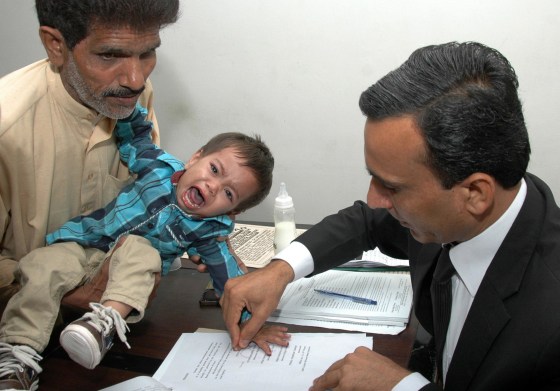
Mohammad Musa Khan appeared in court in the city of Lahore last week, charged with attempted murder along with his father and grandfather after a mob protesting against gas cuts and price increases stoned police and gas company workers trying to collect overdue bills.
"Police are vindictive. Now they are trying to settle the issue on personal grounds, that's why I sent my grandson to Faisalabad for protection," the baby's grandfather, Muhammad Yasin, told Reuters, referring to a central Pakistani city.
Image: A Pakistani lawyer taking the thumb impression from nine-month-old toddler Mohammad Musa KhanAFP - GETTY IMAGES
A Pakistani lawyer taking the thumb impression from nine-month-old toddler Mohammad Musa Khan on a bail bond in Lahore on Saturday.
The baby is on bail and due to appear at the next hearing on April 12 but Yasin said he was not sure if he would take him to court for the case.
"There is immense pressure on me from various corners," he said.
At his first appearance in court last week, Musa cried while his fingerprints were taken by a court official. Later, the baby sucked on a bottle of milk and tried to grab journalists' microphones as his grandfather spoke to the media.
"He does not even know how to pick up his milk bottle properly, how can he stone the police?" Yasin asked journalists at the court last Thursday.
The baby was apparently charged because an assistant sub-inspector complained in a crime report that Musa's whole family had beaten him up and injured his head.
— Reuters

9-month old boy accused of attempted murder in Pakistan


India elections 2014 620 Narendra Modi, a man with a massacre on his hands, is not the reasonable choice for India


Narendra Modi at a business convention in New Delhi, February 2014. Photograph: Reuters
It looks likely that Modi will be India's next prime minister. But his apologists can't dismiss the facts about his rule as chief minister of Gujarat


The world's biggest election began yesterday: one in which more than half a billion Indians are set to turn out to vote over the next six weeks. Polls suggest that the Congress party will take an unprecedented pummelling – which makes Narendra Modi, leader of the Hindu nationalist Bharatiya Janata party, frontrunner to be India's next prime minister.
Modi bears a responsibility for some of the worst religious violence ever seen in independent India – but there's nothing like looking like a winner to attract apologists. And the standard apology for Modi comes in two parts. First, there is normally an acknowledgement that the chief minister of Gujarat bears some vague responsibility for the orgy of killing and rape that engulfed his state in 2002 – but, um, wasn't that all a long time ago? And hasn't he behaved himself since – or, as the FT put it yesterday, done his best to "downplay tensions" between Hindus and Muslims? This is followed by pointing to Gujarat's rapid economic development and an appeal: shouldn't the rest of India enjoy some Modinomics? Or, as Gurcharan Das, the former head of Procter & Gamble India, put it in a piece for the Times of India last weekend: "There will always be a trade-off in values at the ballot box and those who place secularism above demographic dividend are wrong and elitist."
Given the enormity of the allegations against Modi, this is frankly pathetic. First, the Gujarat massacres have not safely been consigned to the past; whatever the claims of his supporters either in India or over here (such as the Labour MP Barry Gardiner who invited him to Britain last year), there has been no "clean chit" for Modi. Courts in India are still hearing allegations against him. And second, the much-talked about Gujarati model may have brought lots of money to the state, but it has ended up in relatively few hands, without yielding improvements in health, infant mortality, or even workers' wages.
Let's look at the carnage of 2002 first. On 27 February that year, a train coach carrying Hindu pilgrims caught fire in Godhra station in Gujarat. Fifty-eight people died. Within hours and without a shred of evidence, Modi declared that the Pakistani secret services had been to blame; he then had the charred bodies paraded in the main city of Ahmedabad; and let his own party support a state-wide strike for three days. What followed was mass bloodshed: 1,000 dead on official estimates, more than 2,000 by independent tallies. The vast majority of those who died were Muslim. Mobs of men dragged women and young girls out of their homes and raped them. In 2007, the investigative magazine Tehelka recorded boasts from some of the ringleaders. One, Babu Bajrangi, boasted of how he slit open the womb of a pregnant woman.
When BJP supporters try to dismiss the pogrom of 2002 as ancient and contested history, what they are trying to erase is that epic, shameful violence. Other allegations have been made about Modi's direct involvement in the carnage, but the ones I have listed above aren't contested by any serious observer.
Now try this thought experiment. Imagine if, in the wake of 7/7, which killed 52 civilians, Ken Livingstone had not behaved with his commendable dignity, but had immediately blamed the tube attacks on jihadis; paraded the bodies up and down Pall Mall; and then declared a capital-wide strike. As Suresh Grover, the human-rights campaigner working for the families of three British citizens who were killed in Gujarat in 2002, puts it, he would have probably been arrested for wilful neglect of duty, hate speech and for inciting violence. Modi, by contrast, said a couple of years ago that he felt the same pain over the bloodshed as a passenger in a car that has just run over a puppy. He referred to the refugee camps set up to shelter some of the 200,000 Muslims who lost their homes as "baby-making factories". And his minister for women is now serving 28 years in prison for murder and conspiracy to murder.
All of this is routinely summed up in journalistic shorthand that refers to the chief minister as being a "polarising" or "controversial" figure.
As for the so-called Gujarati development model, there isn't one. The state has enjoyed growth but very little development. Under Modi, it has lagged behind the other major states in India in tackling infant mortality, in reducing poverty, and in increasing literacy. In 2006, there were even more undernourished children in Gujarat than in 1993, which Modi has claimed is because middle-class girls are "beauty-conscious".
Big businesses back Modi, but that is because he gives them so much. As a string of reports from the independent Comptroller and Auditor General, among other bodies, points out, his administration has sold off public land dirt cheap to industrialists, provided companies with energy at below-market prices and given them loans at an interest rate of 0.1%. They in return have provided him with sponsorship and rides in their private jets. As Atul Sood, a professor at Jawaharlal Nehru University in New Delhi, has written: "The governance model of Gujarat is all about aggressive implementation of development on behalf of the big private investor. It is a model that works for the rich and against the poor."
And this somehow represents an improvement for India.