Search This Blog

Tuesday, July 22, 2014

Judges grant secret court hearings


Justice Secretary Chris Grayling said five applications had been made by the Government for evidence to be heard in secret courts over the past year

Secret court hearings were granted by judges to the Government in at least three of its five attempts to secure them during the first year of controversial new laws being in place.

Ministers' applications for closed material proceedings (CMP) - allowing evidence to be heard in private - were accepted in cases involving an IRA mole suing MI5, terror suspects alleging British complicity in their torture in Somaliland, and Iranian shipping officials who were listed as having their assets frozen due to suspected involvement in nuclear proliferation activity.

Under the Justice and Security Act 2013, powers were granted for judges to grant secret hearings for evidence that may jeopardise national security if heard in public.

Justice Secretary Chris Grayling announced that between June 25 2013, when the powers came into force, and June 24 this year, ministers made five applications for CMP.

In the same period, a decision whether to grant one of the applications was made in secret, while another application - involving British terror suspects Mohammed Ahmed Mohamed and a man known only as CF - was granted publicly.

Since June 24, judges have granted permission for secret hearings in two of the other cases.

On July 8, Home Secretary Theresa May won a top judge's permission to use secret court hearings to defend a damages claim brought by IRA mole Martin McGartland.


Mr McGartland is suing MI5 for breach of contract and negligence in his aftercare following a shooting by the IRA which left him unable to work.

A former agent of the Royal Ulster Constabulary Special Branch, Mr McGartland claims the security services failed to provide care for post-traumatic stress disorder and access to disability benefits.

Mr Justice Mitting said "sensitive material" relating to protection and the training of security service "handlers" arose in the case and that secret hearings could be used in the interests of national security.

On July 11, court documents show the Government was granted secret hearings in a case involving members of the Islamic Republic of Iran Shipping Lines, who are seeking damages from the Foreign Office for loss of earnings after being included on a frozen assets list for their alleged involvement in "proliferation-sensitive nuclear activities and the development of nuclear weapon delivery systems".

Source: belfasttelegraph.co.uk

Friday, June 20, 2014

Kenyan security forces kill coastal-massacres suspects

Kenya’s Interior Ministry on Thursday said security forces have killed five people suspected of involvement in bloody attacks on two coastal towns that left 65 people dead.


In a tweet posted on its official Twitter account, the ministry said “five suspected attackers shot dead while escaping, three AK 47 guns and several ammunitions recovered”.
It said the incident took place in Lamu County, where the two attacks took place.
Somali Islamist group al Shabaab has claimed responsibility for the attacks in the town of Mpeketoni on Sunday night and the nearby village Poromoko on Tuesday morning. Kenyan President Uhuru Kenyatta has denied that, instead attributing the bloodshed to his rivals and calling it “politically motivated ethnic violence against the Kenyan community”.
He said on Tuesday, “This, therefore, was not an al Shabaab terrorist attack. Evidence indicates local political networks were involved in the planning and execution of the heinous crime. This also played into the opportunist network of other criminal gangs.”
There are fears that Kenyatta’s comments could further stoke political tensions in a country where allegiances generally run along ethnic lines. But analysts say that, by blaming the attacks on domestic rivals, Kenyatta could ease pressure on his government, which has been strongly criticised about its handling of security and the threat from Somali-linked militants.
Kenyatta, an ethnic Kikuyu, appeared to direct his comments at his opponent and main presidential challenger in last year’s election, Raila Odinga, an ethnic Luo, who returned to Kenya in May after a long period abroad, although the president did not mention him by name.
In a Monday statement condemning the Mpeketoni attack, Odinga said, “This is not time for blame games... We must as leaders and as a nation rally together to respond to this serious national tragedy.”
An upsurge in violence
In the attack on Mpeketoni, near the popular tourist attraction of Lamu town, gunmen killed 49 people by targeting football fans watching a World Cup match in a television hall as well as two hotels, a police post and a bank. Barely 24 hours later, attackers then raided the nearby Poromoko village, going from house to house killing people and ordering residents to recite an Islamic creed.
Kenya has blamed al Shabaab for a spate of gun and bomb attacks in recent months.
The country also holds al Shabaab responsible for last year’s massacre in Nairobi’s Westgate shopping mall in which 67 people were killed.
Al Shabaab has said its attacks are intended to punish Kenya for sending troops to Somalia to confront its Islamist fighters. Kenya has previously said it would keep its troops in Somalia.
But violence between different ethnic groups is not uncommon in Kenya either. Tribes of Somali origin and other ethnic groups have in the past fought over land and other issues, though that has mostly occurred in Kenya’s lawless northern border area.
After the 2007 presidential vote in Kenya, ethnic tensions erupted into violence that killed about 1,200 people.

Thursday, June 19, 2014

Who should govern Somalia: Somalis or the UN?


Reporter
Al-Shabaab's attack on Kenya over the past two nights, in which more than 60 were killed, shows the group still poses serious threat to the region's stability, writes Jamal Osman.
News
Last week the UN Special Representative for Somalia, Nicholas Kay spoke at Chatham House. The talk was about the country's successes and the difficulties it faces: the role of the UN mission in Somalia (Unsom) and the "political in-fighting within the government".
But there's in-fighting elsewhere that he would have been unlikely to mention: the power struggle between the UN and the current government. It comes down to who should govern Somalia: Somalis or foreigners?
Mr Kay is seen as the most powerful man in the country. He is accused of undermining the government, siding with Somalia's archenemies, Ethiopia and Kenya, blackmailing and threatening those who oppose him, including the president, and generally using divide-and-rule tactics.
This is a critical year for Somalia. The people have set themselves an ambitious agenda for reform.Aleem Siddique, Unsom
Responding to the allegations, Aleem Siddique, Unsom spokesperson said: "The United Nations is mandated to support and help co-ordinate international assistance for Somalia's state and peace building efforts.
"This is a critical year for Somalia. The people have set themselves an ambitious agenda for reform. Unsom is committed to supporting these efforts, guided by the principles of Somali ownership and leadership to restore peace and stability for all Somali people."
With no functioning central authority caused by the country's two-decade-long war, most local administrations receive some sort of financial or military support from foreign entities. Therefore, as a matter of fact, non-Somalis have leverage in the country.

'Yes men'

For instance, the current central government in Mogadishu cannot survive without the backing of the African Union forces, which is part of a UN mission.
Relying on external actors means that, in Somalia, all want to have influence. The main players are the UN, the US, the EU, international NGOs, the African Union, neighbouring countries, Arab nations and Turkey, a relative newcomer.
In public, all of them say they have the same vision, but the reality is that they have their own agendas and interests, which at times collide.
Abukar Arman, a writer and former Somali diplomat thinks the whole problem is that "there is no clear demarcation of executive authority" between top two Somali leaders and also amongst key international bodies.
[Authority in Somalia] boiled down to a game of diplomatic stare-down that sidelines the one who blinks first.Abukar Arman
"So, it boiled down to a game of diplomatic stare down that sidelines the one who blinks first. Meanwhile, the Somali government functions within said power dynamic and blinks on most occasions."
But some believe that the current leaders want to look different to their predecessors, whom the Somali public regarded as "yes men".
The local media often analysis Mr Kay's appearances, speeches and photo-shoots with foreign players. And people become suspicious when he's pictured comfortably sitting with Ethiopian or Kenyan leaders, Somalia's foes.
What's more, Somalis are uneasy with the UN man speaking on behalf of them on international arenas, especially when there is a government that should be playing that role.
Senior government officials told me that they have even considered filing an official complaint against the UN man in the hope of changing him.

'Decades of bloodshed'

Somalia faces numerous obstacles in its desire to end decades of bloodshed. Some are obvious, others not. Current leaders accept they cannot achieve progress without outside help.
But they would like to claim some sort of ownership of the process. They also feel that the very people who were supposed to support them are sabotaging the system for their own sake.
As Mr Arman puts it, there are "some influential elements - domestic and foreign profiteers - who are hell-bent on keeping business as usual".
Meanwhile, ordinary Somali citizens who suffer most are holding onto their hope for a better tomorrow. It's those civilians that decision makers should be thinking about.

Scottish independence: Post-referendum agreement reached

'


The referendum will be held on 18 September, with voters asked the Yes/No question: "Should Scotland be an independent country?"

The UK and Scottish governments have finally agreed a form of words to explain what will happen after the independence referendum.
Their explanation of the processes that will be followed in the event of either a "Yes" or a "No" vote will be included in an Electoral Commission information leaflet.
The commission had asked the two governments to come up with a joint statement by last Christmas.
But negotiations took much longer.
The agreed statement stressed that the result of the referendum will be decided by whichever side receives the most votes.
It said: "If more people vote 'Yes' than vote 'No' in the referendum, Scotland would become an independent country.
"If more people vote 'No' than 'Yes' in the referendum, Scotland would remain a part of the United Kingdom."
It also emphasised that, in the event of a "Yes" vote, independence will not happen until negotiations between "people representing Scotland and people representing the rest of the United Kingdom" have been completed.
These negotiations would include "discussion about the allocation of assets and liabilities", it added.
In the meantime, Scotland would continue to be part of the UK, with the existing division of powers between Holyrood and Westminster continuing.
After independence, the Scottish government would "become responsible for all aspects of government in Scotland," it stated.
In the event of a "No" vote, the statement said that the UK Parliament and government would continue to be responsible for reserved matters such as defence, security, pensions, benefits and most tax powers while Holyrood would retain control of devolved matters.
The agreement commits the two governments to working together to implement the added powers agreed in the Scotland Act 2012, specifying the enhanced tax powers.
The statement does not mention the Scottish government's proposed date of 24 March 2016 as Scotland's independence day.
It also makes no mention of the offer of more powers from the three main pro-Union parties.
Instead, it states that any further changes to Holyrood powers would "be made by the UK Parliament, seeking the consent of the Scottish Parliament."
The statement will be included in an Electoral Commission pamphlet which will be distributed to homes across Scotland prior to the referendum on 18 September.
The document will also include messages to voters from both the pro-independence Yes Scotland campaign, and Better Together, which supports Scotland remaining part of the UK.

Cost of global violence and conflict reaches $1,350 per person


The last seven years have seen a rapid deterioration in world peace and the cost of global violence was put at $1,350 per person, according to an index measuring world peace as several countries slid down the index into civil war and violence.

The economic cost of dealing with world violence stood at $9.8 trillion, or 11.3 percent of total global economic output – as much as the economies of Britain, France, Germany and Italy combined, according to new research by the Institute for Economics and Peace (IEP).The last seven years have seen a rapid deterioration in world peace and the cost of global violence was put at $1,350 per person, according to an index measuring world peace as several countries slid down the index into civil war and violence.

The pattern reversed the 60-year trend in more peace after the end of World War II.

The index was measured gauging conflict, unrest, safety and security as well as militarization and defense spending.

“Given the deteriorating global situation we cannot be complacent about the institutional bedrocks for peace,” said Steve Killelea, the IEP’s executive chairman, Reuters reported.

“This is a wakeup call to governments, development agencies, investors and the wider international community that building peace is the prerequisite for economic development,” he added.

The decline in world peace is not being felt round the world evenly. While 51 countries had improved levels of peace since 2008, 111 had deteriorated.

Syria has pushed Afghanistan out of the No. 1 spot for the world’s least peaceful nation, as the bloody civil war continues there for a third year.


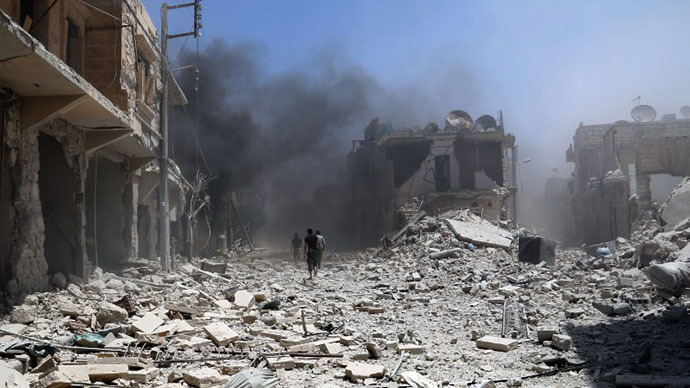
Rubble covers the street following an alleged airstrike by a Syrian army helicopter in the northern city of Aleppo, on June 11, 2014. (AFP Photo / Zein al-Rifai)


Iraq was ranked 159 out of 162 countries before the latest bloodshed unleashed by the ISIS Sunni militants.

South Sudan, the world’s newest country, came 160 as it slides towards a full-blown tribal civil war just three years after its birth, which was itself a result of a lengthy conflict with northern neighbor Sudan.

Elsewhere in Africa, the Central African Republic saw a marked deterioration in peace, although Somalia and the Democratic Republic of Congo have been locked in violent internal conflict for a number of years, so their low peace rankings were not a surprise.

Perhaps a surprising country that has slid down the index is Russia, as the domestic political situation and relations with neighboring Ukraine begin to take their toll. Ukraine itself also became less peaceful.

Other countries that have seen a marked deterioration in peace were Libya and Egypt. In China, increased military spending saw it drop to 108th position.

The IEP predicts that things could get worse, with 500 million people living in countries at risk of becoming less peaceful.

Despite the crisis in Ukraine, Europe was still the most peaceful area of the world, with 14 of the 20 most peaceful countries.

The UK saw an improvement in peace levels over the past decade and saw the largest drop in total crime of all European countries. Although London has become safer, certain areas such as Hackney, Lewisham and Lambeth remain the most dangerous areas of the country.

Violent crime and homicide was about 10 times higher in the US than the UK, although overall the US has become more peaceful in the last 20 years.

Peace levels in the US varied markedly by state, with Louisiana the least peaceful state for the 20th year running and the South having the highest rates of homicide, incarceration and violent crime.
In contrast the most peaceful states such as Maine and Vermont had better economic opportunities and higher levels of educational attainment.

Iceland is still the most peaceful country on earth

How Kenya made itself vulnerable to terror


A man observes the remains of destroyed vehicles and buildings in the Kenyan town of Mpeketoni, about 60 miles  from the Somali border. Well-armed assailants attacked the coastal town for hours, setting two hotels on fire and spraying bullets into the street, killing dozens. (Associated Press)
 
When Kenya took its anti-terror war to the doorsteps of the al-Qaeda-linked al-Shabab in Somalia in 2011, its mission was to cripple and wipe out the militants.

The military incursion was launched after the Muslim extremists kidnapped several tourists and virtually brought tourism in Kenya, one of the country’s top foreign exchange earners, to its knees.

Initially, the war paid handsome dividends, with al-Shabab being pushed away from the Kenyan border and eventually being routed out of Kismayo — a Somali city, whose port the group exploited to finance its terrorist network in East Africa. For months, Kenyan defense forces and the African Union Mission in Somalia (Amisom) thought they had dealt a serious blow to their enemy.

But the celebration was short-lived. In early 2012, al-Shabab started turning the tables on Kenya by attacking areas inside the East African economic powerhouse. The group also abandoned conventional warfare and adopted an asymmetric, hit-and-run approach using its cells in Kenya.

The spate of attacks, aimed at forcing Nairobi to withdraw its troops from Somalia, have continued to date, with the worst being the slaying of 67 people in a four-day siege of Nairobi’s Westgate Mall in September.

The Kenyan forces are searching door-to-door for Somali-linked militants responsible for killing at least 15 people along the coast on Monday. 
 
In the latest attack, on June 15, at least 48 people were killed when more than 50 militants attacked Mpeketoni township in Lamu, 80 miles from the Kenya-Somalia border, with explosives and guns.

But if Kenya could pursue the terrorists in Somalia, why has it failed to stop them from slaughtering people within its borders? Al-Shabab is having a field day in Kenya because of serious failures in the country’s security apparatus and governance. The weaknesses can be summarized as follows:

•Weak security intelligence: Most attacks, including the latest in Mpeketoni, caught Kenya’s National Intelligence Service (NIS) on the back foot. The performance of the intelligence agency has come into question in recent months, and some Kenyan politicians have called for the firing of its head, Michael Gichangi, who is accused of failing to help security agencies stop terrorists in their tracks. The agency has failed to rise to the occasion even when foreign intelligence agencies warn of imminent attacks. Last month, for instance, the United States and Britain advised their citizens to leave Kenya in anticipation of terror attacks. A day before the Mpeketoni bloodbath, the Standard newspaper reports, Britain closed its consulate in Mombasa for fear of attacks. Despite these red flags, NIS seems not to have been bothered after President Uhuru Kenyatta slammed the West over the travel advisories.

•Rank corruption: For the past three years, Transparency International has ranked police and the immigration department among the most corrupt institutions in Kenya. Terror masterminds have capitalized on endemic graft to advance their agenda. Terror suspects have, for instance, walked to freedom after bribing police officers. On the other hand, some officers working for the immigration and registration of persons department have been prosecuted for issuing Kenyan identification documents to illegal foreigners from Somalia —  some of whom turn out to be al-Shabab terrorists.

•Poor anti-terror strategy: Kenya’s anti-terror plan has all the hallmarks of firefighting. Security agencies have been swinging into action, and at times violating human rights, after terrorists hit their targets. In the aftermath of an April grenade attack in downtown Nairobi, for example, Kenyan security agencies roughed up and detained more than 600 people for allegedly lacking proper documents.

The majority of those seized in the operation, code-named “Usalama Watch,” were from the ethnic Somali community, and Somali leaders accused the government of ethic profiling. This has given rise to bad blood between police and members of the community. Al-Shabab has  called for an end to this harassment in its list of demands to Kenya if Nairobi wants the group to halt its murderous mission in Kenya, as Daily Nation reports.

•Poor and inadequate equipment: Kenya's police, charged with maintaining homeland security, lacks modern machinery to deal with new security threats such as terrorism. Budget constraints and rank corruption have conspired to deny the officers sophisticated weapons to match the firepower of terrorists. Many police stations across the country lack basic equipment. In March, the Associated Press revealed that the anti-terror police unit in Nairobi was operating on a budget of $735 per month. In comparison, parliamentary salaries and allowances total about $15,000 per month, per representative. Poor pay and lack of basic amenities have demoralized the officers, and some are thought to be rocking the anti-terror boat from within.

•Messy investigations: Like a ritual, the Kenyan government has been promising to “leave no stone unturned” and ensure “terrorists are brought to book” whenever an attack occurs. In many cases, this has turned out to be hot air because investigations end up hitting dead ends because of poor handling. In some scenarios, indiscriminate arrests leave police with the wrong suspects, and many cases in court flop because of lack of evidence.

•Poor local and regional cooperation: In the aftermath of the Westgate Mall attack, it emerged that the National Intelligence Service had warned security agencies of a possible attack. This warning was ignored because of poor coordination between NIS and police.
Regionally, Horn of Africa states have not been sharing intelligence on terrorism as much as they should. Kenya, Ethiopia, Uganda, Tanzania, Rwanda and Burundi are fighting a common enemy, but there has been little cooperation.

There is some hope though. Kenya and East African states seem to have learned their lessons the hard way and are working to right their mistakes. Kenya, for instance, has launched an ambitious plan to install CCTV cameras in all major towns. Kenyatta is also planning to shake up the security system amid the ongoing police reforms.

Regionally, East African Community states have agreed to implement a common anti-terrorism strategy to combat terror and other transnational crimes.

Harry Misiko, a copy editor at the Nation Media Group in Nairobi, is a 2014 Alfred Friendly Fellow at The Post. E-mail: harrison.misiko@washpost.com

Scottish independence: Unison leader to vote Yes

ALEADING trade union official said he is backing independence to create a fairer Scotland with more decisions taken “in favour of working people”.


Stephen Smellie, deputy convenor of Unison, will vote Yes in the independence referendum. Picture: Ed Jones

Stephen Smellie, the deputy convener of Unison in Scotland, will publicly state his support for a Yes vote in the referendum at the union’s national conference in Brighton.

With exactly three months to go until the referendum on September 18, the pro-independence Yes Scotland campaign published new poll findings showing most people in Scotland want decisions over economic policy and welfare to be taken by the Scottish Parliament, rather than at Westminster.

Excluding those who are undecided, 72 per cent of people want these decisions taken by Holyrood, while 28 per cent believe they should be made in London, the Panelbase study found.

Among Labour supporters, 68 per cent support decisions on economic and welfare policy being made in Scotland, when those who did not know were factored out, with a similar figure of 67 per cent among Liberal Democrat voters.

Mr Smellie will set out his reasons for backing independence when he addresses a fringe event at the Unison conference.

Speaking ahead of his speech, he said: “As a trade unionist I look to see where I will be able to negotiate a better deal. In an independent Scotland the trade unions will be more influential than is possible at a UK level.

“Having spent years arguing for a better, more just and fairer Scotland, I do not believe all those people and organisations who have worked for fairness will let the politicians simply get on with it. In alliance with voluntary groups, communities, churches and progressive forces, trade unionists will be able to ensure that decisions taken by government will be more often in favour of working people, of communities, of sustainability, of peace, of justice. These decisions will be fairer.”

Mr Smellie, who is a Labour member, said a Yes vote would make his party stronger.
“The kind of Labour Party needed to champion interests of working people is more likely to develop in an independent Scotland than in the current UK,” he stated.

“The Scottish trade unions have it in their power to make sure this happens.”

He also hit out at the industrial climate, saying at the moment it could be “difficult, no doubt, to stand up to the rich and powerful people who would not shirk from threatening to destroy our economic base if we do not dance to their tune”.

Mr Smellie added: “That is what happened at Grangemouth [oil refinery] last year. The UK political class have created an environment where companies can do this. However, in an independent Scotland there is a chance to construct a social solidarity that would say to [Grangemouth owners] Ineos and others; we are not prepared to let you destroy our economy, our jobs and our community.”

Yes Scotland chief executive Blair Jenkins welcomed Mr Smellie’s comments, adding: “It is a significant feature of the Yes movement that so many prominent Labour figures are joining the campaign, because they realise that independence is the best way to use our vast wealth and resources for the benefit of all people in Scotland.

“The latest poll shows that 34 per cent of Labour voters currently plan to vote Yes in September - a figure which we believe will continue to grow.

“And new poll findings today show overwhelming support for the proposition that people in Scotland will be better off if decisions about economic policy and welfare are taken in the Scottish Parliament, rather than by Westminster. Excluding people who are undecided, 72 per cent back Holyrood and just 28 per cent favour Westminster - including big majorities among Labour and Lib Dem voters.”

OPINION: China Becomes Latest World Power to Oppose Scottish Independence


GLASGOW, (RIA Novosti), Mark Hirst – The Chinese Premier’s rejection of Scottish independence reflects the views of many Chinese students and members of the Scots-Chinese community, a Glasgow based Chinese academic has told RIA Novosti.
Yajun Deng of Glasgow Caledonian University said, “The attitudes of Chinese and other international students are very similar to the debate in Scotland about independence.”
“International students are very mobile and can easily alter which universities they apply to, so I think Scottish independence would have an immediate effect on the number of Chinese students applying to study here,” Deng told RIA Novosti.
Deng’s comments follow a visit by Chinese Prime Minister Li Keqiang to London where he met his British counterpart, David Cameron.
After the meeting Li told reporters his country wanted to see a “strong, prosperous and united United Kingdom".
"I believe that the United Kingdom can stay at the forefront in leading the world's growth and development and also continue to play an important and even bigger role for regional stability and global peace,” Li added.
Scottish First Minister and leader of the pro-Scottish independence political party, Alex Salmond, responded by saying, “Premier Li is of course entitled to his views, and it is noteworthy that he made clear the Chinese Government will 'respect the choice' which the people of Scotland make this September whatever it may be.”
The Chinese Premier’s comments follow those made by US President Obama, former US Secretary of State, Hilary Clinton and the Swedish Foreign Minister, Carl Bildt, who all gave their backing to Scotland remaining within the United Kingdom.
In a reciprocal statement issued after Li expressed his view on Scottish independence the UK Government confirmed its opposition to Tibetan independence and said, “the UK recognizes that Tibet is part of the People’s Republic of China and does not support Tibetan independence.”
Earlier this year Deng authored a report following a study of Chinese students examining their attitudes to Scottish independence. It found that 45 percent of Chinese students would be less likely to come to Scotland if the country became independent.
Deng told RIA Novosti that many students associated Scotland with its distinct culture and landscape rather than the quality of its education system, with one respondent replying, “Scotland has the skirts for males with beautiful scenery, but England is the main part of the UK.”
Scottish voters will take part in a referendum on 18 September and will be asked one question, "Should Scotland become an independent country?"

en.ria.ru