Search This Blog

Wednesday, May 14, 2014

Protests Grow Over Addis Ababa's Expansion


Addis Ababa is growing fast and set to expand further, pitting the government against Oromo activists, seeking to protect their rights.
Gambia Street in downtown Addis Ababa, Ethiopia, bustles with traffic. Credit: David Stanely
Ethnic Oromo students in Ethiopia are ratcheting up opposition to the territorial expansion of the Horn of Africa nation's capital, Addis Ababa. Thousands of students at all eight regional universities in Oromia, the largest of Ethiopia's federal states, turned in recent days to demand an immediate halt to the city's so-called "Integrated Development Master Plan," unveiled earlier this month.
Today, Tuesday 29 April, an estimated 25,000 people, including residents of Ambo town in central Oromia, participated in a city wide demonstration, in the largest show of opposition to the government's plans to date. A handful of students have been injured and others arrested in protests at the campuses of Jimma, Haromaya, Ambo, Wollega, Metu, Bule Hora, Adama and Maddawalabu universities, according to local reports.
Once dubbed a "sleeping beauty," by Emperor Haile Selassie, Addis Ababa is an awakening city on the move. Vertically, buoyed by a growing economy and rural to urban migration, there is construction almost on every block — so much so that locals refer to it as “a city underconstruction.” The country’s first light rail transit which will connect several inner city neighbourhoods, being constructed with the help of the China Railway Group Ltd, is reported to be 60% complete. Horizontally, over the last decade, not least due to an uptick in investment from returning Ethiopian expats from the U.S. and Western Europe, the city has expanded at a breakneck pace to swallow many surrounding towns.
Addis Ababa’s rapid urban sprawl is also getting noticed abroad. In 2013, it's the only African city to make the Lonely Planet's annual list of "top 10 cities to visit." In April 2014, in its annual Global Cities Index, New York-based consultancy A.T. Kearney named Addis Ababa, “the third most likely city to advance its global positioning” in sub-Saharan Africa, only after Johannesburg and Nairobi. If it maintains the pace of development seen over the last five years, Kearney added, “the Ethiopian capital is also among the cities closing in fastest on the world leaders.”

Overlapping jurisdictions

Founded in 1886 by emperor Menelik II and his wife Empress Taytu Betul, Addis Ababa sits at the heart of the Oromia Regional State. According to the country’s constitution, while semi-autonomous, Addis Ababa is treated as a federal district with special privileges granted to the Oromia region, for which it also serves as the capital.
The Addis Ababa City Administration, the official governing body, has its own police, city council, budget and other public functions overseen by a mayor. The overlapping, vague territorial jurisdictions have always been the subject of controversy. Now contentions threaten to plunge the country into further unrest.
Home to an estimated 4 million people, Addis Ababa offers Ethiopia one of the few gateways to the outside world. The state-run Ethiopian airlines, one of the most profitable in Africa, serves 80 international cities with daily flights from Addis to Europe, different parts of Africa, the United States, Canada, Asia and the Middle East.
In addition to being the seat of the continental African Union, the city hosts a number of United Nations regional offices, including the United Nations Economic Commission for Africa. There are also more than 100 international missions and foreign embassies based in Addis, earning it the nickname of 'Africa's diplomatic capital.' All these attributes require the city to continually grow to meet the needs and expectations of a global city.
City officials insist the new “master plan”, the 10th iteration since Addis Ababa began using modern city master plans in 1936, will mitigate the city’s disorganised growth and guide efforts to modernize it over the next 25 years.
According to leaked documents, the proposed plan will expand Addis Ababa's boundaries to 1.1 million hectares, covering an area more than 20 times its current size. Under this plan, 36 surrounding Oromia towns and cities will come under Addis Ababa's jurisdiction. Oromo students, opposition and activists say the plan will undermine Oromia's constitutionally granted special interest.

A history of problematic growth 

Addis Ababa’s spatial growth has always been contentious. The Oromo, original inhabitants of the land, have social, economic and historical ties to the city. Addis Ababa, which they call Finfinne, was conquered through invasion in 19th century. Since its founding, the city grew by leaps and bounds. But the expansion came at the expense of local farmers whose livelihoods and culture was uprooted in the process. At the time of its founding, the city grew "haphazardly" around the imperial palace, residences of other government officials and churches. Later, population and economic growth invited uncontrolled development of high-income, residential areas — still almost without any formal planning.
While the encroaching forces of urbanisation pushed out many Oromo farmers to surrounding towns and villages, those who remained behind were forced to learn a new language and embrace a city that did not value their existence. The city’s rulers then sought to erase the historical and cultural values of its indigenous people, including through the changing of original Oromo names.
Ultimately, this one-time bountiful farm and pasture land from which it draws the name Addis Ababa – meaning ‘new flower’ – where Oromos made laws under the shades of giant sycamore trees, grew foreign to them by the day. It is this traumatic sense of displacement that elicits deep passions, resentment and resistance from the Oromo community. The Oromo are Ethiopia's single largest ethnic group, numbering over 25 million - around 35% of the total population - according to the 2007 census.
Ethiopia’s constitution makes a pivot to Addis Ababa’s unique place among the Oromo. Article 49 (5) of the constitution stipulates, “the special interest of the state of Oromia with respect to supply of services, the utilisation of resources and joint administrative matters.” 
The Transitional Government of Ethiopia, which drafted the constitution, was fully cognisant of the potential conflicts of interest arising from Addis Ababa’s unbridled expansion, when it decided “to limit its expansion to the place where it was before 1991 and to give due attention to its vertical growth,” according to Feyera Abdissa, an urban researcher at Addis Ababa University.
But in the city's 1997-2001 master plan, which has been in effect over the last decade, the city planners determined vertical growth posed key urbanisation challenges. In addition, most of Addis Ababa's poor cannot afford to construct high-rise dwellings as per the new building standards. Officials also noted that the city’s relatively developed infrastructure and access to market attract the private investment necessary to bolster its coffers; the opening up to privatisation contributed to an upswing in investment. According to Abdissa, during this period, “54% of the total private investment applications submitted in the country requested to invest in and around Addis Ababa.” In order to meet the demand, city administration converted large tracts of forest and farmland in surrounding sub-cities into swelling urban dwellings, displacing local Oromo residents.

Local self-rule

In 2001, in what many saw as a conspiracy from federal authorities, the Oromia regional government decided to relocate its seat 100kms away, arguing that Addis Ababa was too “inconvenient” to develop the language, culture and history. The decision led to Oromia-wide protests and a brutal government crackdown, which left at least a dozen people, including high school students, dead. Hundreds of people were also arrested. In 2005, regional authorities reversed the decision amid internal pressures and protracted protests in the intervening years.
But the current opposition to the city's expansion goes far beyond questions of self-rule. Each time Addis Ababa grew horizontally, it did so by absorbing surrounding Oromo sub-cities and villages. Many of the cities at the outskirts of the capital today, including Dukem, Gelan, Legetafo, Sendafa, Sululta, Burayu, Holeta and Sebeta, were one-time industrious Oromo farmlands. While these cities enjoy a level of cooperation with Addis Ababa on security and other issues of mutual interest, they have all but lost their Oromo identity. If the proposed master plan is implemented, these cities will come directly under Addis Ababa City Administration — thereby the federal government, further complicating the jurisdictional issue. 
Among many other compromises made possible by Ethiopia’s ethnic federalism, each state has adopted the use of its native tongue as the official language of education, business and public service. In theory, the country’s constitution also grants autonomous self-rule to regional states. Under this arrangement, each state makes its own laws and levy and collect taxes.
In contrast, municipalities that fall under federal jurisdiction, including Addis, are governed by their own city administrations and use Amharic, Ethiopia’s federal working language. For the Oromo, as in the past, the seceding of surrounding towns to Addis means a loss of their language and culture once more, even if today’s driving forces of urbanisation differ from the 19th century imperialist expansion.
As seen from its recent residential expansions into sub-cities on the peripheries such as Kotebe, Bole Bulbula, Bole Medhanialem, Makanisa and Keranyo, the semi-agrarian community, including small, informal business owners, were given few options. The city’s new code requires building high-rises that are beyond their subsistence means. Unable to comply with the new city development code, the locals were pressured into selling their land at very low prices and eke out a living in a city that faces chronic unemployment. As a result, the horizontal expansion and displacement of livelihoods turned a one time self-sufficient community into street beggars and day labourers.
Activists fear that the latest expansion is part of a grand plan to contain a resurgent Oromo nationalism. As witnessed during the 2001 protests, any attempt to alter Addis Ababa's administrative limits, unites Oromos across religious, regional and political divides. Unless halted, with a steam of opposition already gathering in and outside of the country, the ongoing of protests show ominous signs.
In a glimpse of the fervent opposition that could quickly turn deadly, within weeks after the plan was unveiled, two young and upcoming Oromo artists have released new music singles lamenting the city's historic social and cultural heritage. One of the singers, Jafar Yusef, 23, was arrestedthree days after releasing his musical rendition — and has reportedly been tortured. Despite the growing opposition, however, the Addis Ababa municipal authority is vowing to forge ahead with the plan, which they say was developed in consultation with a team of international and local urban planners. Federal Special Forces, known as Liyyu police, who have previously been implicated in serious human rights violations, have been dispatched to college towns to disperse the protests. Soldiers in military fatigues have laid siege to several campuses, preventing students from leaving, according to eyewitness reports.

Trouble at the top while those at the bottom lack the basic necessities 

The city administration is also riddled by a crippling legacy of corruption, massive inefficiency and poor service delivery. Its homeless loiters in the crowded streets that are shared by cars, pedestrians and animals alike. There are few subsidised housing projects for poor and low-income families. Many of the residents lack clean drinking water, healthcare and basic education. While some progress had been made to upgrade the city's squatter settlements, the city is full of dilapidated shacks. Despite poor drainage system and other infrastructural deficiencies, studies show that there is a general disregard for health and environmental hazards in Ethiopia's urban redevelopment scheme.
A lot of these social and economic problems are caused by the city’s poorly conceived but dramatic urban expansion. In the last two-decades, in an effort to transform the city into a competitive metropolis, there have been an uptick in the construction of high-rise buildings, luxury hotels and condominiums, which displaced poorer inhabitants, including Oromo farmers. “No one is ensuring the displaced people find new homes, and there are no studies about what his happening to them,” Mara Gittleman of Tufts University observed.
Regardless, the outcome of the current controversy will likely test Ethiopia’s commitment to ethnic federalism. The advance of the proposed master plan would mean further estrangement between the Oromo masses and Oromia regional government. Long seen as a puppet of the federal regime, with substantial investment in cultural and infrastructural development, regional leaders are only beginning to sway public opinion. Allowing the master plan to proceed would engender that progress and prove suicidal for the Oromo Peoples' Democratic Organization (OPDO), the Oromo element in Ethiopia's ruling coalition. In the short run, the mounting public outcry may not hold much sway. The country’s one-time vibrant opposition is disarray and the ruling Ethiopian People's Revolutionary Democratic Front (EPRDF) has almost complete control of the political system.
The opposition to the expansion plans does not pose an immediate electoral threat to the EPRDF who, controlling the system as they do, are likely to claim an easy victory in next year's elections. However, opposition, and the government's possible aggressive response to it, could make Oromo-government relations more difficult. The government now has a choice, violently crackdown on protestors, labelling them "anti-development", or engage with them as stakeholders representing historically marginalised communities. Ethiopia's federal constitution suggests the latter course of action; sadly, recent history may suggest the former.
Correction 29/4/14: The article originally stated that Jafar Yusef was 29, rather than 23. This has been changed.
Correction 15/5/14: The article originally referred to Bule Hora at Bolu Hora. This has now been changed. We are grateful to the reader who pointed this out.
Think Africa Press welcomes inquiries regarding the republication of its articles. If you would like to republish this or any other article for re-print, syndication or educational purposes, please contact: editor@thinkafricapress.com.

Immunity for government leaders will harm the African court


Pretoria, South Africa - A proposal to give immunity to sitting government leaders before Africa's regional court would be a major setback for justice for grave crimes, African organisations from 19 countries and international organisations with a presence in Africa said in a letter to African governments released yesterday.
Justice ministers and attorney generals of African Union (AU) member countries are scheduled to meet in Addis Ababa, Ethiopia on 15 and 16 May 2014, to consider a draft protocol to expand the authority of the African Court on Justice and Human Rights to include criminal jurisdiction over genocide, war crimes, and crimes against humanity.
A proposal providing immunity for heads of state and senior government officials from prosecution for such crimes is being considered as part of the amended protocol.
'Exempting sitting heads of state and senior government officials from African Court jurisdiction on grave crimes would shield the powerful from the reach of the law,' said Sulemana Braimah, Executive Director of the Media Foundation for West Africa. 'This is fundamentally at odds with the AU Constitutive Act, which rejects impunity.'
The consideration of the draft protocol comes at a time of intense opposition to the International Criminal Court (ICC) by some African leaders, particularly in the face of the ICC's proceedings against Uhuru Kenyatta and William Ruto, who were later elected as Kenya's resident and vice president.
'Impunity remains one of the biggest threats to human rights protection in Africa,' said Thuso Ramabolu, human rights officer at Lesotho's Transformation Resource Centre. 'It's crucial for people responsible for mass atrocities to face justice, irrespective of their official positions. Immunity poses grave alarm and would create an incentive to hold on to power indefinitely.'
International conventions, including the Convention against Torture, the Convention on the Prevention and Punishment of the Crime of Genocide, and the Geneva Conventions of 1949 recognise the imperative of accountability for grave crimes irrespective of the title or position of those responsible. The irrelevance of official capacity before international criminal courts has become entrenched in international law since the post-World War II trials before the International Military Tribunal at Nuremberg.
Immunity with respect to serious crimes is also barred before some domestic courts in Africa.
'Even domestic law in Kenya and South Africa bars immunity for sitting officials before domestic courts on grave crimes,' said Stella Ndirangu, program manager at the Kenyan Section of the International Commission of Jurists. 'African governments should not roll back important progress in ensuring perpetrators can be held to account.'
For media interviews and further information contact:
Jemima Njeri, +27 83 234 6566 or +27 12 346 9500, jnjeri@issafrica.org

Ethiopia: New President for the National Chamber


The Ethiopian Chamber of Commerce and Sectoral Associations (ECCSA) has elected a new president on May 1, 2014.

ECCSA has elected Solomon Afework who was there representing the South Chamber of Commerce and Sectoral Association. Solomon won the election by securing 61 percent of the entire vote to become the successor of Mulu Solomon.

The election held on Thursday was the first of its kind to witness more than 2 nominees for the presidency. Among the nominees it was Abebaw Mekonen who won 72 votes to become the vice president of the Chamber.

Other candidates include, Getachew Ayenew representatives of the Amhara Chamber of Commerce and Sectoral Associations and Tadesse Genna representative of the Oromia Chamber of Commerce and Sectoral Associations who managed to secure only 59 and 48 votes respectively.

According to The Reporter, the election process was controversial and highly contested with instances of procedural irregularities. Individuals who attended the election told the paper, that the result was unexpected.
Source: The Reporter

30 Incorrectly Used Words That Can Make You Look Horrible

Easy to get wrong. And easy to get right

This post is in partnership with Inc., which offers useful advice, resources, and insights to entrepreneurs and business owners. The article below was originally published at Inc.com.
While I like to think I know a little about business writing, I often fall into a few word traps. For example, “who” and “whom.” I rarely use “whom” when I should. Even when spell check suggests “whom,” I think it sounds pretentious. So I don’t use it.

And I’m sure some people then think, “What a bozo.”
And that’s a problem, because just like that one misspelled word that gets a resumé tossed into the “nope” pile, using one wrong word can negatively impact your entire message.
Fair or unfair, it happens.
So let’s make sure it doesn’t:
Adverse and averse
Adverse means harmful or unfavorable; “Adverse market conditions caused the IPO to be poorly subscribed.” Averse means dislike or opposition; “I was averse to paying $18 a share for a company that generates no revenue.”
But you can feel free to have an aversion to adverse conditions.
Affect and effect
Verbs first. Affect means to influence; “Impatient investors affected our roll-out date.” Effectmeans to accomplish something; “The board effected a sweeping policy change.” How you use effect or affect can be tricky. For example, a board can affect changes by influencing them, or can effect changes by implementing them. Use effect if you’re making it happen, and affect if you’re having an impact on something someone else is trying to make happen.
As for nouns, effect is almost always correct; “Once he was fired he was given twenty minutes to gather his personal effects.” Affect refers to emotional states so unless you’re a psychologist, you’re probably not using it.
Compliment and complement
Compliment is to say something nice. Complement is to add to, enhance, improve, complete, or bring close to perfection. So, I can compliment your staff and their service, but if you have no current openings you have a full complement of staff. And your new app may complement your website.
For which I may decide to compliment you.
Criteria and criterion
“We made the decision based on one overriding criteria,” sounds pretty impressive but is wrong.
Remember: one criterion, two or more criteria. Although you could always use “reason” or “factors” and not worry about getting it wrong.
Discreet and discrete
Discreet means careful, cautious, showing good judgment; “We made discreet inquiries to determine whether the founder was interested in selling her company.”
Discrete means individual, separate, or distinct; “We analyzed data from a number of discrete market segments to determine overall pricing levels.” And if you get confused, remember you don’t use “discreetion” to work through sensitive issues; you exercise discretion.
Elicit and illicit
Elicit means to draw out or coax. Think of elicit as the mildest form of extract or, even worse, extort. So if one lucky survey respondent will win a trip to the Bahamas, the prize is designed to elicit responses.
Illicit means illegal or unlawful. I suppose you could “illicit” a response at gunpoint… but best not.
Farther and further
Farther involves a physical distance; “Florida is farther from New York than Tennessee.”Further involves a figurative distance; “We can take our business plan no further.” So, as we say in the South, “I don’t trust you any farther than I can throw you.” Or, “I ain’t gonna trust you no further.”
(Seriously. I’ve uttered both of those sentences. More than once.)
Imply and infer
The speaker or writer implies. The listener or reader infers. Imply means to suggest, while infer means to deduce (whether correctly or not.) So, I might imply you’re going to receive a raise. You might infer that a pay increase is imminent. (But not eminent unless the raise will be prominent and distinguished.)
Insure and ensure
This one’s easy. Insure refers to insurance. Ensure means to make sure. So if you promise an order will ship on time, ensure it actually happens. Unless, of course, you plan to arrange forcompensation if the package is damaged or lost–then feel free to insure away.
Number and amount
I goof these up all the time. Use number when you can count what you refer to; “The number of subscribers who opted out increased last month.” Amount refers to a quantity of something you can’t count; “The amount of alcohol consumed at our last company picnic was staggering.”
Of course it can still be confusing: “I can’t believe the number of beers I drank,” is correct, but so is, “I can’t believe the amount of beer I drank.” The difference is I can count beers, but beer, especially if I was way too drunk to keep track, is an uncountable total–soamount is the correct usage.
Precede and proceed
Precede means to come before. Proceed means to begin or continue. Where it gets confusing is when an “ing” comes into play. “The proceeding announcement was brought to you by…” sounds fine, but “preceding” is correct since the announcement came before.
If it helps, think precedence: Anything that takes precedence is more important and therefore comes first.
Principal and principle
principle is a fundamental; “We’ve created a culture where we all share certain principles.”Principal means primary or of first importance; “Our startup’s principal is located in NYC.” (Sometimes you’ll also see the plural, “principals,” used to refer to executives or (relatively) co-equals at the top of a particular food chain.)
Principal can also refer to the most important item in a particular set; “Our principal account makes up 60 percent of our gross revenues.”
Principal can also refer to money, normally the original sum that was borrowed, but can be extended to refer to the amount you owe–hence principal and interest.
If you’re referring to laws, rules, guidelines, ethics, etc, use principle. If you’re referring to the CEO or the president (or the individual in charge of the high school), use principal. And now for those dreaded apostrophes:
It’s and its
It’s is the contraction of it is. That means it’s doesn’t own anything. If your dog is neutered (that way we make the dog, however much against his will, gender neutral) you don’t say, “It’s collar is blue.” You say, “Its collar is blue.” Here’s an easy test to apply. Whenever you use an apostrophe, un-contract the word to see how it sounds. In this case, turn it’s into it is. “It’s sunny,” becomes, “It is sunny.” Sounds good to me.
They’re and their
Same with these; they’re is the contraction for they are. Again, the apostrophe doesn’t own anything. We’re going to their house, and I sure hope they’re home.
Who’s and whose
“Whose password hasn’t been changed in six months?” is correct. “Who is (the un-contracted version of who’s) password hasn’t been changed in six months?” sounds silly.
You’re and your
One more. You’re is the contraction for you areYour means you own it; the apostrophe inyou’re doesn’t own anything. For a long time a local non-profit had a huge sign that said “You’re Community Place.”
Hmm. “You Are Community Place”?
Probably not.

In the Shadow of the Grand Dam and Addis Ababa, Ethiopia Blooms!


Prof. Tecola W Hagos
By Tecola W Hagos

General

There is no need for mudslinging in our discourse, and that we can be reasonably polite to each other in talking about some of the most complex political, legal, and economic problems facing our beloved Ethiopia. I have read the recent joint article “Misplaced opposition to the Grand Ethiopian Renaisance Dam” by professors Minga Negash, Mammo Muchie, and Seid Hassan in support of the GERD. I have also read “My Takes on the Ethiopian Dam and the Addis Ababa Master Plan,” the criticism of Prof Messay Kebede, the prolific writer and astute public intellectual. There are also no less important articles about Ethiopia using the waters of its own rivers, such as the article “The River Dam” by Prof Mankelklot Haile Selassie.

What we have here for our discussion are two extremely important issues concerning Ethiopia: the use of Ethiopia’s rivers and the issue of proper use of the police power of a sovereign state. Such national questions require proper, may be even enlightened, resolution. I wish my good friend Messay had addressed each of these issues in separate articles. I feel that having such important issues discussed in the same article “My Takes on the Ethiopian Dam and…” might have ended up leveling out each (other), rather than increasing the height of the political cusp.

Having a clear understanding of issues will help us see clearly the problems in connection with such issues. With the exception of Messay and few others who oppose the construction of the Dam because they see it as wasteful and/or provocative to Egypt, I suspect most of those individuals opposed to the construction of the Dam chose to oppose the project as a method of personal political power struggle against “Tygreans” presumed hegemony, despite having a clear understanding of both the legal and economic imperative that justify the construction of the Dam. Such opposition’s power struggle is not limited against those Tygreans in power, but against the entire ethnic group of Tygreans irrespective of the individual Tygrean political stand whether in support or against the TPLF/EPRDF.

How else can one understand the lumping and condemnation of highly visible public intellectuals, such as professors Gelawdewos Araya and Teodros Kiros, in the same pro TPLF boat of fanatics, and me (of less significance compared to the two esteemed intellectuals) who have been in opposition for decades against the EPRDF led Government of Meles Zenawi, as TPLF agents except for narrow ethnicism and hatred of a group?
However, most importantly, I was drawn to Messay’s clarion call in his article for the “unionists” “to become more aggressively engaged in favor of Ethiopian unity” and so to say to come out from the shadows and promote a unitary Ethiopian State. This stand of Messay is a courageous stand for Ethiopia that ought to be appreciated by all who value Ethiopia’s continued survival. I will focus on that call/point in the second half of my comment.

The Reality of the Grand Ethiopian Renaissance Dam

The first part of Messay’s article dealt with the issue of the GERD, which he identified as the “so-called ‘Grand Ethiopian Renaissance Dam.’” There was no need to belittle the Dam in such cynical manner, for it unnecessarily tainted his otherwise excellent article. Already close to forty percent of the construction of the Dam is completed, to the tune of over 30 billion Birr. In other words, most foundational structure is completed and the infrastructure is being constructed. As a matter of common sense, it is too late to decry the construction of the Dam at this stage and time. Although it might be a case of inattentiveness, Messay also adopted the use of the word “Nile“ in connection with the construction of the GERD as the IRN did, in reference to the use of the water of Abay River. Once again I will state with emphasis the fact that Ethiopia is not using the water of the “Nile” but the water of its own river Abay River. The distinction between the term “Nile” i.e., “the White Nile” and the “Abay River” must not be glossed over or overlooked, and such distinctive awareness is the condicio sine qua non of the whole regime of international law, international custom, treaties, diplomatic relations et cetera on rivers like Abay River that cross borders.

At this advanced stage of the construction of the Dam, I suggest that all those who oppose the building of the Dam change their focus from opposition to the construction of the Dam to some form of constructive engagement on how best to finish the Dam and how best to carry out the management and distribution of power from the Dam. There are a number of future construction and management challenges related to the grid system for the Dam, the allocation of power, and the day to day management of such huge project. The inputs from concerned Ethiopians and others that would be affected and also benefit from the Dam project should get involved in constructive discourse. Such concerned individuals must also suggest solutions, for criticism alone will not be of great help. For example, the issue of transparency as to the names and identity of all corporations and/or business organizations (joint ventures, partnerships et cetera) that are working as contractors and sub-contractors, as consultants, and/or in direct iron-work, concrete-powering, digging, earth-moving, et cetera.

Inductive vs deductive and propositional logic/reasoning

I am always worried about the force of seduction of inductive reasoning. It appeals to most anybody not particularly alert against such fallacious process of reasoning. Even the very best among us can be seduced by such reasoning because of its exacting existential appeal to what appears to be real and irrefutable. The seduction of inductive reasoning is truly overwhelming. The individual using such fallacious argument might believe in his reasonableness for the “factual” proof he needs to maintain his assertion seems to be there solidly tangible. The problem is that such alleged “fact” has no real/organic connection with the particular conclusion.

Messay used a classic case of inductive reasoning by writing that “[o]n the other hand, many Ethiopians are understandably apprehensive of the detrimental ecological and social impacts of such a huge project and are skeptical about its economic benefits, a skepticism based on the failures of the experience of huge dams in other African and non-African countries.” [emphasis in the quotation is mine] The problem with all inductive reasoning, as is the case with Messay’s statement, is the lack of causal connection between the alleged empirical evidence and the conclusion asserted or the absence of valid distribution within the premises/terms in the syllogism/propositions and the conclusion, as logicians would put it. Simply put, there is no organic causal connection between the premises and the conclusion. Just because there were several “failures of the experience of huge dams in other African and non-African countries” does not necessarily follow logically that the Grand Ethiopian Renaissance Dam will fail too. This form of inductive reasoning based on past experience must be handled carefully. I see this form of fallacy very often being the case in those who oppose as well as those who support the Regime/Dam.

This form of inductive reasoning creates havoc in the minds of a number of Diaspora agitators whose ideas are as terrible as their English. There is an acute lack of rigorous use of logic as a proper tool of reasoning in most arguments I read by Ethiopian bloggers. Their fallacious reasoning goes like this: Meles Zenawi is part Tigrean, Meles Zenawi was a violent dictator, Tecola is part Tigrean, and therefore, Tecola is a violent dictator. One is not dealing here with distribution of terms or prepositional inferences, but with the alleged facts commonly shared among entities. David Hume challenged the philosophers of his time in that how a clear showing of causes and effects is impossible. To this day, in my humble opinion, no philosopher has refuted or disproved Hume’s challenge.

In this essay, I am not going that far in mystifying cause and effect, but warning us all involved in discourse/argument/debate on issues dealing with the political and economic life of Ethiopia to be extra careful in asserting conclusions that are not properly/organically derivable from the factual matters we claim to be the cases. The confusion of correlation with cause leads to fallacies as deceptive as inductive reasoning. The most obvious fallacy is identified as post hoc, ergo propter hoc, in a form of misapprehension of events not causally connected but appear in sequence or at the same time. Another equally misleading implication is also known in conditional statements as “affirming the consequent” wherein there is no causal connection between the antecedent and the consequent.

In the “Present Perfect” of the GERD

Of all the tenses in the English language “verb” system of conjugation, the present perfect tense is most intriguing and troublesome for both native and non-native speakers. The use of the “present perfect” with the situation of connecting Meles Zenawi with the Dam.as illustrative of the problems may sound that I am trivializing a serious issue for many. To illustrate some of the problems of drawing the deceased Meles to the Dam, I quote here Messay again:

“. It is important that we resist the temptation of separating the dam from Meles’s megalomania if only because it gives the reason why alternative proposals that would be less costly and more in tune with the environment and the interests of surrounding people were discarded in favor of the Grand Renaissance Dam.”

An activity that started sometime in the past and ended before some other activity, such as the death of Meles, for example, is considered to be in the past perfect, meaning such activity is done with, and completely over. In other words, whether the Dam was conceived of as a result of Meles’s vanity, is in the “past perfect,” with no real connection with the reality at hand.

The reality at hand is not the “vanity” of Meles Zenawi, but the hostility of our historic enemies the Egyptians, the Arabs in general, and our own political ineptitude.

Moreover, the problem of ethnic based federalism is the single most destructive legacy of Meles Zenawi that is in the “present perfect” unlike his alleged “vanity” in the construction of the Dam. I am not trying to drag out Meles Zenawi from his crypt in order to pound on him, but that his policies are very much alive in the hands of his successors that it is humanly impossible to avoid his shadow-presence in the current Ethiopian Government. I would have loved to leave him to his eternity to rest in peace. I cannot look the other way when his full-length portrait is right there in the Hall of Representatives, keeping an eye on his successors. And we are also bombarded by Prime Minister Hilemariam Desalgn in his nauseating reference to Meles Zenawi in public speeches “as our great leader.”

State Development and Sovereignty

Sovereignty of a nation is truly primordial as opposed to most other attributes of nationhood. When it comes to the sovereignty and territorial integrity of Ethiopia, Messay and I are on the same platform. My views on national unity is no different in concept than that of Messay. Article 39 of the 1995 Constitution must be abrogated first and foremost before we start to tackle meaningfully the de-Kililization of the nation and start the building of a nation based on individual political and human rights. Getting rid of Article 39 first is essential as a matter of strategy.

The recent tragedy of the loss of life during the several demonstrations by university students in “Oromo State/Kilile” is one serious warning of future disaster due to the political structure created by the 1995 Constitution. However, no violent action against student demonstrators is justifiable even if there was violence and looting on the part of demonstrators or individuals that are not students who took advantage of the situation. The proper crowed control of such destructive behavior could be through massive police/security presence rather than shooting at demonstrators/people.

At any rate, the Federal Government should have anticipated such reactions from some dissenters and used the public forum to inform the public of its extensive development project of the planned integration of Addis Ababa (and not territorial expansion) with satellite urban centers and suburbia. If the issue was of territorial expansion and changing hither too agreed boundaries between States/Kilils one must follow the procedures laid out in the Constitution and secondary legislations. Nothing in the 1995 Constitution forbids the Federal Government of Ethiopia from reorganizing territorial borders between States/Kilils.

The 1995 Constitution is notoriously poorly written and poorly structured. There are numerous unresolvable questions in regard to allocation of sovereign power between the Federal and State/Kilil governments. For example, the removal of Ethiopians from particular State/Kilil on the basis of ethnic identity is nowhere authorized by the Constitution, even though the past administration of Meles Zenawi allowed massive uprooting of Ethiopians from their farms and homes based on their ethnic identity. The current Government of Hailemariam Desalegn started out by condemning such ethnic cleansing addressing the victims of ethnic cleansing who were removed by force to Bahr Dar. However, the Government of Hailemariam Desalgn seems to be retreating from such clear stand in the Ambo situation.

I am also concerned with the exorbitant amount of money being expended on Addis Ababa that tops billions of dollars while the rest of the nation remains mostly neglected and underdeveloped, where most of the population has no clean drinking-water or access to education, health services et cetera. Ethiopia has tremendous unemployment problems resulting in heart wrenching human tragedy of poverty forcing Ethiopians to flee their own country only to be met by brutality and violent death in the hands of Saudis and others in the Middle East. It seems the priorities of the Ethiopian Government are/were not properly mapped out with the people of Ethiopia in mind. Messay has eloquently and succinctly identified that serious problem in his article that I fully agree with.

“Why expand Addis Abba further when already its disparity with other towns is only too wide? Why not use the available resources to expand other towns that badly need to grow? This focus on Addis Ababa seems to be a continuation of the policy of make-believe, so dear to dictatorial regimes. It is more about impressing tourists, foreign visitors, and supporters than implementing a policy of development that really benefits the country as a whole. More importantly, the plan does no more than expand what Addis Ababa has effectively become, namely, the secluded island of exclusive enrichment for the cronies of the regime.”

I will not attempt in a short article like this one to decipher the convoluted provisions of the 1995 Constitution dealing with the scope of the power of the Federal Government as opposed to the scope of the power of the State/Kilil Governments. I intend to devote time writing on that particular problem in depth in a separate article. For the time being, I will leave you with the thought that Ethiopia as a nation belongs to all Ethiopians in its totality and in its parts equally. In other words the local administrative structure cannot override the principles of individual rights through the mechanism of State/Kilil governments bent to preserve their territories to ethnic groups to the exclusion of non-ethnic members of the State/Kilil living in such territories. There cannot be any privileged group in the 1995 Constitution in human and democratic rights provisions.

Conclusion

I write herein to my Ethiopian brothers and sisters that we are undergoing “our trial by fire” right now, I am hundred percent sure that we will come through our ordeal far stronger and more appreciative of our common history and our bond as one people of extraordinary beauty and courage. Our unity in our diversity is the secret of our national strength, not even religion at its worst would divide us. A people that have overcome entropic forces over thousands of years will not scum to third-rate political machinations of a handful of ersatz political theorists and esoteric “liberation” front leaders.

Our Ethiopia, the cradle of Mankind, the home of great warriors, the playground of incredible athletic World Champions, the incubator of world-class intellectuals and scientists, and the hub of beautiful people will still be there for generations to come, and also for us of the now and the present.

Thus the issue for us ought to focus on how best we can use this great gift we have in Ethiopia. It is the responsibility of each of us to promote social harmony by separating the seed from the chaff, the constructive form the destructive, the unitary from the divisive. Our destiny is not around the corner, but right within our grasp in our own hands, and we mold our future by ourselves with the help of our faith in God who had never failed us. Long Live Ethiopia.

Tecola W Hagos
May 12, 2014
Washington DC

Tuesday, May 13, 2014

California State Assembly recognizes Artsakh's independence


YEREVAN, May 12. / ARKA /. The California State Assembly, in an overwhelming bipartisan vote, called last week for U.S. recognition of the Republic of Nagorno-Karabakh , marking a major milestone in the growing American movement supporting the national and democratic aspirations of the citizens of this independent and historically Armenian country, reported the Armenian National Committee of America – Western Region (ANCA-WR).

The historic vote specifically voiced encouragement for Artsakh’s (Nagorno Karabagh) continuing efforts to develop as a free and independent nation, and formally called upon the President and Congress of the United States to support the self-determination and democratic independence of the Nagorno-Karabakh Republic. AJR 32 was adopted by a vote of 70 to 1, and will now move to the California State Senate for consideration. Earlier this week, AJR 32 was adopted by the State Assembly Rules Committee by a vote of 9-1.

"Today's overwhelming vote puts the California State Assembly on record in support of the people of Nagorno-Karabakh and reaffirms our unwavering commitment to freedom and self-determination for all peoples," noted Assembly Speaker John A. Perez.

AJR 32 lead author, Assemblymember Gatto introduced the resolution on the floor providing historical background; noting the importance of supporting the self-determination and independence of Artsakh. Co-Author Assemblymember Katcho Achadjian (R-CA), Assemblymembers Cheryl Brown (D-CA), Ian Calderon (D-CA), Tim Donnelly (R-CA) Adrin Nazarian (D-CA), and Scott Wilk (R-CA) joined Assemblymember Gatto in urging their colleagues to support the resolution.

"We worked so hard to make it move forward, and we are so proud today that the California State house stood with me in support of the people of Artsakh in their ongoing quest for freedom, democracy and independence," stated Assemblymember Gatto.

California is home to tens of thousands of Armenian-Americans who are refugees of pogroms against Armenians in Sumgait (1988), Kirovabad (1988), and Baku (1990), and the ethnic-cleansing of the Armenian population of Azerbaijan. Dozens of refugees from the region, many from the Shahumian district of Artsakh, were present for the historic vote.

Upon passage by the State Senate, California will join Massachusetts, Rhode Island, Maine and Louisiana in adopting legislation which supports the independence of Artsakh

California State Assembly recognizes Artsakh's independence

California State Assembly recognizes Artsakh's independence
YEREVAN, May 12. / ARKA /. The California State Assembly, in an overwhelming bipartisan vote, called last week for U.S. recognition of the Republic of Nagorno-Karabakh , marking a major milestone in the growing American movement supporting the national and democratic aspirations of the citizens of this independent and historically Armenian country, reported the Armenian National Committee of America – Western Region (ANCA-WR).

The historic vote specifically voiced encouragement for Artsakh’s (Nagorno Karabagh) continuing efforts to develop as a free and independent nation, and formally called upon the President and Congress of the United States to support the self-determination and democratic independence of the Nagorno-Karabakh Republic. AJR 32 was adopted by a vote of 70 to 1, and will now move to the California State Senate for consideration. Earlier this week, AJR 32 was adopted by the State Assembly Rules Committee by a vote of 9-1.

"Today's overwhelming vote puts the California State Assembly on record in support of the people of Nagorno-Karabakh and reaffirms our unwavering commitment to freedom and self-determination for all peoples," noted Assembly Speaker John A. Perez.

AJR 32 lead author, Assemblymember Gatto introduced the resolution on the floor providing historical background; noting the importance of supporting the self-determination and independence of Artsakh. Co-Author Assemblymember Katcho Achadjian (R-CA), Assemblymembers Cheryl Brown (D-CA), Ian Calderon (D-CA), Tim Donnelly (R-CA) Adrin Nazarian (D-CA), and Scott Wilk (R-CA) joined Assemblymember Gatto in urging their colleagues to support the resolution.

"We worked so hard to make it move forward, and we are so proud today that the California State house stood with me in support of the people of Artsakh in their ongoing quest for freedom, democracy and independence," stated Assemblymember Gatto.

California is home to tens of thousands of Armenian-Americans who are refugees of pogroms against Armenians in Sumgait (1988), Kirovabad (1988), and Baku (1990), and the ethnic-cleansing of the Armenian population of Azerbaijan. Dozens of refugees from the region, many from the Shahumian district of Artsakh, were present for the historic vote.

Upon passage by the State Senate, California will join Massachusetts, Rhode Island, Maine and Louisiana in adopting legislation which supports the independence of Artsakh
- See more at: http://arka.am/en/news/politics/california_state_assembly_recognizes_artsakh_s_independence/#sthash.JAdr9R7v.dpuf

California State Assembly recognizes Artsakh's independence

California State Assembly recognizes Artsakh's independence
YEREVAN, May 12. / ARKA /. The California State Assembly, in an overwhelming bipartisan vote, called last week for U.S. recognition of the Republic of Nagorno-Karabakh , marking a major milestone in the growing American movement supporting the national and democratic aspirations of the citizens of this independent and historically Armenian country, reported the Armenian National Committee of America – Western Region (ANCA-WR).

The historic vote specifically voiced encouragement for Artsakh’s (Nagorno Karabagh) continuing efforts to develop as a free and independent nation, and formally called upon the President and Congress of the United States to support the self-determination and democratic independence of the Nagorno-Karabakh Republic. AJR 32 was adopted by a vote of 70 to 1, and will now move to the California State Senate for consideration. Earlier this week, AJR 32 was adopted by the State Assembly Rules Committee by a vote of 9-1.

"Today's overwhelming vote puts the California State Assembly on record in support of the people of Nagorno-Karabakh and reaffirms our unwavering commitment to freedom and self-determination for all peoples," noted Assembly Speaker John A. Perez.

AJR 32 lead author, Assemblymember Gatto introduced the resolution on the floor providing historical background; noting the importance of supporting the self-determination and independence of Artsakh. Co-Author Assemblymember Katcho Achadjian (R-CA), Assemblymembers Cheryl Brown (D-CA), Ian Calderon (D-CA), Tim Donnelly (R-CA) Adrin Nazarian (D-CA), and Scott Wilk (R-CA) joined Assemblymember Gatto in urging their colleagues to support the resolution.

"We worked so hard to make it move forward, and we are so proud today that the California State house stood with me in support of the people of Artsakh in their ongoing quest for freedom, democracy and independence," stated Assemblymember Gatto.

California is home to tens of thousands of Armenian-Americans who are refugees of pogroms against Armenians in Sumgait (1988), Kirovabad (1988), and Baku (1990), and the ethnic-cleansing of the Armenian population of Azerbaijan. Dozens of refugees from the region, many from the Shahumian district of Artsakh, were present for the historic vote.

Upon passage by the State Senate, California will join Massachusetts, Rhode Island, Maine and Louisiana in adopting legislation which supports the independence of Artsakh
- See more at: http://arka.am/en/news/politics/california_state_assembly_recognizes_artsakh_s_independence/#sthash.JAdr9R7v.dpuf

United we stand


United we stand
 United we stand
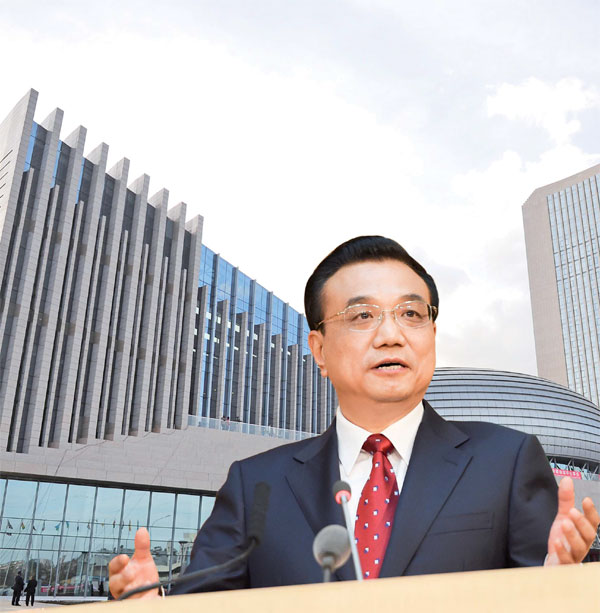
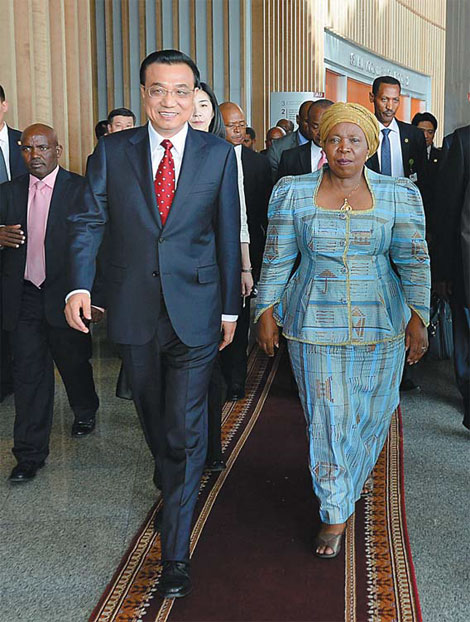
Premier Li Keqiang meets Nkosazana Dlamini-Zuma, who chairs the African Union Commission, at the AU headquarters in Addis Ababa on May 5. Li Tao / Xinhua
 United we stand
Chinese Premier Li Keqiang meets workers from China Communication Construction Company at the Addis Ababa-Adama toll road on May 5. Zacharias Abubeker / AFP


By Li Lianxing, Zhao Yinan and Wang Chao ( China Daily Africa)

Premier calls for closer collaboration and a broadening in the China-Africa project
Chinese Premier Li Keqiang invoked an Ethiopian proverb to underline the importance of unity between countries. "When spiders' webs unite, they can tie up a lion," Li said, speaking at the headquarters of the African Union in Addis Ababa.

Investment will continue to be the main growth driver for China in Africa, but the country will adopt a more pragmatic approach to achieve sustainable growth through closer cooperation with the continent's leaders, Li said on May 5.

Africa provides a silver lining to the dark clouds hanging over the global economy, and collaboration between the continent and China will pay handsome dividends to Chinese companies, he said.
Sino-African ties have grown steadily, and bilateral trade was worth $210 billion last year, said Li, on the first leg of an eight-day four-nation trip to Africa.

Africa has already begun to benefit from being a cohesive unit, with average growth of more than 5 percent and emerging as one of the fastest growing regions in the world, he said.

It is also an important emerging market and represents a collective economy worth $2 trillion, he said.
The continent's 54 countries have an important role to play in democratizing international relations, he said.

"Our Africa policy is a clear reflection of our commitment to deepen and grow Sino-Africa relations."
To achieve this, he said, China will press for progress in six areas: industrial cooperation, financial cooperation, poverty reduction, ecological protection, people-to-people exchanges; and peace and security issues.

China will also look to expand its credit lines to Africa and has earmarked additional aid of $10 billion, he said, adding that, a "beautiful China" will seek to advance hand in hand with a "green Africa".

Li called for an increase in annual bilateral trade to $400 billion by 2020 and indicated that China's cumulative direct investment in Africa would touch $100 billion about then.

China should become more involved in Africa's industrialization and help it develop labor-intensive industries such as textiles and light manufacturing, including the making of home appliances.

China is ready to work more closely with Africa in building roads, railways, telecommunications and electricity infrastructure aimed at bringing greater regional integration, he said.

At the same time, Chinese companies are also being encouraged to form joint ventures with their African counterparts to improve Africa's regional aviation.

Li spoke of a vision in which all African capitals would be linked with a high-speed rail network to boost pan-African communications and growth.

China has developed the best technology in this area, and is ready to work unreservedly with Africa to make its dreams come true, he said.

"Pragmatic cooperation cannot happen in the absence of financial support. China has decided to increase credit lines to Africa by $10 billion and will boost the China-Africa Development Fund by $2 billion."

The new $10 billion credit line will be on top of $20 billion already offered.

China will provide Africa with $10 million in free aid for wildlife preservation and promote joint research in protecting biological diversity, preventing desertification and promoting modern agriculture, he said.

"Protecting the environment is our shared responsibility. We will step up collaboration on ecological and environmental conservation."

The continent is full of vitality, he said, and the ever-expanding scale of investment has brought benefits to both people.

The past and the present proved that Africa benefits from China's growth, and that the world will become better if China and Africa develop together, he said.

Elham Mahmoud Ibrahim, commissioner for infrastructure and energy of the African Union Commission, says Li sent a positive and convincing message to Africa, and that the continent expects the "upgraded relationship" with China to improve its economy.

"I can see the chance that we can collaborate in the future in all areas of infrastructure as mentioned in Li's speech many times, and I think this is the real intention of China coming to invest in Africa. Many issues he talked about involved significant added value to build our capacity as well as to prepare a new generation to maintain and sustain our long-term development."

Ethiopia's Prime Minister Hailemariam Desalegn says China's financial aid to Africa through grants and loans has contributed enormously to bridging the infrastructure gap that has long hampered the continent's development.

"The highways, railways, dams, telephone and electricity networks, seaports and airports as well as other related infrastructure that China has helped build in many countries is clearly having a tangible impact on accelerating economic growth in our continent."

Nkosazana Dlamini-Zuma, who chairs the African Union Commission, says the AU considers China's collaboration with Africa to be a model partnership based on mutual respect and aimed at producing tangible results in areas of common interest.

Africa welcomes the economic investment that the Chinese government and private sector are making in Africa and hopes this will increase in the coming year, she says.

Li's trip to Africa follows one by President Xi Jinping last year.

He Wenping, director of the Institute of West Asian and African Studies at the Chinese Academy of Social Sciences, says: "Infrastructure has been a strong area for Chinese companies in Africa, and now Li is calling for Chinese companies to go into higher-end areas such as high-speed rail and aviation."

Kuruvilla Mathews, professor of international relations, at Addis Ababa University, has called Li's address "engaging and inspiring".

"The premier identified six key areas including poverty reduction and financial cooperation, which provides a comprehensive insight into China-Africa relations. It also shows that China is adjusting its engagements in Africa to more areas beyond the traditional infrastructure and energy industries.
"I am glad that he mentioned ecological protection, which is very important for Africa's sustainable development and has been somewhat neglected before."

David Shinn, adjunct professor at George Washington University and former ambassador to Ethiopia and Burkina Faso, also welcomed Li's remarks on environmental issues.

"China has paid increasing attention in recent years to steps that can bolster the environment at home and in Africa. Li's remarks signal a significant increase in the efforts that China will devote to environmental challenges.

"Before leaving China, Li mentioned the 'growing pains' that China is experiencing in Africa. He is correct in addressing this issue.

The more engaged China is in Africa and as more Chinese live and work in Africa, an estimated 1 to 2 million, the more misunderstanding there will be until each side gets to know each other better."

Harry Verhoeven, convener of the Oxford University China-Africa Network, says Li's call for ecological development comes at an opportune time. "Chinese companies must adopt more rigorous practices that do much more to protect the local environment and to benefit local communities."
The importance of security and peace stands out, he says. "Chinese diplomats have already taken encouraging steps to get more involved in trying to find a political solution for the civil war (in Sudan), but the engagement needs to be scaled up and I would like to see Premier Li Keqiang speak out in powerful terms about South Sudan."

Bultie Kiffilo, a researcher with the Diplomacy School of Ethiopia, says Li's speech conveyed significant messages for future bilateral engagements.

"We appreciate China's diplomatic commitment of non-interference, even as it extends full support to humanitarian campaigns, especially in war or conflict zones like South Sudan."

China's effort to foster peace in the region is a good example of south-south cooperation, and something that is likely to grow, he says.


Contact the writers through lilianxing@chinadaily.com.cn

Diyaarad militeri oo ku dhacday Ceelwaq


  •   
Kenya
Diyaarad militeri ayaa ku dhacday Ceelwaq
Diyaarad militeri oo ay leedahay Kenya ayaa la sheegayaa inay ku dhacday magaalada Celwaaq oo ku taalla xadka Soomaaliya iyo Kenya.
Duuliyihii diyaaradda ayaa la sheegayaa inuu ku dhintay isla gobta ay diyaaraddu ku dhacday.
Dhowr ruux oo rayid ah ayaa la sheegayaa inay ku dhaawacmeen shilkaas diyaaradda.
Goobjooge ayaa BBC-da u sheegay in dadka dhaawaca lagu dabiibayo isbitaal ku yaalla Ceelwaq.
Source: BBC

A Muslim Call to Partition the CAR


Photograph by Michael Christopher Brown An Anti-Balaka fighter demonstrates a decapitation technique

While the world focuses on the calls for partition by pro-Russian citizens in the south and east of Ukraine, similar calls from a small African nation are drawing less attention — despite horrific human rights abuses occurring on its territory. In what the U.N. human rights body and Amnesty International have called “ethnic-religious cleansing” between the country’s Muslim minority (15 percent of the population) and Christian militiamen, more than 2,000 people are dead and nearly a quarter of the country’s population of 4.6 million have been forced to flee the Central African Republic (CAR).

The conflict can be traced back to 2003, when François Bozizé, the army’s chief of staff, seized control of the country with the backing of Chad’s oil-rich president Idriss Déby. Déby helped keep Bozizé in power for eight years, supplying elite Chadian troops to quell unrest, until Bozizé looked to South Africa as its new guarantor. Afterwards, relations with Chad quickly soured, and an angry Déby then backed a loose coalition of mostly Muslim rebels from north and east CAR in their efforts to take over the country. The current conflict is not unprecedented – since independence from France in 1960, the country has suffered five coups and numerous rebellions. Additional spillover from conflicts in Democratic Republic of Congo, Sudan and Chad has made the CAR a chronically weak state.

Ethnic-religious tension between Muslims and Christians exploded in late 2012, when Muslim Seleka rebels, supported by Chadian and Sudanese mercenaries, quickly overran the country’s army. One of the complaints of the Muslim rebels was their exclusion by southern tribes from the country’s oil, gold and diamond wealth. After a series of peace deals with the opposition were not honored, the Seleka rebels invaded the capital and overthrew President Bozizé last March, installing the country’s first Muslim president, Michel Djotodia. Widespread human rights abuses by the Muslim rebels, including the pillaging of neighborhoods, rape and killing of people, prompted the creation of the “anti-balaka” (anti-machete) militias, mainly consisting of the Christian-majority and some animists. While their agenda was not purely religious in nature, the disproportionate violence carried out against Christians prompted Christian militias to attempt a coup early last December, with violence exploding between the two communities in the following days. The forced resignation of Djotodia in January, amid mounting international condemnation, emboldened the attacks of Christian militias on those Muslims, and others, it accuses of having collaborated with the government.

The international condemnation has led to the deployment of some 2,000 French troops and nearly 5,000 African peacekeepers on the ground to help stabilize the country, and more are on the way. The U.N. Security Council approved a peacekeeping mission of 11,800 soldiers on April 10, although they will only arrive in September. The African forces currently consist mainly of Burundian and Rwandan forces, after the widely-despised Chadian forces withdrew in late March.

The ongoing fighting has led to entire neighborhoods emptying of their Muslim populations along with the destruction of property and mosques. Recent violence has seen ex-Seleka militants, who have been ousted from the capital Bangui, regrouping in the north and carrying out attacks on the local population. An attack on a hospital in the northern town of Nanga Boguila on April 26 led Medecins Sans Frontieres (MSF), or Doctors without Borders, to suspend all but emergency care. Three MSF staff were among the 16 killed in the armed robbery involving more than 40 militants, in an action that has not been condemned by the current government.

Far north of the capital, some angry Muslims now talk of a simple solution to the threat of religious violence from Christian militias terrorizing the country’s south. Young Muslims in the town of Bambari, which lies roughly on the dividing line separating the Christian south from a northern region controlled by the mostly Muslim Seleka rebels, are circulating by cellphone a design for the flag of the “Republic of Northern Central Africa.”

“The partition itself has already been done. Now there only remains the declaration of independence,” said Abdel Nasser Mahamat Youssouf, member of a youth group lobbying for the secession of the north.

Within Seleka, hardliners like General Abakar Sabone — who controls the far north Vakaga region — has said partition is inevitable if Muslims are denied a role in government. Other Seleka leaders, such as General Mohamed Dhaffane, second vice president of the ex-Seleka coalition, is uncertain of the benefits of independence. The interim government in Bangui, led by a Christian ex-lawyer named Catherine Samba-Panza, is vehemently opposed to partition, and France, the major foreign military power in CAR, has said it will do everything to prevent partition.

Despite the government’s opposition to partitioning the country, it has already taken steps to partition some of its most powerful institutions, making them Muslim-free. U.N. Secretary General Ban Ki-moon has warned of the dangers of partition, and other African governments are also skeptical of partition on a continent where many borders were arbitrarily drawn, with ongoing separatist movements in Angola, the Democratic Republic of the Congo, Nigeria, Kenya, Somalia and Zimbabwe.

If the country were divided along the lines suggested by the separatists, many fear a repeat of the situation in South Sudan, which gained independence from Sudan in 2011 but is now threatened by civil war between troops backing President Salva Kiir and soldiers loyal to his sacked deputy, Riek Machar. The fighting in South Sudan seems to have worsened ethnic tensions between the Dinka and Nuer peoples, and sparked a massacre in the oil town of Bentiu. Others fear an independent north would also play into the hands of neighboring Chad and Sudan, whose mercenaries have been fighting alongside the Seleka rebels.


If partition is not the answer, the root causes of the call for partition need to be addressed by the interim government in Bangui, with the support of France and the international community, including the U.N. The concerns of Seleka leaders will need to be aired and acted upon, to include a greater role in government and share of resources for Seleka should their fighters lay down their weapons. Greater humanitarian efforts will be required to disperse already approved aid to fleeing refugees, many of whom have fled to different provinces of the country and to the neighboring nations of Cameroon, Chad, Mali, Niger, Nigeria, Senegal and Sudan. Should these efforts fail, the de facto partition could lead to a de jure partition, with the poison of ethnic-religious hatred lingering in the country and seeping into neighboring countries.

London : Khat to be banned in UK after the Lords passed legislation

London - May 12,  2014 - Reports coming from today's UK Houses of Parliament debate on Khat ban indicate that,  finally the Lords passed the legislation banning the use, import and trade of Khat in the United Kingdom. This comes a rejection by the same House few months ago.


Khat is grown in East Africa and Yemen and is imported to the UK mainly through Heathrow airport. Many communities from East Africa and Yemen that had earlier settled in the UK use khat . Somalis are among the largest communities that use khat in the UK.

"Khat is a stimulant drug with effects similar to amphetamine.Chewing it makes people feel more alert and talkative and suppresses the appetite, though users describe an ensuing calming effect when used over a few hours. Regular use may lead to insomnia (inability to sleep), anorexia and anxiety. In some cases it may make people feel more irritable and angry and possibly violent. Psychological dependence can result from regular use so that users feel depressed and low unless they keep taking it. "Drug Scope
Whence the ban comes into effect, Khat will therefore , be controlled as a Class C Drug in UK . This change will have implications for the users or the suppliers.


A person found in possession of Khat for personal use will be liable to arrest when the ban becomes into effect. The penalty could be up to 2 years in prison, an unlimited fine or both, according to thepolice. Persons who supply or import Khat after the ban will be liable to arrest . The penalty could be up to 14 years in prison, an unlimited fine or both. A person convicted of supplying or importing khat will generally receive custodial sentence.

The local authorities will make medical provision to help persons who are heavy khat users in advance of prescription if they come forward.

Khat has destroyed the lives of many Somalis in Britain . In addition to mental and dental healthproblems, it is the major cause of family break-downs among the Somali communities. Visit No 15 Mafresh at Southall next to the train station. It is open 24 hours a day , seven days a week. Addicts sleep there in shifts. Some even use cars parked in-front of the Mafresh as their sleeping places. Other cities and towns in UK have the same style Mafreshes as No 15.