Search This Blog

Monday, March 31, 2014

With new Chinese cyber-tools, Ethiopia more easily spies on its people

Human rights advocates worry that powerful surveillance technology is spreading in Africa, where many countries are becoming more authoritarian.


By Staff writer
BOSTON
Ethiopia’s government is deploying cutting-edge cyber and phone surveillance technologies from China and other nations to conduct widespread spying aimed at suppressing political dissent, according to a new report.
Using modern technology from Chinese telecom giant ZTE, Ethiopia’s state telecom company has spent the last five years meshing that gear with additional spy software from European suppliers to create government surveillance tools spanning social media, phone, and Internet communications, says the report by New-York based Human Rights Watch. 
With that powerful system now in place, the ruling Ethiopian People’s Revolutionary Democratic Front (EPRDF) coalition is using its new capacities to ferret out and harass its political opponents, according to the report titled “They Know Everything We Do: Telecom and Internet Surveillance in Ethiopia.”
Ethiopia's authoritarian regime has long watched its people. But the new technology allows it to far more easily spy on citizens, business people, politicians, journalists, and others – including, as it appears, the vast network of Ethiopians living abroad. 
In the past year, a swath of East African nations from Ethiopia to Uganda, Kenya and Tanzania have been under criticism for tougher policies on free expression and for cracking down on multifarious civil society and NGO groups. Human rights monitors are concerned that new cheap and powerful spyware is already starting to be acquired and used by more African governments. 
Internet usage in Ethiopia is still in its infancy with less than 1.5 percent of Ethiopians connected to the Internet and fewer than 27,000 broadband subscribers countrywide.
By contrast, neighboring Kenya has close to 40 percent access, the report notes. Only about a quarter of Ethiopia’s population has cell phones compared to 72 percent in Kenya.
Yet the chilling effect of surveillance on free speech is most significant in Ethiopia, an essentially one-party state where many now live in fear of answering any phone call from overseas – or expressing their true feelings on the phone. Many worry they will be hauled in to a police station and accused of affiliation with banned groups, according to the HRW report, which was based on 100 interviews with Ethiopians.
“One day they arrested me and they showed me everything. They showed me a list of all my phone calls and they played a conversation I had with my brother,” a former member of an Oromo opposition party, who is now a refugee in Kenya, told interviewers in May 2013.
“They arrested me because we talked about politics on the phone. It was the first phone I ever owned, and I thought I could finally talk freely,” the man said.
Governments around the world engage in surveillance, but in most countries judicial and legislative mechanisms are in place to protect privacy and other rights, the report found. Yet in Ethiopia “these mechanisms are largely absent,” HRW said.
Most of the technologies used to monitor telecom activity in Ethiopia have been provided since 2003 by ZTE, the report says. The company did not respond to HRW inquiries about steps it might be taking to address and prevent Ethiopian human rights abuses linked to unlawful mobile surveillance.
“Some of these Chinese and other companies have been complicit in the worst human rights abuses in Iran and Syria by providing these regimes with all too often hidden [cyber-surveillance] tools of oppression,” says Toby Dershowitz, vice president at the Foundation for Defense of Democracies, a Washington research institute, in an e-mail interview.
At the same time, the report identifies some European companies as having supplied Ethiopia with advanced cyber surveillance technology used to target Ethiopians at home and abroad.
Indeed, Ethiopia appears to have acquired FinFisher surveillance software from the United Kingdom and German-based Gamma International – as well as Italy-based Hacking Team’s Remote Control System.
Such tools provide security and intelligence agencies with access to files, information, and activity on the infected target’s computer. They can log keystrokes, passwords, and turn on a webcam or microphone, essentially converting a personal computer into a microphone or other monitoring device.
Yet Ethiopia is just one among many nations deploying such technology, says Eva Galperin, a global policy analyst at the Electronic Frontier Foundation, a digital rights organization in San Francisco.
“It’s important to understand that Hacking Team and FinFisher are not the only players in this game,” Ms. Galperin says. “That’s just the tip of the iceberg.”
John Bumgarner, a former intelligence officer and cyber conflict expert, agrees. He says that US companies are part of the pattern, too.
“This report points a finger at the Chinese companies selling this hardware,” Mr. Bumgarner says. “But all they’re really doing is taking a page from the playbook of US companies that sell similar kinds of software.”
Powerful spyware is proliferating and is “virtually unregulated at the global level and there are insufficient national controls or limits on their export,” Human Rights Watch said. Rights groups last year filed a complaint at the Organization for Economic Co-operation and Development alleging such technologies have been deployed to target activists in Bahrain, for instance.
Researchers at Citizen Lab, a University of Toronto-based cyber research group, say they have identified FinFisher command and control servers in over 30 countries and have analyzed malware samples that appear to target users in places like Vietnam and Malaysia. Gamma has stated that it only sells its software to select countries for law enforcement purposes.
Human Rights Watch letters to the Addis Ababa government received no response. In response to Citizen Lab research and inquiry about the Ethiopian government’s use of FinSpy, an Ethiopian government spokesperson said in a statement to media, “I cannot tell you what type of instruments we’re going to use or not. I’ve no idea, and even if I did, I wouldn’t talk to you about it.”
Hacking Team, in public statements, says that it only sells its software to government law enforcement or intelligence agencies, not individuals or businesses. Governments can even monitor the use of the software via an “audit trail,” allowing government officials to monitor how employees are using the software so as to identify any “abuse” of the technology.
Yet Ethiopians living in the UK, United States, Norway, and Switzerland are among those known to have been infected with spyware. Lawsuits have been filed in the US and UK alleging illegal wiretapping, the report says.
Just last month, a Washington man with links to Ethiopia’s opposition party sued the Ethiopian government in US federal court, claiming government agents deployed espionage software to hack his personal computer and spy for months on his private communications.
The suit claims it found on his computer some 2,000 files linked to spyware called FinSpy, as well as signs his Skype calls, web-browsing history, and e-mails had been spied on in violation of US law.
“The Ethiopian government is using control of its telecom system as a tool to silence dissenting voices,” said Arvind Ganesan, business and human rights director at Human Rights Watch. “The foreign firms that are providing products and services that facilitate Ethiopia’s illegal surveillance are risking complicity in rights abuses.”
The Internet, Twitter, Facebook and other social media services figured prominently in the uprisings in Arab countries from Tunisia to Libya, and Egypt to Syria. But autocratic regimes are increasingly using them not to empower citizens, but instead build “electronic curtains” to repress their own populations, the report said.
In Syria, the government has waged a cyber battle against its own citizens and media beyond its borders, utilizing advanced cyber attack and surveillance techniques to identify and sometimes torture or kill dissidents.
The surveillance technologies “are not only used to stifle debate but to surveil, hunt down and even torture those whose views differ from these governments,” Ms. Dershowitz writes. “Those who don’t like this preview won’t like the movie to come if these companies and countries are not held accountable.”

Great Somalia: Failure of a Dream ( I)


BY PABLO ARCONADA

The idea Pansomalismo , or the construction of " Greater Somalia " is a project to unite all Somali clans and ethnic groups and fit them in the same pan-Somali state. This family , like many others, has had its ups and downs hour hours , but has never been able to accomplish. In its flag are five points , one for each of the five Somalians Five Somalians ? We explain .

If you look , the flag of the current Somali state is represented by a white five-pointed star , one for each of the " Somalians " that should shape the status of Great Somalia. Five Somalians ? This we have to sound really strange since we have all ever heard a Somalia , the Horn of Africa. You really have to understand that Somalia today ( despite suffering from internal disintegration 1991 ) consists of two such Somalians : Somaliland , north , former British colony and the former Italian Somalia , which would be part of the rest the current state of Somalia.


But without three other Somalians that different governments have claimed fervently Mogadishu since independence and the country's unification in 1960. These are the Ethiopian Somali ( Ogaden regions and the Haud ) , some or all of the state of Djibouti (formerly French Somalia ) and the North Eastern Province , a vast expanse that is part of Kenya. Such claims are based not on a historic regions belonging to Somalia, because a united Somalia as a whole as such has never existed, but that this thesis is based on all that territory inhabited by Somali people must be integrated under the limits of a free and unified Somali state .


But who is Somali ? Migratory movements in the area have been very many centuries , and the continuous arrival of peoples who have been superimposed complicates the identification of a Somali "race." However, despite this variety , we can identify the main peoples inhabiting the Horn of Africa: dir- issa , populating and are most in Djibouti , the Darod , the largest ethnic groups in extent and occupying different regions to north and south of Somalia and even large areas in the Ogaden region , the gadabursi , also in the Ethiopian Ogaden , the Is'haq that would fall in the British Somaliland and finally , among others, and hauiya rahanueyn - Digil that live on the south coast .

Additionally, you should think what builds the identity of the Somali people , if there has traditionally been one of the European Somali national sentiment , or rather could discuss various aspects that constitute that identity as the conscience of a culture, a religion , language and the defense of common habits.

Obviously the ideology of " Somali nation " falls primarily by Islam as a unitary religion and the common language used by all of them and they all speak standard Somali , despite the various existing dialects.

Besides all the great pan-Somali did not begin to build until the end of the nineteenth century and early twentieth century , when it will appear that could be known as the " father of the Great Somalia " . Sayid Mohamed Abdullah Hassan , known by the British as Mad Mullah , saw the need to unite all Somalis , among other things , defend against attacks of different foreign powers that had interested several decades in the control of the Horn of Africa. Ethiopians of Menelik II 's hand , will occupy the lands east of Ethiopia , regions of Haud and Ogaden before mentioned. The British Empire will be entered in Somaliland in 1884 creating a protectorate. France also create their own center in Djibouti with Somalia in 1888 and Italy , who had already settled in Eritrea in 1869 received a series of grants from the sultanates of Obbia , Midyurtina and Zanzibar to settle in the southern region of the Horn of Africa, allowing you to create another Somalia under Italian command.

It will be in this circumstance when the Mad Mullah , attending the dismemberment of his people, a tough and active resistance that lead to his death in 1921 , and will cause quite a few headaches among the British , Italians and Ethiopians will be launched . The struggle will continue even after his death (although low intensity ) until 1927 when it achieved to end the Somali resistance. However the end of the armed struggle led to the disappearance of the ideal of uniting all Somali people under one banner , which will very much alive throughout the entire twentieth century . While the more resistant towards this ideal , the less chance there was of bringing five Somalias .

BETWEEN THE LINES: WHEN 'TOLERANCE' AND 'MULTICULTURALISM' CLASH


Exclusive: Joseph Farah lists nations where homosexuality is punishable by death

Uganda President Yoweri Museveni


You’ve probably heard or read in the press that the African nation of Uganda has passed a law calling for life in prison for the practice of homosexuality.
It’s mentioned in nearly every Western news account of the action taken by the Uganda legislature and signed by President Yoweri Museveni.

One would get the impression from these stories that someone convicted of one consensual act of homosexuality might find himself in prison for life.
But is it true?
No, not really.
Life imprisonment is reserved only for aggravated cases that include, essentially, convictions for a form of homosexual rape or what is defined as “serial homosexuality,” as the bill clearly states.
Now, do I approve of this law?
No, I don’t. I would not like to see homosexuals jailed for consensual acts, though, as a Christian, I believe it to be sinful.
My point is, however, there is a lot of hyperbole and hysteria about Uganda’s new law. Western nations, including the U.S., have either cut back foreign aid or cut it off entirely. Secretary of State John Kerry is sending a “scientific” delegation to Uganda to meet with Museveni to persuade him that his assumptions about homosexuality are wrong. “Progressives” all over the U.S. and Europe are up in arms about Uganda.
The news stories and cable TV discussions about Uganda also leave one with the impression the nation is out of step with the rest of the world, a pariah even in Africa. In fact, homosexuality was already illegal in 37 other African countries, a reality seldom referenced in any news accounts. In 10 nations, homosexuality is punishable by death.
One has to wonder why so much fuss about Uganda when other countries have much harsher laws on the books – including Yemen, Iran, Mauritania, Nigeria, Qatar, Saudi Arabia, Somalia and Sudan. Of course, these countries all share a common characteristic that Uganda does not share. They are all Islamic. In several of these countries, including Saudi Arabia, the death penalty can be carried out by stoning.
Don’t I recall Barack Obama bowing down to the king of Saudi Arabia on a visit there?
Why is Uganda getting such scrutiny for its laws on homosexuality while others, mostly Muslim, get a free pass?
That’s one of the questions Museveni has about a duly passed law that is, by all accounts, very popular among the citizenry.
But there’s more to puzzle over with regard to the Uganda frenzy.
Other nations do things all the time that are repugnant to Americans. But this one in Uganda is in a class by itself in terms of attention, criticism and reprisals.
Just a week ago, Kenya’s parliament passed a bill allowing men to marry as many women as they want without the approval of the wife.
This would seem like an action that would rile up feminists in the West. Yet I can scarcely find any condemnation. No threats of aid cuts. No planned trips by State Department task forces. No hysterical op-eds in the major media.
Almost nothing.
What’s the difference?
Well, Kenya, too, is a mostly Islamic country.
It seems the multiculturalists on the left have one standard of “tolerance” for Islam and another for Christian-oriented nations like Uganda.
Is that a surprise?
It shouldn’t be.
The West is reticent to impose its sense of morality on Islamic nations. It is more than willing to apply its multicultural standard when dealing with Muslims and Shariah law. But when Christians are in charge, as in Uganda, you would think, based on the furor raised, that Idi Amin had returned to power in all his butchery and savagery.
In fact, Uganda may be a more serious concern for U.S. progressives right now than Russia’s invasion of Ukraine, North Korean tyranny, Islamic terrorism and worldwide sex trafficking.
Would it be fair to say the left is losing any sense of perspective?
Media wishing to interview Joseph Farah, please contact media@wnd.com.

Somalia: How Colonial Powers drove a Country into Chaos

Interview of Mohamed Hassan


By GrĂ©goire Lalieu
Somalia had every reason to succeed: an advantageous geographical situation, oil, ores and only one religion and one language for the whole territory; a rare phenomenon in Africa.  Somalia could have been a great power in the region. But the reality is completely different: famine, wars, lootings, piracy, bomb attacks. How did this country sink? Why has there been no Somali government   for approximately twenty years? Which scandals stand behind those pirates who hijack our ships? In this new chapter of our series “Understanding the Muslim World”, Mohamed Hassan explains for us why and how imperialist forces have applied in Somalia a chaos theory. 
How did piracy develop in Somalia? Who are those pirates?
Since 1990, there has been no government in Somalia. The country is in the hands of warlords. European and Asiatic ships took advantage of this chaotic situation and fished along the Somali coast without a license or respect for elementary rules. They did not observe the quotas in force in their own country to protect the species and they used fishing techniques –even bombs!- that created huge damages to the wealth of the Somali seas.
That’s not all! Taking also advantage of this lack of any political authority, European companies, with the help of the mafia, dumped nuclear wastes offshore Somali coasts. Europe knew of this but turned a blind eye as that solution presented a practical and economical advantage for the nuclear waste management. Yet, the 2005 Tsunami brought a big part of these wastes into the Somali lands. Unfamiliar diseases appeared for the first time among the population. This is the context in which the piracy mainly developed. Somali fishermen, who had primitive fishing techniques, were no more able to work. So they decided to protect themselves and their seas. This is exactly what the United States did during the civilian war against the British (1756-1763): with no naval forces, President George Washington made a deal with pirates to protect the wealth of the American seas.   
No Somali state for almost twenty years! How is that possible?
This is the result of an American strategy. In 1990, the country was bruised by conflicts, famine and lootings; the state collapsed. Facing this situation, the United States, who discovered oil in Somalia a few years ago, launched Operation Restore Hope in 1992. For the first time, US marines intervened in Africa to take control of a country. It was also the first time that a military invasion was launched in the name of humanitarian interference.
The famous rice bag exhibited on a Somali beach by Bernard Kouchner?
Yes, everybody remembers those pictures carefully showcased. But the real reasons were strategic. An US State Department report recommended indeed that the United States must stay the lonely global superpower after the Soviet Bloc collapse. To reach that goal, the report advocated to occupy a hegemonic position in Africa, which enjoys a vast amount of raw materials.
However, Restore Hope will be a failure. There was even that Hollywood movie “Black Hawk Down”, with those poor G.I.’s “attacked by the bad Somali rebels”…
US soldiers were indeed defeated by a Somali nationalist resistance. Since then, American policy was to keep Somalia without any real government, even to balkanize it. This is the old British strategy, already applied in many places: setting weak and divided states in order to better rule them. That is why there has been no Somali state for almost twenty years. The United States has implemented a chaos theory in order to stop any Somali reconciliation and keep the country divided.
In Sudan, due to the civilian war, Exxon has had to leave the country after having discovered oil. So isn’t letting Somalia plunge into chaos contrary to American interests, which cannot exploit the discovered oil?
Oil exploitation is not their priority. The United States know that the reserves are there but doesn’t need it immediately. Two elements are much more important in its strategy. First, prevent the competitors from negotiating with a rich and powerful Somali state. If you consider Sudan, the comparison is interesting. The oil that the American companies discovered there thirty years ago, Sudan is selling it today to China. The same thing could happen in Somalia. When he was president of the transition government, Abdullah Yusuf went to China although he was supported by the United States. US mass media had strongly criticized that visit. The fact is that United States have no guarantee on that point: if a Somali government is established tomorrow, whatever is its political color, it could probably adopt a strategy independent of United States and trade with China. Western imperialists do not want a strong and unified Somali state. The second goal pursued by this chaos theory is linked to the geographical location of Somalia, which is strategic for both European and American imperialists.

Why is it strategic?
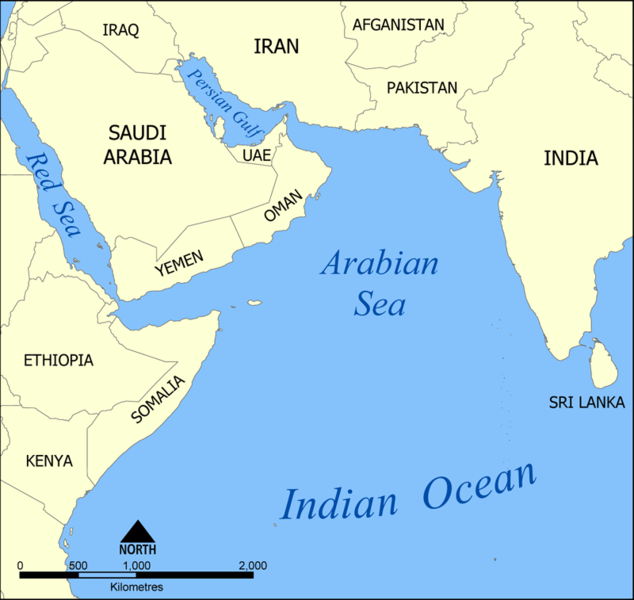
The issue is the control of the Indian Ocean. Look at the map. As mentioned, western powers have an important share of the responsibility in the Somali piracy development. But instead of telling the truth and paying compensation for what they did, those powers criminalize the phenomena in order to justify their position in the region. Under the pretext of fighting the piracy, NATO is positioning its navy in the Indian Ocean.     
Source: Wikipeda
What is the real goal?
To control the economic development of the emerging powers, mainly India and China. Half of the world’s container traffic and 70% of the total traffic of petroleum products passes through the Indian Ocean. From that strategic point of view, Somalia is a very important place: the country has the longest coast of Africa (3.300 km) and faces the Arabian Gulf and the Straight of Hormuz, two key points of the region economy. Moreover, if a pacific response is brought to the Somali problem, relations between African in one hand, and India and China on the other hand, could develop through the Indian Ocean. Those American competitors could then have influence in that African area. Mozambique, Kenya, Madagascar, Tanzania, Zanzibar, South Africa etc. All those countries connected to the Indian Ocean could gain easy access to the Asian market and develop fruitful economic relationship. Nelson Mandela, when he was president of South Africa, had  mentioned the need of an Indian Ocean revolution, with new economic relationships. The United States and Europe do not want this project. That is why they prefer to keep Somalia unstable..
You say that the United States does not want Somali reconciliation. But what are the roots of the Somali divisions?
In order to understand this chaotic situation, we must delve into Somali history. This country had been divided by colonial powers. In 1959, Somalia gained independence through the fusion of the Italian colony in the South, and the British colony in the North. But Somalis were also living in some parts of Kenya, Ethiopia and Djibouti. The new Somali state adopted a star on its flag, each branch representing one part of the historical Somalia. The message behind that symbol: “Two Somalias have been united, but three are still colonized”.
Facing the legitimacy of those claims, the British – who controlled Kenya-, organized a referendum in the Kenyan area claimed by Somalia. 87% of the population, composed mainly of Somali ethnics, voted for the Somali unity. When the results were published, Jomo Kenyatta, a Kenyan nationalist leader, threatened the British to throw the colonists out if they gave a part of the territory up to Somalia. So Great Britain decided not to take the referendum into account, and today an important Somali community is still living in Kenya. You must understand that those colonial borders were a real disaster in the Somali case. The border issue was besides the object of an important debate among the African continent.    
What was the issue of that debate?
In the sixties, as many African countries became independent, there was a debate between what we called the Monrovia and the Casablanca groups. This later, including among others Morocco and Somalia, resolved that the borders inherited from colonialism be discussed. For them, those boundaries had no legitimacy. But most of the African countries and their borders are colonialism products. Finally, the Organization of African Unity (OAU), the ancestor of the current African Union, closed the debate by decreeing that the borders were indisputable: going back over those boundaries would provoke civilian wars everywhere on the continent. Later, one of the OAU architects, the Tanzanian Julius Nyerere, confessed that this decision was the best but that he regretted the Somali outcome.
What will be the impact of the colonial divisions on Somalia?
They will create strains with neighboring countries. During those years when Somalia advocated for revising the borders, Ethiopia became a US imperialism bastion. The United States had also military bases in Kenya and Eritrea. At this moment, Somalia, a young pastoral democracy, wished to build its own army. The goal was to not appear weak in front of the armed neighbors, to support Somali movements in Ethiopia and even to regain by force, if necessary, some territories. But the western forces were opposed to the creation of a Somali army.
So Somalia had tense relations with its neighbors. Was it not reasonable to be opposed to this Somali army project? It would have provoked wars, wouldn’t it?  
The West did not care about conflicts between Africans but its own interests. The United States and Great Britain were providing and training militaries in Ethiopia, Kenya and Eritrea. Those countries were still under the yoke of very repressive feudal systems. But they were also neocolonial regimes devoted to Western interests. On the other hand, the power in place in Somalia was more democratic and independent. So the West had no interest in providing for a country that could escape its control.
As a consequence, Somalia decided to turn to the Soviet Union. This frightened the Western forces that feared Soviet influence stretching in to Africa. Those fears became more important with the 1969 putsch.  
What do you mean?
Socialist ideas were spread in the country. An important Somali community was indeed living in Aden in South Yemen. However, this is where Britain used to exile persons it considered dangerous in India: communists, nationalists and so on. They used to be arrested and sent to Aden where nationalist and revolutionary ideas quickly developed and affected later both Yemenites and Somalis. Under the influence of civilians with Marxist ideas, a coup d’Ă©tat was led by officers in 1969 and Siad Barre took power in Somalia.
What were the reasons of that coup d’Ă©tat?
The Somali government was corrupted. He had however the cards in hand to erect the country to the great regional power rank: a strategic position, only one language, one religion and many common cultural elements. This is fairly rare in Africa. But, by missing the economical development of the country, this government has created a context favorable to divisions among clans. Under the pretext of doing politics, Somali elites become divided. Everyone created his own political party, without any real program, and recruited voters among the existing clans. This increased the divisions and turned out to be totally useless. A democracy in a liberal type was in fact unsuitable for Somalia: there were at once 63 political parties for a three million population country! And the government was even not able to adopt an official script, which was creating serious troubles in the administration. Education was weak. Bureaucracy, police and army were, however, established. This later will play a key role in the progressive coup d’Ă©tat.
“Progressive”! With the army?
The army was the only organized institution in Somalia. As a repressive apparatus, it was supposed to protect the so-called civilian government and the elite. But for many Somalis coming from different families and areas, the army was also an exchange place where there were no borders, no tribalism, no clan divisions. This is how Marxist ideas from Aden circulated among the army.  So the coup d’Ă©tat was led by officers who were most of all nationalist. They did not have a good knowledge of socialism but they had sympathy for those ideas. Moreover, they knew what was happening in Vietnam, and that fed anti-imperialist feelings. The civilians, who knew Marx and Lenin’s teachings lacked a mass political party, supported the coup d’Ă©tat and become the advisers of the officers who took power.  
What changes did the Somali coup d’Ă©tat bring about?
One important positive aspect: the new government quickly adopted an official script. Likewise, the Soviet Union and China were helping Somalia. The students and the population mobilized themselves. Education and social conditions were enhanced. The years that followed the coup d’Ă©tat were in fact the best ones that Somalia never knew. That is, until 1977.
What happened?
Somalia, which has been divided by colonial forces, attacked Ethiopia to get the territory of Ogaden back. Ogaden was mainly populated by Somalis. At this time however, Ethiopia was itself a socialist state supported by the Soviets. This country had been led for a long time by  Emperor Selassie. But in the seventies, there was an important mobilization to overthrow him. The students’ movement, in which I personally participated, made four major demands. First, to nonviolently and democratically resolve tensions with Eritrea. Secondly, to establish a land reform that would distribute the lands to the peasants.  Thirdly, to establish the principle of equality among the nationalities; Ethiopia was a multinational country led by elite who did not represent the diversity. Fourthly, to abolish the feudal system and to establish a democratic state. As in Somalia, the army was the only organized institution in Ethiopia and the civilians joined the officers to overthrow Selassie in 1974.
How did two socialist states, each supported by the Soviet Union, enter conflict?
After the Ethiopian revolution, a delegation including Soviet Union, Cuba and South Yemen organized a round table with Ethiopia and Somalia in order to resolve their contradiction. Castro went to Addis Abeba and Mogadishu. To him, Somali claims were justified. Finally, the Ethiopian delegation agreed to  seriously seriously its Somali neighbor’s demands. The two countries made an agreement stipulating that no provocation should happen as long as no decision has been taken. Things seemed to start well but Somalia did not honor the agreement…
Two days after the Ethiopian delegation returned to its country, Henry Kissinger, a former Nixon Secretary of State, turned up to Mogadishu. Kissinger was representing an unofficial organization: the Safari Club that was among others including Shah’s Iran, Mobutu’s Congo, Saudi Arabia, Morocco and French and Pakistani intelligence services. The objective of that organization was to fight against the Soviet infiltration in the Gulf and in Africa. Under the Safari Club pressures and help promises, Siad Barre committed a disastrous strategic mistake of attacking Ethiopia.    
What were the consequences of that war?
Soviets left the region. Somalia, still led by Siad Barre, integrated the neocolonial network of the imperialist forces. The country had been seriously damaged by the conflict and the World Bank and the IFM were in charge of “rebuilding” it. This has aggravated infighting among Somali bourgeoisie. Each regional elite wanted to have its own market. They made the divisions among the clans’ worst and contributed to the progressive dislocation of their country up to Siad Barre’s fall in 1990. Since that, any head of state succeeded to him.  
But, thirty years after the Ogaden war, the opposite scenario happened: Ethiopia was supported by the United States to attack Somalia…
Yes, as I said, since the Restore Hope failure, United States has preferred to keep Somalia in chaos. However, in 2006, a spontaneous movement developed under the Islamic courts to fight against the local warlords and bring unity to the country. It was a kind of Intifada. In order to stop this movement from rebuilding Somalia, United States decided suddenly to support the Transitional Federal Government (TFG) after having refused to recognize it before. In fact, they realized that their project of a Somalia without effective state was no more possible: a movement – furthermore Islamic!- was about to lead to a national reconciliation. In order to sabotage the Somali unity, United States decided to support the TFG. But this later was lacking any social basis and an army. So the Ethiopian troops, commanded by Washington, attacked Mogadishu to overthrow the Islamic courts.
Did it work?
No, the Ethiopian army was defeated and had to leave Somalia. On their side, the Islamic courts were dispersed in several movements that still control a big part of the country today. As for Abdulla Yusuf’s transitional government, he collapsed and United States replaced it by Sheik Sharif, the former Islamic Court spokesman.
So Sheik Sharif has passed to “the other camp”?
He used to be the Islamic courts spokesman because he is a good orator. But he has no political knowledge. He has no idea what imperialism or nationalism are. That is why western powers took him back. He was the Islamic court’s weak link. Today he chairs a fake government, created in Djibouti. This government has no social base or authority in Somalia. It only exists on the international level because the imperialist forces support it.
In Afghanistan, the United States said they were ready to negotiate with Taliban. Why don’t they look for discussing with the Islamic groups in Somalia?
Because those groups want to take the foreign occupier over and to allow a national reconciliation for the Somali people. As a result, the United States wants to break those groups: a reconciliation, through the Islamic movement or through the TFG, is not in the interests of the imperialist forces. They just want chaos. The problem is that today, this chaos reached Ethiopia too, which is very weak since the 2007 aggression. A nationalist resistance movement came to the light over there to fight against the pro-imperialist government of Addis Ababa. With their chaos theory, United States had in fact created troubles in the whole region. And now, they took it out on Eritrea.
Why?
This little country leads an independent national policy. Eritrea also has a vision for the whole region: the Horn of Africa (Somalia, Djibouti, Eritrea, Ethiopia) do not need foreign powers’ interference; its wealth should allow it to establish new economical relationship on the basis of mutual respect. According to Eritrea, the region must get it together and its members must be able to discuss about their problems. Of course, this policy frightens United States that fears that other countries follow that example. So they accuse Eritrea of sending weapons to Somalia and instigating troubles in Ethiopia.
Isn’t Eritrea sending weapons in Somalia?
Not even a bullet! This is a pure propaganda as they did against Syria about the Iraqi resistance. Eritrea’s vision catches up with the project of Indian Ocean revolution that we spoke about before. The western powers do not want of that and wish to bring Eritrea back to the circle of the neocolonial states under control, such as Kenya, Ethiopia or Uganda.
Are there no terrorist in Somalia?
Imperialist powers have always labeled as terrorists the people who fight for their right. Irishmen were terrorists until they signed an agreement. Abbas was a terrorist. Now, he is a friend.
But we heard about Al Qaeda in Somalia?
Al Qaeda is everywhere, from Belgium to Australia! That invisible Al Qaeda is a logo designed to justify to the public opinion military operations. If United States say to their citizens and soldiers: “We are going to send our troops into the Indian Ocean in order to probably fight against China”, people would be afraid of course. But if you tell them that it is just about fighting piracy and Al Qaeda, it won’t be a problem. The real goal is however different. It consists in setting forces in the Indian Ocean region that will be the theater of major conflicts in the coming years. This is what we will analyze in the next chapter…

Mohamed Hassan is a geopolitics and Arab world specialist. Born in Addis Abeba (Ethiopia), he participated in student movements on the occasion of the socialist revolution of 1974 in his country. He studied political science in Egypt before specializing in public administration in Brussels. As a diplomat for his country of origin, he worked in Washington, Beijing and Brussels. Co-writer of L’Irak sous occupation (EPO, 2003), he has also contributed to books about Arab nationalism, Islamic movements and Flemish nationalism. He is one of the best contemporary experts on the Arab and Muslim world.

In Times of Government Surveillance, Whose ‘Security’ Is at Stake?


By Noam Chomsky
A leading principle of international relations theory is that the state's highest priority is to ensure security. As Cold War strategist George F. Kennan formulated the standard view, government is created “to assure order and justice internally and to provide for the common defense.”
The proposition seems plausible, almost self-evident, until we look more closely and ask: Security for whom? For the general population? For state power itself? For dominant domestic constituencies?
Depending on what we mean, the credibility of the proposition ranges from negligible to very high.
Security for state power is at the high extreme, as illustrated by the efforts that states exert to protect themselves from the scrutiny of their own populations.
In an interview on German TV, Edward J. Snowden said that his “breaking point” was “seeing Director of National Intelligence, James Clapper, directly lie under oath to Congress” by denying the existence of a domestic spying program conducted by the National Security Agency.
Snowden elaborated that “The public had a right to know about these programs. The public had a right to know that which the government is doing in its name, and that which the government is doing against the public.”
The same could be justly said by Daniel Ellsberg, Chelsea Manning and other courageous figures who acted on the same democratic principle.
The government stance is quite different: The public doesn't have the right to know because security thus is undermined—severely so, as officials assert.
There are several good reasons to be skeptical about such a response. The first is that it's almost completely predictable: When a government's act is exposed, the government reflexively pleads security. The predictable response therefore carries little information.
A second reason for skepticism is the nature of the evidence presented. International relations scholar John Mearsheimer writes that “The Obama administration, not surprisingly, initially claimed that the NSA's spying played a key role in thwarting 54 terrorist plots against the United States, implying it violated the Fourth Amendment for good reason.
“This was a lie, however. Gen. Keith Alexander, the NSA director, eventually admitted to Congress that he could claim only one success, and that involved catching a Somali immigrant and three cohorts living in San Diego who had sent $8,500 to a terrorist group in Somalia.”
A similar conclusion was reached by the Privacy and Civil Liberties Oversight Board, established by the government to investigate the NSA programs and therefore granted extensive access to classified materials and to security officials. There is, of course, a sense in which security is threatened by public awareness—namely, security of state power from exposure.
The basic insight was expressed well by the Harvard political scientist Samuel P. Huntington: “The architects of power in the United States must create a force that can be felt but not seen. Power remains strong when it remains in the dark; exposed to the sunlight it begins to evaporate.”
In the United States as elsewhere, the architects of power understand that very well. Those who have worked through the huge mass of declassified documents in, for example, the official State Department history “Foreign Relations of the United States,” can hardly fail to notice how frequently it is security of state power from the domestic public that is a prime concern, not national security in any meaningful sense.
Often the attempt to maintain secrecy is motivated by the need to guarantee the security of powerful domestic sectors. One persistent example is the mislabeled “free trade agreements”—mislabeled because they radically violate free trade principles and are substantially not about trade at all, but rather about investor rights.
These instruments are regularly negotiated in secret, like the current Trans-Pacific Partnership—not entirely in secret, of course. They aren't secret from the hundreds of corporate lobbyists and lawyers who are writing the detailed provisions, with an impact revealed by the few parts that have reached the public through WikiLeaks.
As the economist Joseph E. Stiglitz reasonably concludes, with the U.S. Trade Representative's office “representing corporate interests,” not those of the public, “The likelihood that what emerges from the coming talks will serve ordinary Americans' interests is low; the outlook for ordinary citizens in other countries is even bleaker.”
Corporate-sector security is a regular concern of government policies—which is hardly surprising, given their role in formulating the policies in the first place.
In contrast, there is substantial evidence that the security of the domestic population—“national security” as the term is supposed to be understood—is not a high priority for state policy.
For example, President Obama's drone-driven global assassination program, by far the world's greatest terrorist campaign, is also a terror-generating campaign. Gen. Stanley A. McChrystal, commander of U.S. and NATO forces in Afghanistan until he was relieved of duty, spoke of “insurgent math”: For every innocent person you kill, you create 10 new enemies.
This concept of “innocent person” tells us how far we've progressed in the last 800 years, since the Magna Carta, which established the principle of presumption of innocence that was once thought to be the foundation of Anglo-American law.
Today, the word “guilty” means “targeted for assassination by Obama,” and “innocent” means “not yet accorded that status.”
The Brookings Institution just published “The Thistle and the Drone,” a highly praised anthropological study of tribal societies by Akbar Ahmed, subtitled “How America's War on Terror Became a Global War on Tribal Islam.”
This global war pressures repressive central governments to undertake assaults against Washington's tribal enemies. The war, Ahmed warns, may drive some tribes “to extinction”—with severe costs to the societies themselves, as seen now in Afghanistan, Pakistan, Somalia and Yemen. And ultimately to Americans.
Tribal cultures, Ahmed points out, are based on honor and revenge: “Every act of violence in these tribal societies provokes a counterattack: the harder the attacks on the tribesmen, the more vicious and bloody the counterattacks.”
The terror targeting may hit home. In the British journal International Affairs, David Hastings Dunn outlines how increasingly sophisticated drones are a perfect weapon for terrorist groups. Drones are cheap, easily acquired and “possess many qualities which, when combined, make them potentially the ideal means for terrorist attack in the 21st century,” Dunn explains.
Sen. Adlai Stevenson III, referring to his many years of service on the U.S. Senate Intelligence Committee, writes that “Cyber surveillance and meta data collection are part of the continuing reaction to 9/11, with few if any terrorists to show for it and near universal condemnation. The U.S. is widely perceived as waging war against Islam, against Shiites as well as Sunnis, on the ground, with drones, and by proxy in Palestine, from the Persian Gulf to Central Asia. Germany and Brazil resent our intrusions, and what have they wrought?”
The answer is that they have wrought a growing terror threat as well as international isolation.
The drone assassination campaigns are one device by which state policy knowingly endangers security. The same is true of murderous special-forces operations. And of the invasion of Iraq, which sharply increased terror in the West, confirming the predictions of British and American intelligence.
These acts of aggression were, again, a matter of little concern to planners, who are guided by altogether different concepts of security. Even instant destruction by nuclear weapons has never ranked high for state authorities—a topic for discussion in the next column.
Noam Chomsky is Institute Professor & Professor of Linguistics (Emeritus) at the Massachusetts Institute of Technology, and the author of dozens of books on U.S. foreign policy. He writes a monthly column for The New York Times News Service/Syndicate.

Source: In These Times