Search This Blog

Sunday, February 23, 2014

Ethiopian Renaissance dam 30% complete: Ethiopian Official Said

Project leader Semegnew Bekele says construction of Ethiopia's Renaissance Dam is progressing according to schedule
 
Ethiopia's Great Renaissance Dam is constructed in Guba Woreda, some 40 km (25 miles) from Ethiopia's border with Sudan, June 28, 2013. (Photo: Reuters)

Ahram Online

Thirty percent of Ethiopia's Renaissance dam is complete, project leader Semegnew Bekele has said.
Construction is progressing according to schedule, he added in comments reported by Aswat Masryia. 

The project has been a source of concern for the Egyptian government since May last year, when images of the dam's construction stirred public anxiety about its possible effects on Egypt's share of the Nile's water.

However, Bekele insisted the dam would serve Egypt, Sudan and Ethiopia. 

Minister of Irrigation Mohamed Abdel-Motteleb told Al-Ahram daily newspaper that Egypt may send an official statement demanding construction of the dam be halted until a mutually agreeable solution is found.

Egypt, Ethiopia and Sudan formed a tripartite technical committee to study the possible effects of the dam.

But the committee's discussions were thwarted last December when Sudanese President Omar Al-Bashir announced his support for the dam during a meeting with Ethiopian Prime Minister Hailemariam Desalegn.

Egypt has demanded that Ethiopia submit the dam's construction plans for assessment by international experts.

Ethiopian Irrigation Minister Alamayo Tegno said his country was already committed to the recommendations of an international committee of experts.

According to Walta information, an Ethiopian website, there are 7,500 workers and 500 experts from 25 countries working on the project.

Change the laws and boost investment, workshop tells government


Haileleule Tamiru, Managing Partner of Deloitte Ethiopia

by Haileleule Tamiru

Addis Ababa, Ethiopia - Various companies have proposed that the government introduce better petroleum and mining laws to help boost the potentially lucrative industry.
eDuring a two-day workshop at the Harmony Hotelorganized by the renowned consultancy firm Deloitte Ethiopia earlier this week, representatives of different companies said that Ethiopia has immense mineral and petroleum resources, adding that the government should improve the existing mining and petroleum laws to attract more direct foreign investments.
Haileleule Tamiru, managing partner of Deloitte Ethiopia, said that his company (HST Consulting), has represented Deloitte in Ethiopia since 2003. Deloitte consults on corporate finance, tax and audit, working closely with banks, mining, oil and gas companies, among others. Last year the company organized a workshop for the banking sector, and is currently planning to organize similar workshops for different sectors.
Haileleule told The Reporter that oil was discovered in South Sudan, Uganda, and Kenya. “Somalia also has oil. Ethiopia will discover oil. And we need to be prepared. The right legal framework should be there, and we will need to build our capacity,” he said.
Representative from the Ministry of Mines, Almaz Belayneh, in her keynote address said that currently there are 12 international petroleum companies engaged in oil and gas exploration in different parts of the country. Almaz said that this was a good start, adding that the ongoing exploration work will eventually bear fruit.
Tadesse Tilahun, CEO of National Oil Company (NOC), echoed that oil is being discovered in different east African countries, saying that it would be wise if the region could work together to build oil pipelines and refineries. “It would be commendable if they could share these resources. Ethiopia has already started exporting electric power to Djibouti and Sudan, and is in the process of selling power to Kenya. This should be emulated in the oil sector. This is how we can economically integrate Africa,” he told the participants.
Read more at: The Reporter

KOSOVO LESSONS ARE USEFUL FOR SOMALI LAND: Learn More on Kosovo's Digital Diplomats

How an Kosovers and army of young people is convincing Facebook, Google, and other Internet giants to recognize one of the world's newest countries.

DANIEL MIHAILESCU/AFP/Getty Images
by PHILIP BOYES
+
How do you put a nation on the world map? For centuries, statehood was achieved by spilling blood on the battlefield or by wheeling and dealing among diplomats in smoke-filled rooms. But young states are finding this is only half the story: Becoming recognized on the world stage isn't just about getting voting rights at the United Nations -- it's about winning over Internet giants like Google and Facebook.

Digital diplomacy, whereby diplomats engage with citizens, allies, even rivals online to debate and develop policy and respond to events, is a relatively new concept -- and one that is re-wiring traditional, often hierarchical authority structures. The United States was one of the first countries to subscribe to the idea: Online statecraft was pioneered during Hillary Clinton's time as secretary of state by Alec Ross, Clinton's senior advisor for innovation, and Jared Cohen, a member of her policy planning staff. According to the Brookings Institution, the State Department now has over 150 full-time digital diplomats. Britain and other EU countries have followed suit. And even Iran has put President Hassan Rouhani on Twitter.
But today, it is really small nations, particularly new ones struggling for attention, who are beginning to best use the Internet to their advantage. And Kosovo, steered by eager and resourceful young people who are redefining what digital diplomacy can mean, is leading the way. 
There's certainly plenty for Kosovo to fight for. Five years after unilaterally declaring independence from Serbia and being recognized by 106 U.N. members, Kosovo is still struggling for acceptance by the likes of Russia, China, India, and many other influential countries, some of which are contending with separatist regions of their own. Digital diplomacy could help Kosovo's cause by linking the country's diplomatic officials and citizens to like-minded people in other states, who might in turn apply pressure to their governments to recognize the newest Balkan country.
But there's an additional level to Kosovo's digital diplomacy: The country is being ignored by the likes of Amazon, eBay, Google, Skype, and Yahoo, which do not recognize Kosovo as independent on their sites. Thousands of other, less-known international websites, portals, and social media platforms also have not included Kosovo as a country in their drop-down menus used, among other things, to allow users to identify their locations and enter valid mailing addresses.
The widespread lack of online recognition burdens average Kosovars daily. For example, want to order a book from Amazon and have it delivered to your home in Pristina, Kosovo's capital? Because Amazon doesn't recognize Kosovo as an independent state, you need to put "Albania" as your country of residence, followed by "Kosovo Kosovo Kosovo" in the additional comments box, just to drill home the point that you don't actually live in Albania. And even then, orders end up disappearing in the bureaucratic cracks. Similar headaches abound with other Internet companies.
Kushtrim Xhakli wants to change this state of affairs. Achieving digital recognition, the young Kosovar entrepreneur says, is "about dignity and having a right taken for granted by people around the world."  A former advisor to Kosovo's education minister, Xhakli has pieced together a campaign that sets out to make digital ambassadors out of an entire generation of Kosovars. Over 70 percent of the country's population of two million is under the age of 30, and many of them are plugged in: At just below 80 percent, the country's Internet penetration rate is similar to those of Western Europe. Given the right tools, Xhakli believes, tech-savvy young people can help more conventional diplomats in suits and ties in their quest to win Kosovo recognition, while also making Kosovars' lives easier.
The particular tool he is championing is the new Digital Kosovo platform, which Xhakli helped conceptualize, code and design. Developed and run within the framework of the Pristina-based IPKO Foundation, an independent NGO of which Xhakli is a board member, Digital Kosovo initiative aims to enable Kosovars to utilize online services just like other Internet users across the world. Its website, up and running since September, contains ready-to-use templates based on scenarios where Kosovo is either absent or is listed as part of Serbia or Albania by a company or institution. Anyone can then personalize the template and send it directly to high-level decision-makers at the entity in question -- all within just a few seconds.
The templates are meant to put increasing pressure on major online companies, as well as airports, airlines, newspapers, and universities, that don't recognize Kosovo as independent. The ultimate goal is to make it possible for Kosovars to use the Internet for business, travel bookings, online shopping, and more.
Xhakli and his large army of online volunteers are already bombarding Google Maps with templated messages demanding that the system recognize Kosovo. Messages are also being sent to London and Sydney airports -- which have yet to add Kosovo to their websites -- and to the Brussels airport, where Pristina is still listed as being in Serbia, even though the map of Kosovo is demarcated from Serbia on the airport's information boards.
The backers of the Digital Kosovo platform -- which is funded by the Kosovo Ministry of Foreign Affairs, the British Council, and the Norwegian Embassy -- view this sort of digital diplomacy as cutting-edge. "Internet recognition of Kosovo is of huge practical and symbolic importance and it is unacceptable that Kosovo still doesn't appear on so many websites," said Myrna Macgregor, First Secretary at the British Embassy in Pristina.
Digital Kosovo claims that its blend of lobbying efforts and citizen advocacy has already brought about victories. In November, following a campaign of sending templated messages and communications with the company, Facebook recognized Kosovo as a state. (Previously, Kosovars wanting to create an account had to register as citizens of Serbia.) Digital Kosovo also says it has helped win over small companies, like MailChimp.
In addition to demanding that institutions recognize Kosovo online, Xhakli -- who, after a wide-ranging early career in telecommunications and energy, could now be called Kosovo's chief digital diplomat -- is working to improve perceptions of Kosovo through other digital avenues. Sometimes, this involves pin-balling across Europe: giving a talk at a tech conference or meeting with Ed Parsons, head of Google Maps. Last year, Xhakli also helped set up Wiki Academy Kosovo, which trained writers and editors to improve the quality and quantity of online content about Kosovo.
Kosovo's burgeoning success in the digital sphere could be a useful model for other nations seeking international recognition, be it South Sudan or Palestine -- which, unlike Kosovo, already has a top-level domain (.ps). That said, there are limits to digital diplomacy's reach. For instance, it can't solve Kosovo's problem of widespread corruption; the country is ranked111 out of 177 states in Transparency International's Corruption Perception Index. It also can't remove deep-rooted divisions between ethnic Albanian and Serbian communities. Some observers consider both of these issues impediments to Kosovo's situating itself within the family of European states.
Yet even these problems could be eased in the future if digital awareness and savvy -- this time, on the domestic front -- lead to more open government and makes authorities more alert to abuses of rights, resources, and privilege.
"No one is saying this is a miracle," Xhakli says of his work, "but it is a way or re-imagining the future of democracy and statehood."


Saturday, February 22, 2014

Arstakh President Marks Anniversary of Call for Unification


Demonstrations in Stepanakert. Feb. 13, 1988

STEPANAKERT—On Thursday, Feb. 20, the President of the Nagorno Karabakh Republic Bako Sahakian marked the 26th anniversary of the day in 1988 on which the Supreme Soviet of the Nagorno-Karabakh Autonomous Oblast voted to unify Artsakh with Armenia.

In February of 1988, mass demonstrations demanding an end to Azeri oppression and massacres and calling for the reunification of Artsakh with Armenia accompanied the legislative body’s proclamation. The Azeri authorities responded with more violence against Armenians that eventually led to the massacres in the city of Sumgait.

“February 20 has entered the history of our nation as a day that symbolizes the freedom-loving spirit of the people of Artsakh and their steadfast will to live freely and independently on their native land, determining their own destiny themselves,” Sahakian said in a speech. “In response to that legitimate, peaceful and just demand Azerbaijan carried out massacres and deportations, plunging our newly-independent country into a bloody war.”

“Surviving incredible hardship and ordeals, suffering irrevocable losses, our nation was never disappointed and did not retreat. On the contrary, at the cost of its brave sons, due to the unity and heroism of its sisters and brothers dispersed throughout the world, it was able to defend the native land,” the President continued.


“The past years have proven that the chosen path was correct and irreversible. The Armenians of Artsakh continue to build a democratic state adherent to international norms and standards. They continue to make their villages and towns prosperous, build new roads and water lines, houses and hospitals, schools and kindergartens, steadily improving the nation’s living conditions,” President Sahakian concluded.

The Reinvention of Al-Shabaab


The Center for Strategic and International Studies in Washington published in February 2014 an analysis titled "The Reinvention of Al-Shabaab: A Strategy of Choice or Necessity?" by Matt Bryden, director of Sahan Research, a think tank located in Nairobi, Kenya. 

In this excellent study, Bryden notes that al-Shabaab's leadership was once relatively heterogeneous, including nationalist and politically pragmatic figures such as Hassan Dahir Aweys and Muktar Robow.  

There were differences within al-Shabaab over the value of a relationship with al-Qaeda, the wisdom of attacks on civilians, and the role of foreign fighters in the organization.  

Following a purge of the nationalists, what now remains of al-Shabaab is the more extremist fringe: an al-Qaeda franchise in Somalia, imbued with the "takfiri" ethos that legitimizes the killing of other Muslims, and recommitment to the cause of international jihad and the restoration of an Islamic caliphate.  

American Sues Ethiopian Government for Spyware Infection

Months of Electronic Espionage Put American Citizen and Family at Risk4


Washington, D.C. - An American citizen living in Maryland sued the Ethiopian government today for infecting his computer with secret spyware, wiretapping his private Skype calls, and monitoring his entire family's every use of the computer for a period of months. The Electronic Frontier Foundation (EFF) is representing the plaintiff in this case, who has asked the court to allow him to use the pseudonym Mr. Kidane – which he uses within the Ethiopian community – in order to protect the safety and wellbeing of his family both in the United States and in Ethiopia.

"We have clear evidence of a foreign government secretly infiltrating an American's computer in America, listening to his calls, and obtaining access to a wide swath of his private life," said EFF Staff Attorney Nate Cardozo. "The current Ethiopian government has a well-documented history of human rights violations against anyone it sees as political opponents. Here, it wiretapped a United States citizen on United States soil in an apparent attempt to obtain information about members of the Ethiopian diaspora who have been critical of their former government. U.S. laws protect Americans from this type of unauthorized electronic spying, regardless of who is responsible."

A forensic examination of Mr. Kidane's computer showed that the device had been infected when he opened a Microsoft Word document that contained hidden malware. The document had been an attachment to an email message sent by agents of the Ethiopian government and forwarded to Mr. Kidane. The spyware contained in the attachment was a program called FinSpy, a suite of surveillance software marketed exclusively to governments by the Gamma Group of Companies. In the several months FinSpy was on Mr. Kidane's computer, it recorded a vast array of activities conducted by users of the machine. Traces of the spyware inadvertently left on his computer show that information – including recordings of dozens of Skype phone calls – was surreptitiously sent to a secret control server located in Ethiopia and controlled by the Ethiopian government.

The infection appears to be part of a systematic program by the Ethiopian government to spy on perceived political opponents in the Ethiopian diaspora around the world. Reports from human rights agencies and news outlets have detailed Ethiopia's campaign of international espionage, aimed at jailing opposition and undermining dissent. But Ethiopia is not alone. CitizenLab – a group of researchers based at the University of Toronto, Canada – has found evidence that governments around the world use FinSpy and other technologies to spy on human rights and democracy advocates across the globe.

"The problem of governments violating the privacy of their political opponents through digital surveillance is not isolated – it's already big and growing bigger," said EFF Legal Director Cindy Cohn. "Yet despite the international intrigue and genuine danger involved in this lawsuit, at bottom it's a straightforward case. An American citizen was wiretapped at his home in Maryland, and he's asking for his day in court under longstanding American laws."

In the complaint filed in U.S. District Court in Washington, D.C., today, Mr. Kidane asks for a jury trial as well as damages for violations of the U.S. Wiretap Act and state privacy law. The Ethiopian Embassy in Washington received a courtesy copy of the lawsuit, and the District Court will formally serve the Ethiopian Foreign Ministry in Addis Ababa with copies of the papers in both English and Amharic.
Richard M. Martinez, Mahesha P. Subbaraman, and Samuel L. Walling of Robins, Kaplan, Miller & Ciresi L.L.P. are assisting EFF as co-counsel on this case.

For the full complaint in Kidane v. Ethiopia:
https://www.eff.org/document/complaint-32


Contacts:
Nate Cardozo
   Staff Attorney
   Electronic Frontier Foundation
   nate@eff.org
Cindy Cohn
   Legal Director
   Electronic Frontier Foundation
   cindy@eff.org
Related Cases

Source: eff.org

KHUBARADA BAADHAYSA XASUUQII HARGEYSA KA DHACAY SIDEETAMAADKII OO XABAASHII SADDEXAAD LIX QOF KASOO SAARAY IYO MADAXA KOOXDA OO KA WARBIXIYEY


Khuburo Caalami ah oo ku guda jira baadhitaanka xasuuqii 1980s ka dhacay Somaliland oo baadhitaan ku samaynaya Xabaal Wadareedii 3aad - Hargeysa 21/02/2014

Hargeysa - Khubarada Baadhaysa Xabaalaha Xasuuqa Badhka oo ay ku aasan yihiin dadkii lagu xasuuqay Hargeysa sideetamaadkii ayaa shalay soo gabagabeeyey xabaashii saddexaad ee ay Somaliland ka qodaan tan iyo intii ay hawshaasi bilaabeen, kuwaas oo ka soo saaray lafaha lix qof oo ka mid ah dadkii dawladii Maxamed Siyaad Bare ku xasuuqday Xabaalaha Badhka.

Dr Franco Moro oo ah khabiir ku takhasusay lafaha dadka la xasuuqo ayaa sheegay in cadaymaha ay xabaashan ka heleen ee muuqda ay tahay Ilkihii Cagaftii godka u qoday dadkan la laayey ee aastay oo muuqda, waxaanu intaasi ku daray in lixdan qof ee la laayey loo dhigay saf loona jeediyey wajigooda jihada waqooyiga.

Lafaha lixdan qof ee dawladii Siyaad Bare xasuuqday ayaa dhamaantood xidhnaa Macawiso, kuwaas oo loo malaynayo inay ahaayeen dad reer Miyi ah oo laga soo ururiyey hareeraha magaalada Hargeysa.

Khabiirka Kooxdan hogaaminayey Mr Franco Moro ayuu Wargeyska Haatuf waydiiyey ugu horayn inuu faahfaahin ka siiyo xabaashan hadda gabagabada ah ee ay hawsha ka hayeen maalmihii la soo dhaafay ayaa waxa uu yidhi “Tani waa xabaashii saddexaad ee aanu goobtan Badhka ka baadhno, xabaashani waxay ahayd xasuuqii 1984-kii, xabaashan waxa aanu ka helnay lix qof, dhamaan lixdan qof ee xabaashan lagu aasay waxay la mid ahaayeen kuwii hore ee aanu sanadkii hore soo saarnay, lixdan qofi waxa ay xabaashan u wada yaaleen oo ay u jeedeen jihada waqooyiga, wajigooguna waxa uu xigay dhinaca midigta, xubnahooduna way kala baxsanaayeen, dharkoodiina way xidhnaayeen.

Xabaashan shaqadii aanu ka haynay waanu dhamaynay, xabaashan waxa ka muuqday oo cadayn ah calaamadaha cagaftii qoday godkan oo ku yaala dhinaca galbeed ee xabaasha.

Macluumaadka aanu halkan ka helay waxay caawin karaan guddida xasuuqa si ay ugu soo bandhigto una tusto qof kasta wixii halkan ka dhacay, xasuuqani waa mid eray bixintiisu ay sharci tahay hadba cidii kiis ama talaabo laga qaadayo, waxaana wax la isticmaali karo.


Mudada aanu halkan joogno waxa aanu qaban doonaa in aanu xabaalo kale oo noocan ah aanu faqno, marka aanu helno macluumaadka dadkii goobjooga ahaa markii xabaalahan dadka la laayey lagu aasayey.

Friday, February 21, 2014

1% Somalia Pirates, 99% Somali People: Captured by British Ex-Marine in Pirate Hunter


As Americans queued in the early hours of November 28, 2008, in anticipation of Black Friday shopping, the chemical tanker MV Biscaglia was under attack in the Gulf of Aden.

With a security detail of just two unarmed men and a ship laden with tons of highly flammable palm oil, Somali pirates boarded the ship and took command. If the palm oil had been ignited, the explosion would have acted more like a napalm bomb in cooking the sea than the ingredient found in supermarket products, from cereals and baked goods to soaps and cosmetics.

That year, the MV Biscaglia became the 97th hijacked ship off the Horn of Africa.

For Carl "Rocky" Mason, one of the two security guards tasked with protecting the tanker and crew and author of the mini book Pirate Hunter, he had seen that action before. And it often began with violence. Some crew member would be stabbed or shot with the pirates setting the tone by instilling terror. So as Mason fast-forwarded the outcome of the attack in his mind -- being squeezed by teenage Somali pirates armed with AK-47 assault rifles and RPG launchers -- he knew he had to abandon ship to survive.

It was either that or as Mason writes, "There was no way I wanted to come quietly, to spend the next few months being tortured in some Somalia hellhole."

With a rescue helicopter running out of fuel, a skiff full of pirates he and his security guard partner had "pissed off," it was wiser to live and fight another day. After failing to defend the ship with a makeshift flare gun, a water canon and an ear-splitting sonic device that didn't work as designed on open water, while fighting the Pirates "down to our last flare for over an hour" the battle was lost.
"We had no choice but to abandon ship hoping the Indian crew would be safe. As a western security team, we would have been prized hostages. So we took our chances with the sharks," he said. Unfortunately for the crew, maritime law didn't allow guards to carry lethal weapons at the time.

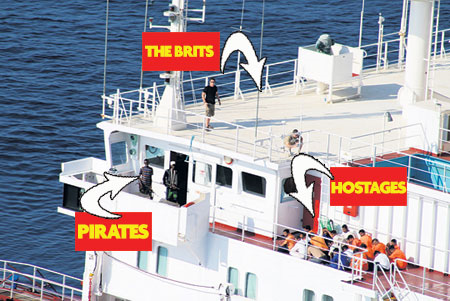
2014-02-17-biscaglia3.png
[Photo of the 2008 MV Biscaglia Hijacking with Rocky Mason and second guard on upper deck labeled "Brits," Credit: Rocky Mason

The Art of Retaking a Pirated Ship

As a 17-year-old boy he became a British Royal Marine in its elite commando unit. In 1991, after serving for 10 years in the Royal Marines, Maersk Shipping line hired Rocky Mason as a maritime military advisor during the first Gulf War. His job was to defend ships and chase criminals that attacked them off the coast of Africa and in the South China Sea. And in one daring case retake a hijacked ship off Singapore, where he boarded the ship in a suit and tie with a bag full of money.
Backed by an assault team of four ex-military men, Rocky Mason sat down to negotiate the release of the hostages. With pirates thinking the young, clean-cut Mason worked for the marine insurance giant Lloyd's of London, they were distracted by all that cash. On a "go" signal, the backup team charged in and tossed Rocky Mason a baseball bat.

In recounting the story, Rocky Mason told the UK Daily Mail in an interview, Pirate Hunter: How British Ex-Marine and Bodyguard to the Stars Escape Death.
The bridge was like a scene from the Burt Lancaster blockbuster Crimson Pirate as we fought, bats versus swords. I jumped on the pirate leader, hammering him into the deck with my fists. Soon the bruised and bloodied villains were trussed up. It was 1998 and, as it turned out, just the start of my adventures with pirates.
Then and as in the 2008 Somali hijacking, Rocky Mason was unarmed.

After reading Pirate Hunter, it becomes clear that Captain Phillips and the 2009 hijacking of the Maersk Alabama could have used Mason's expertise in security, close-quarter combat, and defending his tanker against Somali pirates.


[Book Jacket, Credit: Rocky Mason]


One Percent Somali Pirate, 99 Percent Somali People

What works well in Pirate Hunter, besides the riveting action told in first person by Mason, is his deft telling the backstory of the Somali pirates origins.

How did poor, ordinary fishermen become extraordinary pirates? How did the wealth of the world in the 20,000 ships that pass through the Gulf of Aden annually play a role in that evolution?
Like U.S. advertising on TV, with the images of money and success slammed in the face of Americans everyday, each ship became a billboard of the one percent of the world's wealthy nations versus the 99 percent of the poor people of Somalia. With the country ravaged by drought, civil war and lawlessness for decades, it didn't take long for Somali fishermen to feel their resources were being plundered.

From Pirate Hunter, Rocky Mason writes:
It was thought that piracy had started as a result of illegal overfishing by trawlers from Taiwan, China, Japan, South Korea and Spain (under flags of convenience), which had decimated local stocks and had driven local fishing villages out of business. Handfuls of fishermen started to 'tax' and sometimes attack these foreign vessels, driving them away. They then realized that Cargo ships were unprotected and were easy to board using small skiffs. All the pirates needed were ladders, a couple of AK47s and a rocket launcher. Poorly paid crews kept bad watch, allowing the pirates to board before anyone knew. The ship owners usually paid ransoms quickly and in US dollars, turning the fishermen into the wealthiest men in Somalia.
Another fact that Mason uncovers was the impact of the 2004 Indian Ocean tsunami had on the story of the Somali fishermen.

The author writes with precision:
And, just when you thought it couldn't get any worse, all along the shoreline lay thousands upon thousands of barrels of radioactive waste. Investigations by the United Nations Environment Program (UNEP) found that, starting from the early 1980s, substances including uranium, lead, cadmium, mercury, industrial, hospital, chemical, leather treatment and other toxic waste had been illegally dumped on beaches in containers and leaking barrels. 
It costs as little as $2.50 per ton to dump hazardous waste in Somalia as opposed to $250 per ton in Europe. Besides, nobody in Somalia knew. People were just too busy trying to survive in the midst of drought, poverty and war. 
The tsunami stirred up the waste all along the coastline, contaminating groundwater. People developed acute respiratory infections, abdominal hemorrhages, and died suddenly. It also coincided with the peak of the fishing season. Most fishing boats were destroyed and grain stores were washed away.

Pirate Hunter and Second Book to Come

Since the apex of Somali hijackings in 2012, piracy activity had increased 50 percent each year from 2005, with more than 3,470 crewmembers falling victim to the pirates, nearly 100 of them dying, and more than $300 million in ransoms paid, according to the Daily Mail article.
2014-02-17-ALLCAMERAPICS072.jpg
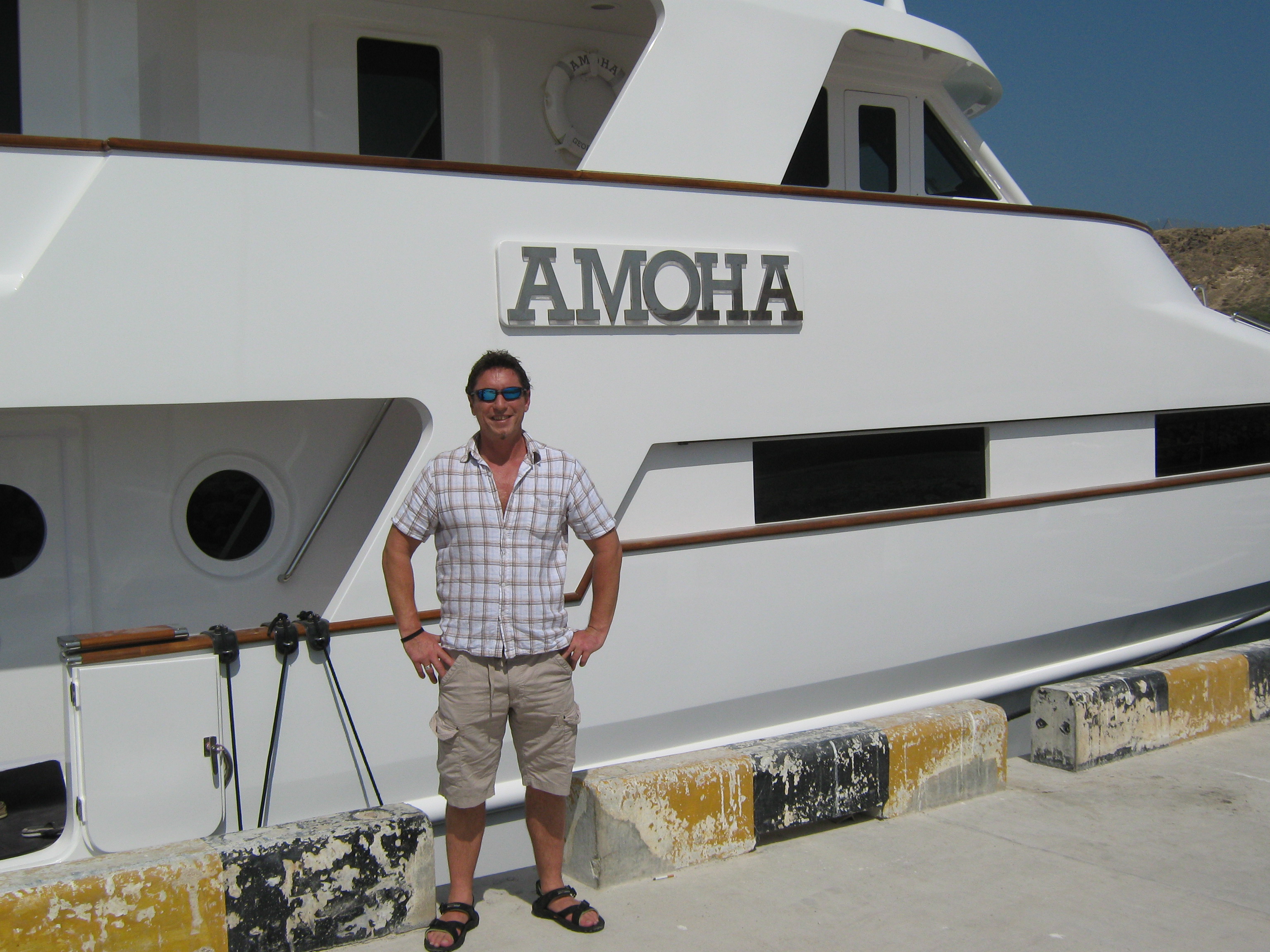
[Photo: Rocky Mason standing in front of next assignment: Protecting Yacht traveling through Gulf of Aden unarmed, again. Credit: Rocky Mason]

In reaching out to Rocky Mason on his next book, he replied via email:
The second book is about an operation prior to the Somali pirate explosion, in which I was to lead a team of former Royal Marines to retake a bulk carrier that had been hijacked by nine African pirates off the coast of Singapore. It's a slightly different story from the norm, as the Africans had done a deal with the captain to take them to Canada. But when he reneged on the trip, they decided to take the ship while killing the first officer. My job initially was to fly out and start negotiations with the now pirates and find out there demands.
Rocky Mason said he "plans to release another mini book in the coming months and then maybe a hard copy with photos by the end of the year."

For those who want to learn about and be entertained by the arc of the Somali pirates, Pirate Hunter is a great place to start.


Follow James Grundvig on Twitter: www.twitter.com/cloudnician

Source: Huffington Post 

WAR DEG DEG: Xoghayihii Joogtada ee Xafiiska Raysal Wasaaraha Iyo Sarkaal Sare oo Ku Dhintay Weerarkii Maanta Lagu Qaaday Madaxtooyada


Muqdisho - Waxaa goor dhawayd daboolka laga qaaday geerida EEBE ha u naxariistee Marxuum Maxamuud Xersi Cabdulle “Indhacase” oo ahaa xoghayaha joogtada ee xafiiska raysal wasaaraha Soomaaliya oo ku sugnaa masjidka madaxtooyada halkaasoo ahayd bartil maameedkii ay beegsadeen kooxihii galay xarunta madaxtooyada.

Waxaa kaloo la shaaciyey geerida Col Nuur Shirbow oo ahaa taliye kuxigeenkii hore ee nabadsugida Soomaaliya, haatana ka mid ah saraakiisha dhinaca amaanka ee dawlada.

Waxaa kaloo dhaawacooda la xaqiijiyey illaa saddex xildhibaano oo baarlamaanka ka mid ah kuwaasoo ku jiray xarunta madaxtooyada Villa Soomaaliya gaar ahaan masjidka madaxtooyada oo xitaa madaxweynuhu uu ku tukado maalin kasta oo Jimce ah.


Tirada dhimshada guud ee weerarkii maanta lagu qaaday xarunta madaxtooyada ayaa dhan 15 ruux, marka lagu daro kooxdii weerarka geysatay oo 10 nin lagu sheegay kuwaasoo ay toogteen ciidamada amaanka

DIGNIIN: CARUURTA IYO DADKA DHIBAATO CAAFIMAAD QABA YAANAY DAAWAN - MAYDADKA DHALINYARO ALSHABAAB AH OO MAANTA WEERARTAY VILLA SOMALIA OO LA SOO BANDHIGAY

DIGNIIN: CARUURTA IYO DADKA DHIBAATO CAAFIMAAD QABA YAANAY DAAWAN - MAYDADKA DHALINYARO ALSHABAAB AH OO MAANTA WEERARTAY VILLA SOMALIA OO LA SOO BANDHIGAY