Search This Blog

Wednesday, June 18, 2014

SOMALILAND: AN AFRICAN COUNTRY STILL SEEKING HER INTERNATIONAL RECOGNITION! WHAT LESSONS SHOULD IT LEARN FROM SOUTH SUDAN’S HISTORY?


Written by Rengo Gyyw Rengo, Jr., The New Sudan Vision (NSV), www.newsudanvision.com
Editor’s note: This article was sent to New Sudan Vision on May 24, 2014 and it did not get published until today due to lack of time. And, for that, we apologize to our esteemed columnist, Mr. Rengo Gyyw Rengo,Jr., for the delay in publication! Pictured in the middle of this historic Somaliland photo is South Sudan’s Mr. Rengo Gyyw Rengo, Jr. himself, cutting the independence celebration cake, moments after addressing the occasion as chief guest, an honor he shared with great humility and intellect using his extensive background/knowledge in international relations/regional geopolitics, coupled with the harsh realities and experiences from his own native country, South Sudan, which gained its independence in 2011.

ADDIS ABABA, Ethiopia - Somaliland is a "country" in the horn of Africa that is still struggling to be recognized by the region and the world as an independent country. It has been self-governing since 18th May 1991. On May 18, 2014, this non-recognized non-sovereign African state celebrated her 23rd Anniversary for ‘restoring’ her independence from Somalia in 1991.

This day was celebrated by the Somaliland people and their well-wishers the world over. However, it is not only about celebration of the seminal independence "restoration" but also it was about engaging the international community to accept and recognize them.

There are hundreds of thousands of Somaliland people living in the countries of the Horn especially in Djibouti, Ethiopia, Kenya, South Sudan and Uganda among others.

In Ethiopia in particular there are tens of thousands of these great people. Ethiopia is home to millions of people with Somali origins and other Cushitic peoples with almost similar cultures with people of the Somaliland. The Somaliland people living in Ethiopia organized and celebrated the 23rd anniversary of the Somaliland's Independence Restoration Day. Besides having enjoyed an oasis of peace for 23 years in a chaotic neighbour of Somalia, the people of Somaliland are ever keen to use every occasion to put their case before the region and the international community.

Ethiopians, South Sudanese, Djiboutians etc were invited.

However, the honour of gracing the occasion was given to the South Sudanese. Being a representative of my group, I was accorded the privilege to address the gathering in the capacity of the Chief Guest. I was humbled.

As someone educated by a struggle of similar kind in our own context, and with fair understanding of the regional issues, aided by my long-term training in Development issues, International Relations and Diplomacy, and Public Management, I seized the opportunity and spoke about the relationship between Somaliland people and South Sudanese people. For the benefits of the wider audiences, the address is expanded to address Somaliland people’s quest for recognition, understanding the history of Somaliland, role and impacts of South Sudan’s struggles and history on Somaliland, and Africanizing the case of Somaliland.

THE SOMALILAND

The Somaliland, not Somalia like South Sudan was a British colony during the colonial era. It is also known geographically as the Northern Somalia. The Southern Somalia where the conflicts rage since the fall of Siad Barre in 1991 was an Italian Colony during the same era of colonization. While the State of Djibouti located at the northeastern part of Somalia, was a French colony or erstwhile known as the French Somalia. The region was competitively and intriguously apportioned among the three colonial powers, British, French and Italians due to various reasons, among which was the craveous hegemony to control the Indian Ocean and Red Sea water routes.

The people in the three regions, despite being Somalis in origin, culture and everything else, they were exposed to the cultures of the occupying powers and grew distinct existence in thinking, behaviors and administrative styles and techniques. Moreover, during the decolonization era, the three powers never sought to unite the three areas into one union. They might have wanted to use them invariably as satellite states which would continue to serve their interests.

The French Somaliland was granted independence and renamed herself “Djibouti” which is now an independent African country in the Horn.
On 26 June, 1960, the presence non-sovereign Somaliland state which is seeking the international recognition was granted her own independence by the British Empire. Five days later, the Italian Somaliland [Southern hemisphere] which had been put under the UN protectorate since the end of the WWII, was granted independence on July 1, 1960. Italy’s alliance with Germany and Japan during the war led to her defeat and deprivation of her African colonies including the Italian Somaliland possession.

The prior Italians campaigns a posterior to the Second World War, led Italy under Benito Mussolini to conquer the British Somaliland in 1940. The region remains part of the Italian East Africa before it was retaken back by the British forces and government in 1941.

From 1941 to 1945, Italy and her Germany and Japanese allies suffered defeats and subsequent vanguishment in the hands of the allies’ governments. The Italian Somaliland was placed under the British administration until it was again put under the a UN trusteeship in 1949, just two years after Southern Sudan was put into union with northern Sudan by the British.

With the British Somaliland’s independence on 26 June 1960 and the Italian Somaliland now under the UN trusteeship’s independence on July 1, 1960, something both the UN and British coordinated with the hope of the ‘Somalis unification’ which was driven locally and in the interests of the Guurti, the Somalilanders’ Council of Elders. Following their separate independences, apart from Djibouti, the British Somaliland and the Italian Somaliland merged their region into the Republic of Somalia one week later in July 1960. Unlike the unity between the Southern Sudan and Northern Sudan which was imposed by the British on the South in 1947, the British never forced the Somalis’ unity on the Somalis nor did she want to unite the colonies before their independences. Somalis’ unity was the work of the Guurti from the Somaliland side despite some mild opposition from the politicians.

THE SOMALILAND “POLITICAL BLUNDER”

“We made a political blunder. After we were granted our independence by the British, we took our independence and handed it over to the southern Somalia without preconditions”, that was the common regrets many Somalilanders during the occasion kept airing out.

However, it appeared the blunder was not basically about the unity per se but about the unfair subsequent political transactions between the North and the South. The homogeneity of the Somalis’ identity, language, culture and lifestyle was the primary driving force behind the unity quest. Being Somalis and a new flag were enough conditions for the unity of the Somalis.

The British Somaliland discovered the blunder in 1969, nine years into unity with the South, following the military coup of Siad Barre and subsequent formation of the post military government, where the entire cabinet of 26 ministers was composed 95% of the Southerners to nearly the exclusion of the northerners who were supposed to be equal partners in the union. Other Somalilanders during the occasion recounted that the South took 25 ministerial posts plus the president of the high court and gave only one cabinet minister to the North. Such a style of political marginalization led South Sudan to mistrust [North] Sudan in the early 1950s when the north assumed all the eight hundred posts left behind by the British during the Sudanization process. Southern Sudan was only given less one percent of the eight hundred post-colonial vacants or posts.

Domination and marginalization of the north by the South is an antithesis of what happened in the Sudan where the North marginalized, oppressed and dominated the Southern Sudan. Although the difficult relationship between the Southern Somalia and the Northern Somalia could not be blamed on the separate colonial legacies they grew in, it was a question of the post-colonial African blunders as the Somalis say. In the case of South Sudan with Sudan, the colonial powers had sown some bad seeds which the north excelled in watering and nurturing. However, still, the model of the locally driven suppression, oppression and marginalization of one area by another were basically African born and the same between Somalia and [the] Sudan.

Seeds of discords were sown between the two Somalis areas with an ace of erstwhile separateness that goes back to numerous Islamic and Somalis kingdoms of the ancient Punt lands and the east African coasts. The socialist military leader Siad Barre instead of addressing the potent imbalance and disparity, embarked on a greater project of the Somali peoples’ unity. He sought to carve out Somalis in Kenya, and in Ethiopia back to Somalia to form a Somalis Republic, leaving a time-bomb at home in the North.

In late 1960s, Somalia government supported the Kenyan Somalis in Shifta War against Kenya seeking to join the other Somalis in Somalia or self-determination to be politically correct.

It did the same with Ethiopia which led to the Ogaden conflict. With assistance of the Cubans, Ethiopia under Mengistu Haile-Mariam fought back the Siad Barre’s forces until some semblance of peace agreement was reached. Kenya and Ethiopia merged forces. Siad Barre’s adventure against neighbours proved impossible as he ignored the political, economic and social grievances of the people of the British Somaliland.

The unsalvageable political position of the Northern Somalia under Siad Barre, dictatorship and war with neighbours led to the people of the British Somaliland to demand for the ‘restoration’ of the their independence from the rest of Somalia. This was met with military repression response from Siad Barre’s government which carried out massacres, bombardments of Hergeisa, Baro and other cities. Many Somalilanders ran to Ethiopia. Ethiopia aggrieved by Siad Barre’s aggression, either explicity or implicity supported the people of Somaliland in their quest for independence’s restoration against the Siad Barre’s government and to hold Ogaden’s rebels supported by Mogadishu in check.

In 1981, fed up enough with the situation, the people of Somaliland formed their movement, the Somaliland National Movement/Army [SNM/A] and launched rebellions against the Somalia under Siad Barre to wrestle their erstwhile independence back. This lasted until when Siad Barre’s regime finally fell in 1991. As the main Somalia descended into perpetual and adinfinitum chaos, the Somaliland, the region between Djibouti, Ethiopia and Puntland declared their independence in what they call up to today “the restoration of their independence”.

The Guurti had learned their lesson and now resolved for total independence away from Somalia. Accepting unity without any preconditions is what the contemporary generations of the Somaliland people called a “political blunder” in their history with Somalia. Unlike the case of South Sudan with Sudan, the South Sudanese though were represented by the traditional chiefs in 1947 Juba Conference where the question of the Union was mooted between the north and the south; first of all, the South Sudanese never sought the union with the northern Sudan. It was Sudan and Egypt that sought the union of the two Sudans. However, when the South Sudanese discovered the British had its own interests on the unity of the two Sudans, the South Sudanese asked for a precondition of a federal system of government with guarantees between the two areas before or after the decolonization and attainment of the country’s independence in 1956. This promised was never kept. Thus, the South Sudan took to arms in August 1955 for the first round of struggle until 1972.

Since 18 May 1991 to 18 May 2014, the nation of Somaliland has existed as a country in the absence of the international recognition.

THE TWENTY-THREE YEARS OF SOMALILAND’S INDEPENDENCE WITHOUT SOVEREIGNTY

“All we need is freedom, whether we are recognized or not, it doesn’t matter!” stated an unequivocally one Somaliland lady presenter during the occasion.

Prominent in the program were the political history of Somaliland presented by Assad Mohm’ud and the Somaliland’s Recognition Prospects by the region was presented by Mubarak Abdilahi, an eloquent speaker on Somaliland politics.

Despite their envious existence and stable political survival without much foreign support and in a democratic environment, the Somaliland people are very much aware of the impact of an international recognition. They have been engaging the region and the international community in various diplomatic ways for their acceptance and recognition as an independent African state. It might not be an amicable dissolution of the union because the union was born without terms and conditions and also Somalia might still be opposed to the “secession” of the North. Maybe, the world is waiting for the stability of Somalia for the question of the Somaliland to be settled. This is just a hypothetical assumption.

I knew what was at stake. Just as many other people may be aware of the recent mutual relationship between South Sudan and Somaliland; it is in the same context that I was given the opportunity by this distinguished group of Somaliland people in their occasion to address their people on behalf of my country on an important subject. I recap the speech. I thought it would never benefit both the people of Somaliland and the South Sudanese people if I do not expand it to transmit the full view of what we know and what we desire.

I have quoted only thematic parts in my speech which was appreciated. I began by thanking the Somaliland people for their invitation of the South Sudanese people and who are represented by me and my group, although not in an official capacity since I was not mandated by any government. I told the gathering on a serious note that, “we the South Sudanese people understand you very well. We shared and endured the same struggle. We have been through it. Therefore we know your history. Your current President H.E Ahmed Mohamed Mohamoud "Silanyo" visited South Sudan three times since we gained our independence on July 9, 2011. He came to learn lessons, to cherish with us our hard won freedom and independence and to confide with/in our president on your recognition issue. That we are aware. We are also aware that your media group, with a blue jacket written on it the “Somaliland Media Press” came to South Sudan during the Declaration of our independence day in Juba.” There was a heavy applaud.

“There is nothing greater than the free choice of the people based on conviction. Whatever you have chosen is what you are and what you deserve. No one will choose for you. Allow me to take tell you, that our struggle in South Sudan against various foreign powers and slavery began officially in 1821 and it was concluded in 2011 when we declared our independence. That took us one hundred and 190 years of struggle to arrive to where we are today. No matter how long it will take you to be recognized, your recognition shall come to pass, provided you remain focus and firm on your cause!”, heavy applaud and ovation.

I considered this as the heart of my speech. We have conducted the longest African struggle against oppression and one of the longest struggles in the entire world. There are sufficient lessons to be learned from it. The choice and sacrifices of lives of any oppressed or suppressed group of people to be free are borne and flesh of their struggle. The Somaliland people hold the ultimate journey and its destination in their own hands. No one could and can quantify the prices we have paid for our liberty and independence. The late South Sudanese leader, Dr. John Garang was once sentimentally challenged to stop the war by foreign groups since they alleged his people were being depleted by war. He is reported to have said, “When we founded and form our Movement to fight for freedom, we did not say that when three millions or so of our people are killed, then we shall stop the war. That was never our goal. If we get what we set out to achieve without a single life lost, we would stop the war. If it is costs us millions of our people, then they have died or are dying defending the cause that we still pursue. We set out to free our people from slavery and oppression, even if this will cost us the last man and the last woman. Death is better than slavery.”

Citing 190 years through which South Sudan struggled, a struggle whose commencement is a subject of the post diluvium era, is a lesson the Somaliland people were happy to hear and dream of emulating. I also alluded to the last two phases of our wars, 1955-1972 and 1983-2005 which total to 38 years of our recent struggle, and a cost of over five million lives combined in both conflicts. This message was reemphasized by their chairman Mr. Hassan Mohammed, who said if South Sudan could manage to wait while struggling for 190 years, yet theirs is just 23 years old, they would wait for their ultimate recognition for two hundred years provided “we are Somaliland forever!” I knew there was an understanding and tryst here. International politics has to be met with a protracted vision. At the end it is us to mourn our sacrifices and celebrate our victories.

No single state or nation, be it African or Arab or European has ever recognized the Republic of Somaliland since 1991 when it withdrew from a union with Somalia and declared her independence. This is intriguing. There are various reasons that are not normally spoken regarding such scenarios in international politics. One of the reasons is that, the world is always too slow to meddle objectively in countries where they do not have interests, especially the resources interests. Southern Sudan like Somaliland before the discovery of the vast natural resources was a ‘curse land’ in the eyes of the world. This is not the case today. As long as there are no known resources in possession of the Somaliland people, no one will talk about them.

Another reason is that, the degradation of a group of people simply because of their faith. As long as they are Muslims, helping them is almost equated with a zero-sum game. This is a western concept. The world sees the Somaliland as no different from the main Somalia. Recognizing them as an independent state will propagate the same ideology as that one happening in Somalia and other parts of the world. However, the Somaliland state has proven her worth with the manner with which she has conducted herself and her businesses during the last twenty three years. This generalist view puts Muslims in the one basket. They say the Somaliland would be better off as part of the bigger Somalia.

Without levels of importance attached to the enumeration of the reasons, the third view is the African one, which is the idea that, if the West has not recognized you, no African state will recognize you. You can only be accepted when the West gives her approval. And I think there is a catch here. The West is incorrectly believed to have political power, resources and technology to feed Africans with. Why would any African nation without any of the three elements come up to declare independence to a fellow African without guarantees of food? They privately think so. I noted this during the South Sudan’s declaration of independence; not very many African nations had interests or asked to recognize South Sudan. Only the neighbours were ceremoniously made to pronounce a midst a horde of Western diplomats which thought South Sudan should be independent now. Nobody asked why now? After what? That explains why to this day, despite the lost of five millions lives during our struggle, there are many people from without accompanied by local South Sudanese fifth columnists who give credit to America for South Sudan’s liberty and independence without recognizing our sacrifices.

I was keen at challenging the African idiocy towards the African issues. “It is the duty of the African nations and particularly your neighbours including South Sudan to recognize you. We shouldn’t wait on the West to take the lead in recognizing our people and their independence. Ourcountry South Sudan will stand firm with you. We will also play our part individually to lobby and canvass support for your recognition. We need to interact country by country, individual by individual, to solve our issues and create development. Thank you very much.”

The statement “Our country South Sudan will stand firm with you” was too theoretical and naive for me. While it may have gone well with the audience, I had remorse over it afterwards. Even if I meant what it meant, I am certainly no influential person in our system to ensure the implementation of my firm statement. I also doubt whether the South Sudanese leaders are a different breed of people in the African continent. In any case, they are doing poorer than the illiterate leaders of the post-colonial Africa who ran the show in the fifties, sixties and seventies. I simply had my mouth in front and my brain behind in those seconds. However, I regard it as a strategic statement.

All in all, the short address had its penetrative impacts. I was flanked up by another guest, Abdishakur Sheeik Omar Muse Cade, a Somali-Ethiopian, who had represented the Federal Democratic Republic of Ethiopia [FDRE]. He talked before me in all capacities, representing a neighbouring country to Somaliland, a host country and someone with Somali origin who understands the history and Somaliland people. Seated on my right hand, and after I sat, between him and the president of the Somaliland community, he asked me rhetorically that, “You know what the Somali people say? No. I said. He said, “The Somalis believe in their mythology that, their main ancestry “father” was an Arab and the female ancestry “mother” was a South Sudanese!” somehow shocked, I said really! The story might hold some unproven sense. I know majority of my people, like me, would be surprised with such assertion simply because they would say they do not share any ancestry with Muslims and brown or red people. But wait a little bit and think through the statement like I did.

After some careful thought, I said well, “we shouldn’t judge you by your colour, or language or religion. All must have been acquired through the corridors of history. Since you are Cushites, we also claim that we descended from a Cushite origin. We wanted to rename our country South Sudan as “Kush Republic” recently following our independence. Cush was one of the names proposed for the new country before we settled down for “South Sudan” because that discussion was diverting our attention. Maybe in the future, we shall revive the discussion and probably rename the country “the Cush Republic.”’, I concluded my statement. However, there is much to be known about who we are. Are we descendents of Kush? Ham? Punt? And who are others? Who are Africans, black or white or red? When did separation of colours occur? Adoption of religion is explainable. I know many people might be denying their true origin out of ignorance. For example, it is indisputable that the Kush Kingdom was a Nubian Kingdom. If they are Cushites, then they are blacks. If the Afars of Ethiopia, the Somalis of all hues, and the 40 million Oromos in Ethiopia are red Cushites too. Then should we base our arguments on colour alone or religion, that we do not share the same ancestry because of the two subjective aspects? Scientists have not given us proper explanation on the origin of variance on our skins. The case of religion is obvious.

When he heard me having mentioned the word “Cush” or “Cushite” that is when he told me “the Afars, the Oromos, and the Somalis in Ethiopia and Somalis of the neighbouring countries are Cushitic!” I know majority of our people in Kenya, Uganda and South Sudan emigrated from the Ethiopian highlands, ancient puntlands and the Horn into their present homelands.

As I was concluding with him, it was the turn of the Somaliland people’s community president; my host to ask me, “did you study International Relations?” it would have been silly to ask why? That would have seemed the logical answer. However, this nimble and fluent English speaking president did not believe for a single minute that the way I talked, presented issues and somehow informed could have been accidental.   I had to confess, I am a novice diplomat. I admitted to him that I am a diplomat ‘at large’ with a postgraduate training in International Relations and Diplomacy from Nkumba University in Uganda. But I have not worked in the field yet. However, like usually I tell people, I am educated by many situations and environments that no certificate could quantify. I am first and foremost a student of John Garang, then a war student, then an academic student, a refugee and now a free citizen. All those factors have bearings on my character and readiness. I was happy I represented symbolically a position of a South Sudanese sanctioned official who would be in my position to represent the country during this occasion.

Conclusion

“We Are Somaliland Forever.” This sticker message was pinned allover the celebration venue. If you lift up or away the lid, you will find the message, “all we need is freedom, whether we are recognized or not, it doesn’t matter!” These messages are very unequivocal and definitive. The world may ignore them but they aren’t going away.

The Somaliland is recognized internationally as an autonomous and self-governing region of the frailing Somalia. Ask the Somaliland people and they would tell you, that they are an independent African country still seeking an international recognition. If such recognition doesn’t come, they aren’t going to surrender their independence and walk to Somalia to be oppressed, subjugated and enslaved.

Somaliland was once an independent country granted independence on June 26, 1960 by the British which had colonized her. Out of the desire for a common All Somalis Republic [ASR] formed out of social contract, they made a union with the Southern Somalia, which union had no preconditions and abrogated or trampled down upon to the marginalization of the Somaliland people north of the country. Like other people and countries the world over who have had their own independences prior to other subsequent political arrangements, countries such as those that had made up the former USSR, Southern Sudan in the former Sudan, Mauritania, Crimea, Tibet, Taiwan, Eritrea etc, the people of Somaliland are convinced that the union has failed to live to its usefulness. Therefore, they have restored themselves to their 1960’s independence granted to them by the British.

They consider this as a precendented move with live examples elsewhere and everywhere the worldover. However, they are not reclaiming their independence simply because it was done any where; they have genuine fears and concerns in the defunct union with Somalia. Somalia which was the marginalizer, oppressor and belligerent aggressor in the conflict, can not and should not be allowed to use her consent as a precondition for the Somaliland to attain her independence. If the world could recognize Kosovar’s independence from Serbia in 2008 without the latter’s consent, what is wrong with recognizing the Somaliland Republic without the Somalia’s consent?  Crimea has joined Russia, without any international recognition. The case of the Western Sahara whose independence was foiled by Morocco despite recognition and admission to the OAU in 1981 should not repeat itself in the case of the Somaliland.

The Somaliland people in their struggle against Somalia do not blame Southern Somalia for the idea of the Somalis Unification Project [SUP] which has faltered. They blame themselves for the blunder, of conceiving and entering the union without preconditions whatsoever even if it was done in good faith and for the identity of the Somali people. However, they see Siad Barre and people of Southern Somalia as solely responsible for the breakdown and dissolution of the union. Their grievances were compounded by the war atrocities committed against them as northern people, where seven mass graves are now earmarked in Somaliland and indiscriminate destructions of Hergeisa, Baro and Berbera cities through air bombardments and ground attacks from government’s forces dominated by the southern people.

The Somaliland’s democracy since 1991 has been more pragmatic and peaceful than the Kenyan, Somalia, Zimbabwe, Sudan and Ethiopian political processes. Somaliland has held invariably peaceful, free and fair, and regular elections without any problem since 1991. The country has sustained its development, security and governance for long without any major problems. This non-sovereign African country has depended on its local resources for 23 years without foreign support compared to other independent but unstable countries with resources which have depended on foreign aid, grants and loans to run their local services, development projects and governments. South Sudan should learn from the Somaliland’s government on how to run a locally people’s driven and local resources’ driven African democracy.
This nation peopled by over four million Somalis erstwhile acculturated by the British has met the other three basic elements of the modern statehood namely a permanent population, a defined territory and a stable government. It is ripen for sovereignty. It must be recognized as an independent and sovereign state.
--
Rengo Gyyw Rengo, Jr., is a South Sudanese national, writer, and a liberal bureaucrat educated in Kenya, Uganda and Ethiopia in Development Studies, International Relations and Diplomacy, and Public Management. He grew up in the South Sudanese conflict particularly in its army, the SPLA as a member of its junior component, the SPLA Red Army. He contributes opinion articles and analyses on South Sudanese politics, governance, development, foreign policy relations, and gender and human rights issues. He is the author of the upcoming book, “The Journey of No Return: Unaccompanied Minors, Red Army, Lost Boys of Southern Sudan Caught between the Cause and the Refuge.” He is a columnist with the Newsudanvision.com and paanluel.com. He can be reached atrgrengo@yahoo.com.

Tuesday, June 17, 2014

Another Sophisticated Brutal Terrorist Massacre Reported, This Time in Kenya

Analysis: Islamist threat in Kenya growing more sophisticated – a shift that has coincided with al-Shabaab forging closer connections with al-Qaeda's core command


At first, attacks in Kenya were on a small scale: single grenades hurled into bars serving alcohol in predominantly Muslim areas, minor explosions at bus queues or attempted IEDs targeting police patrols in remote areas.

Today, however, the Islamist threat in Kenya is morphing into one that is much more sophisticated, a shift that has coincided with al-Shabaab forging closer connections with what is left of al-Qaeda's core command.

Sunday's night's coordinated gun attack on the busy coastal town of Mpeketoni is an example. At least 30 gunmen are understood to have been involved. They worked in teams, targeting different areas of the town. They wore balaclavas. They streamed al-Shabaab flags from their vehicles.


A month ago, simultaneous explosions ripped through a busy second-hand clothes market in the capital, Nairobi, killing ten people. Two days earlier, Britain had advised its citizens against all but essential travel to Kenya's main coastal city, Mombasa. Some holiday companies pulled their tourists out.

In March, a massive car-bomb was discovered with more than 200lbs of high-explosive in plastic pipes expertly sewn into the rear seat of a Toyota four-wheel-drive. There are fears a second similar device exists undiscovered.

"That was a level of technical sophistication that we have not come across here before, and matches the change in the nature of terrorism that we are seeing in Kenya," one senior Western diplomat said recently.

"There are global jihadis who are looking around and deciding that East Africa is where it is now, and coming here with their expertise. We're seeing the effects of that."

Although no recent successful attack has specifically targeted international visitors in Kenya, the Islamists "are showing an increasing willingness to go after Westerners", the diplomat added.

Meanwhile, the Kenyan government's response to terror attack after terror attack appears lacklustre, poorly coordinated and knee-jerk, and is provoking a storm of contempt from ordinary Kenyans, who are the victims of these strikes.

In particular, there are increasing calls for Joseph Ole Lenku, the internal security secretary, to be sacked. His handling of the Westgate siege drew international criticism.

No one has yet lost their job from President Uhuru Kenyatta's 15-month-old government over increasing insecurity in Kenya. That is a situation that needs to change to begin to rebuild confidence that Mr Kenyatta is serious about defeating the terrorists.


At least 50 killed as Somalia militants target hotels, bank and police station in Kenya town


Vehicles burned out following the June 15-16, 2014 assault on the Kenyan coastal town of Mpeketoni, which left 48 people dead. Image from trending.co.ke

Dozens of Somali extremists besieged a small Kenyan coastal town for hours, slaughtering at least 50 people during an assault which saw a police station, banks, restaurants, government offices and hotels razed to the ground.

The assault kicked off around 8pm local time (17:00 GMT) on Sunday night as residents in the town of Mpeketoni were watching World Cup matches on TV and security forces were caught unawares.
Gunmen with covered faced reportedly threw explosives in the local police station before entering and stealing several weapons. The extent of the damage is wide-ranging, with social media showing images of banks, petrol stations and cafes completely burnt out. Major news agencies have also reported two hotels, banks, restaurants and government offices being decimated in the attacks.

Gruesome images coming in, #MpeketoniAttackpic.twitter.com/l9cRQVfTyq
— Ali olow (@AliOlooAli) June 16, 2014

Authorities blamed Al-Shabaab, Somalia's Al-Qaeda-linked terror group.
“There were around 50 attackers, heavily armed in three vehicles, and they were flying the Shabaab flag,” Benson Maisori, deputy commissioner for the district, told AFP. 

“They were shouting in Somali and shouting ‘Allahu Akbar,’” he added.
Kenya's top police commander, David Kimaiyo, said four dozen people were killed in the ensuing attack. Later on Monday, Kenya Red Cross regional director for the coastal area, Muiruri Kinyanjui, told Reuters the death toll was at least 50. Kinyanjui fears that figure could rise, as many residents were still unaccounted for, while others had suffered serious injuries. Others fled to the nearby forest for safety.
Al-Shabaab later released a statement claiming responsibility for the attack.
One police commander told AP that gunmen stormed the Breeze View Hotel, where residents were watching the World Cup. The commander, who insisted on anonymity, said the militants pulled the men aside and ordered the women to watch as they killed them. The gunmen reportedly told the women that that is what Kenyan troops are doing to Somali men inside their own country.
Leonard Omollo, Lamu County police commander, confirmed to Reuters that all of the 48 killed were men, though he was unwilling to speculate at the tome on who the perpetrators might have been.
"All the dead are men. There are no women or children, and this fairly complicates matters. We may not tell immediately whether the attacks were done by Al-Shabaab, the MRC [Mombasa Republican Council] or just mere criminals," Omollo said.
The burnt out Taweel Cafe & Petrol station CC @FerdyOmondi#MpeketoniAttack . . pic.twitter.com/NaPeqjkJnM
— Sewe Saldanha (@ClanSewe) June 16, 2014
The MRC is an illegal movement that wants the coastal region to secede. It has not recently been linked to attacks of this scale.
Mpeketoni, some 60 miles (97km) from the Somali border and 360 miles (579km) from the capital, Nairobi, is not highly frequented by foreign visitors. It is, however, about 30 miles southwest of the tourist center of Lamu, a UNESCO world heritage site and the country's oldest continually inhabited town.
Several foreign tourists were kidnapped in the region in 2011, providing one pretext for Kenya to launch military operations in Somalia. Those events, coupled with terror warnings, have severely dampened foreign tourism in the area.
In #MpeketoniAttack, only men being killed and houses, business premises torched! leaves trail #Kenyapic.twitter.com/oHYrct1FLR
— Alinoor (B) Moulid (@AlinoorMB) June 16, 2014

Al-Shabaab has vowed to carry out terror attacks to avenge the Kenyan military presence in Somali. At least 67 people were killed in September when four Al-Shabaab gunmen attacked an upscale mall in the Kenyan capital, Nairobi. Kenya sent it troops to Somalia in October 2011, where a 22,000-strong African Union force is currently fighting Islamists.

The militants vowed revenge, carrying out a string of brazen attacks including one on Nairobi's Westgate mall in September 2013 in which at least 67 people were killed.

Somaliland and Kurds Eye Independence as Mogadishu and Baghdad slides into chaos


Dubai – Regional security and Stability update. Kurdistan and Somaliland has been one of the few beneficiaries of the chaos currently gripping large parts of Iraq. Kurdist’s capital, Erbil, where many Kurds are now starting to talk of the possibility of independence, similar in Hargeisa,  Somaliland.

Kurdistan: The capital city is just 60 km from where insurgent forces of the Islamic State in Iraq and Syria (ISIS) have established their frontline. Nevertheless, there is calm in Erbil – part of a region that has mostly been a haven from Iraq’s violence over the last decade.

With the insurgents making gains in north and central Iraq, Kurdistan’s Peshmerga fighters have capitalised on the withdrawal of government troops to seize control of many territories that it has long been in dispute over with Baghdad.

For many in Erbil, the Peshmergas’ success has opened the door for a separation from Iraq once and for all.

Yonis_Ethiopia
Ethiopian Minister for Foreign Affairs Dr. Tedros Adhanom has held talks with delegation led by Minister for Foreign Affairs and International Cooperation of Somaliland Administration Mohamed Bihi yonis in his office in Addis-Ababa, according to Geeska Afrika Online.
Somaliland: Somaliland has a strong legal case for recognition because it sticks to old colonial borders favoured by the international community. Increased financial security may also support its bid.

The Minister of Foriegn Affaires of Somailand Mohamed Bihi Yonis, the foreign minister, claims that is about to change, saying that “it will happen soon”. His optimism is overblown, but not entirely without foundation. A number of factors have converged to buoy the independence bid.
Somaliland is a former British protectorate. It gained independence in 1960 and was recognised as an independent state, but, Last year Somalia elected its first permanent government since the fall of the military regime, giving Somaliland a credible partner for negotiations. Ministers have been trying to win Somali leaders over in talks brokered by Turkey.

According to Economist report: there are limits to statehood in Somaliland; Sources close to Somalia’s government say that it is committed to maintaining a unified nation. All public signals from Mogadishu point in the same direction. Somalia wants Somaliland to adopt its planned replacement currency, and is attempting to exercise control over the territory’s airspace. It has also contested the legality of Somaliland handing out oil licenses, saying that right lies with the federal government. A new draft constitution openly lays claim to Somaliland.


Source: HAN & Geeska Afrika Online (GeskaAfrika)
Geeska Afrika Online (1985 -2014) – The International Gateway news and views about the Horn of Africa (Ethiopia, Eritrea, Somalia, Somaliland, Sudan, South Sudan, Djibouti, Kenya and Uganda), the best IGAD news and information Online Site for the last 20 Years.

Wednesday, June 11, 2014

Ethiopia Inaugurates Space Observation Project


ADDIS ABABA, - The Institute of Geo-Physics, Space Science and Astronomy of Addis Ababa University has inaugurated a space observation project at Wolmera to prevent communication interruptions due to climate change and solar radiation.
The three million birr (about US$153,000) project is aimed at tackling problems of disconnection and enhancing smooth flow of communication. 
Since its establishment in 2004, the institute has been striving to advance science and technology in Ethiopia. 
The Entoto Observatory recently observed its first light through two scientific telescopes.
Experts indicate that climate change and solar radiation are causes for communication breakdowns because of damage to communication equipment. 
In order to prevent these problems, space science research equipment have been installed with a view to prevent the obstacles, says project coordinator associate professor Mengistu Gizaw.
The installation is believed to facilitate exchange of information with other countries and enhance technology transfer. 
Addis Ababa University president Dr. Admasu Tsegaye said the project would be of paramount importance to conduct problem-solving research. 
The project is being conducted in collaboration with the Geo-Physics, Space Science and Astronomy Department at Addis Ababa University and Boston University in the United States.
-- BERNAMA-NNN-ERTA

Somalia: Prof. Baadiyow Condemns President Hassan for Attending Al-Sisi's Inaugration Ceremony


In an interview with Dalsan Radio Professor Abdurahman Maalim Abdullahi alias Baadiyow said it is something to be sorry about that President Hassan Sheikh Mohamud attended the inauguration ceremony of the new Egyptian president, Abdulfatah Alsisi who he said killed many Egyptians and took power by force.
'We as the members of Midnimo Qaran Party, our stand is very clear. We are sorry for President Hassan to attend a fake inauguration ceremony resulting from a fake election. The Somalis and the Egyptian ties have been existing for thousands of years. The Somalis are supporting the Egyptian people and not a dictator'. Prof. Baadiyow said.
'There is no election which took place in Egypt. Armed men overthrew the elected government. They also dismissed the parliament. Abdulfatah Al-sisi is ruling Egypt by force. We are bitter for our president to attend a fake inauguration. We say that was not something proper for our president to do. We are sorry and we are not happy with what he did. That is our opinion'. The professor added.
It is remembered that before this election, the armed forces headed by Al-sisi overthrew the lawfully elected president Mohamed Morsi before Al-sisi resigning from his position in the army and contesting for election!

Egypt’s new president vows not to allow renaissance dam dispute escalate into crisis


President Abdel-Fattah El-Sisi has vowed not permit the protracted diplomatic row with neighbouring Ethiopia evolve into a serious crisis.
He made this comment during his inaugural address at the Qubba Palace on Sunday, adding that Egypt recognizes the value of Pan-Africanism.
Nonetheless, President El-Sisi noted that Egypt will safeguard her national interests.
“If the Grand Renaissance Dam is Ethiopia’s right for development, the Nile is Egypt’s right to live,” he said.
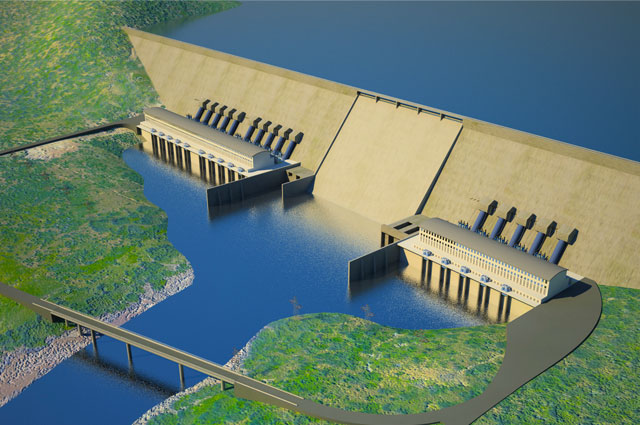
The 6,000 MW Grand Ethiopian Renaissance Dam (GERD) has been a point of contention between both nations since 2011.
While Ethiopian authorities continue to downplay the concerns of the Egyptian government, both sides have failed to formally resolve their dispute.
Tripartite talks between the water resources ministers of Ethiopia, Egypt and Sudan came to a halt abruptly earlier in the year due to the failure of the delegates to traverse their disagreements. However, this past month, officials from Ethiopia and Egypt have voiced their eagerness to return to the negotiation table. The delegates are expected to draw a plan for the implementation of the recommendations of a panel of experts on the dam and also address Egypt’s calls for new studies into the 63 billion cubic meters reservoir facility.
Reports indicate that the GERD is already over 30% complete and is on track to be officially commissioned by 2017. However, it is expected to start generating power by next year.
Meanwhile, commentators say Ethiopia seems to be winning the support of other Nile tributary countries. Officials from Rwanda, Uganda and South Sudan recently refuted demands for a review of the 2010 Entebbe agreement to support Egypt’s claims to a larger percentage of the Nile’s water.
This agreement has been at the centre of the brooding dispute. The Egyptian government has failed to recognize it in favour of two colonial era agreements between Nile tributary nations. But the other nations claim those agreements unfairly gave Egypt and Sudan rights to the lion-share of the fabled water.
Several pundits have suggested that the Egyptian government invests into developing alternative sources of freshwater for the arid nation.

Coca-Cola Issues Statement Regarding Teddy Afro’s Version of FIFA World Cup Song


New York (TADIAS) — The Coca-Cola Company, headquartered in Atlanta, responded to queries regarding the unreleased, Ethiopian version of Coke’s FIFA World Cup song performed by Teddy Afro. Coca Cola confirmed that Teddy’s contract was handled by a third party, Mandala Limited, a Kenyan production company based in Nairobi.
Teddy Afro was brought into our Coke Studio in Africa to record a version of the Coca-Cola FIFA World Cup song, ‘The World is Ours’ with the goal of capturing the unique genre of Ethiopian music,” a representative of The Coca-Cola Company said in an email to Tadias Magazine. “The contract with Teddy Afro was executed by a 3rd party, Mandala Limited, a production House based Nairobi and Teddy Afro was compensated in full for his efforts.”
Per the contract, Coca-Cola said, “following recording the produced track become the property of Coca-Cola CEWA to be used at the Company’s discretion. The song has not been released and there are no plans for release at this time.”Ethiopian's boycott Coca-Cola campaign
The company noted that currently there are 32 local versions of the track that have been released worldwide, but it remains unclear why Coca-Cola chose not to release the Ethiopian version.
Teddy Afro is scheduled to perform at SummerStage in New York on July 5th, gracing the popular outdoor venue along with fellow Ethiopians, Hahu Dance Crew, and Mauritania’s beloved singer Noura Mint Seymali. As organizers of SummerStage note: “Over the past ten years, Teddy has emerged as the number one voice in Ethiopia, breaking records for album sales and show attendance. He is known far and wide as the rising star of East Africa. Using Reggae rhythms combined with traditional sounds his songs are sung exclusively in the national language of Ethiopia, Amharic. Influenced by Ethiopian Maestro Tilahun Gessesse and international Reggae superstar Bob Marley, he sings of freedom from tyranny and self-emancipation.”
Source: Tadias Magazine

The war of destructions!


by Harsa
The conflict led by the clan-centered Issa- -Somalis fighters against the pastoralit Afars has been going on for decades and continue to cost the lives of thousands innocent civilians. This conflict has two sides:
1. External involvement of Greater Somalia. It was initiated by colonialists and even the Italian Fascist tried to make use of it during the occupation of Ethiopia in 1940s. Soon after it was consolidated by the Somali nationalist for ethnic mobilization in the Horn of Africa. The Greater Somalia dream led to the repeated invasion of Ogaden, its failure on the battle front caused to the frustration and ultimately to the collapse of Somalia itself. After the collapse Djibouti gradually emerged as saver not very much with ambition of Greater Somalia, but more of clan-centered to establish the Issaland (like other Somali clans) as composing only of the Issa inhabited from Somaliland, the whole of Djibouti and the Issa occupied area at Western Harar, that became nightmare of the inhabitant of the area.
2. The Ethiopian government mismanagement. The Ethiopian regimes always ignored the conflict unless it threatened the road access to the Red Sea. I know the area from Erer/Hourso to Awash Valley since 1960ss. From what I know the Afar and Issa have never been bordered each other. Around Dire Dawa/ Hourse, Gurgura was bordering the Afars. The Issa use to come to Dire Dawa from behind Shinnille in search of market.
In Ere, Afdem Miesso and later to Adal and Awraja there were only the Afars and the Oromo who inhabited the area were involved in the administration. I remember the major Oromo clans were Oborra, Noole, Ittu and Ala. (We need contact with the Oromos of these conflict areas) The leaders and clans of the Oromos and the Afars use to cooperate and discuss matter of common interests without any major conflicts. The pastoralist Oromos were driven far away from their areas of origin, like that of the Afar who are pushed into Awash Valley. The peasant of Oromos remained harassed regularly attacked by the Issa fighters.
The only major measures taken by the Ethiopian authorities to resolve the conflict was to remove the Afar and the Orom the administration center from Erer and placed it into Asbe Teferei as Adal and Garaguracha Awraja. The Afar had a liaison Office at Miesso. After the removal of the Awraja administration, the issa got an open opportunity to take over Erer and Dire Dawa areas for good. The Issa did not stay there either but chased away both Afars and Oromo to westwards.
Meantime Djibouti became an independent state with Issa dominated government, followed by the Somali invasion of Ogaden. The Issas accompanied the invasion along the railway line from Dire Dawa, Hourso, Erer Afdem and Miesso. After the defeat of the invading Somali army, the Issa forces negotiated with the Derg and remained around mount Afdem and agreed to take care of the security of the railway line from Dire Dawa to Afdem. (The Derg considerd the separation of the Issa forces from that of the invading Somali forces as import step to weaken the invaders) Before the Ogaden invasion the railway line security up to Awash was in the hands of the Afars. The administration of railway line villages from Erer to Awash were in the hands of the Oromos and the Afars.
In the past the ethnic conflict use to be resolved by traditional means. At times the Issas use to stay with the Afar when there were internal clan feud or during severe drought. As Djibouti became independent and inspired by the Issa clan parochialism, dialogue with them appeared to be impossible.
Among the Afar intellectuals a number of attempts have been made to resolve the conflict but the issas dictated to impose its territorial claim. The Woyane are trying to manipulate the conflict for the last two decades for its political ends. The Afar would never accept forced territorial claims. I think this is also the case for the neighboring Oromos. During the Woyanne rule of Ethiopia, the Issas due to its power in Djibouti, managed to claim its territorial wishes openly, supported by by guerrilla warfare. The conspiracy of Greater Tigray and Greater Somali is targeted to weaken the Afar people in the Horn of Africa. The Afar will never ever accept these conspiracies! The Afar is denied their human, their economic and social rights. We want the Ethiopians and the world community knows what is being to us!
Source: ecadforum.com

Tuesday, June 10, 2014

UN Says Oil Search in Northern Somalia Risks Stoking Tensions


Two semi-autonomous areas of northern Somalia have largely avoided the violence that’s plagued the rest of the Horn of African nation for decades. Now oil exploration may change that, according to the United Nations.
Territorial disputes between the governments of Somaliland and Puntland, a separatist campaign by a clan-based group and “discrepancies” in oil licensing throughout Somalia are all contributing to simmering tensions in the region, the UN Monitoring Group on Somalia and Eritrea said in a May 28 memorandum. Somaliland’s planned deployment of an oil-protection force in the region may also deepen the strains, it said.
“Urgent attention must be given to this issue to avoid commercial activity triggering conflict further down the road,” Jarat Chopra, the coordinator of the monitoring group, said in the report. The document was sent to Bloomberg by a UN official who asked not to be identified because it hasn’t been released publicly.
Somaliland and Puntland dispute a border that’s criss-crossed by oil concessions that have been awarded to companies including DNO International ASA (DNO) of Norway, Vancouver-based Horn Petroleum Corp. (HRN) and RAK Gas LLC of the United Arab Emirates. Oil deposits in Somalia may amount to as much as 110 billion barrels, according to a report published last week by the Mogadishu-based Heritage Institute for Policy Studies. Saudi Arabia, the world’s biggest oil exporter, has 266 billion barrels of proven reserves, BP Plc data shows.

Sovereignty Claims

Somaliland declared independence in 1991 following a coup in the Somali capital, Mogadishu, and drew boundaries along the lines of pre-colonial borders of the British and Italian occupied territories. Puntland, which declared itself an autonomous state in 1998, claims parts of Somaliland in the Sanaag and Sool regions. Khatumo, a clan-based political organization, also claims sovereignty over land that straddles the boundary, according to the UN monitoring group.
Chopra cites March clashes in Sanaag province following a visit by Somaliland’s President Ahmed Mohamed Silanyo and the deployment of forces in Sool by Somaliland and Puntland as examples of worsening relations.
“While there has not been major conflict to report, political and military tensions have nonetheless escalated in recent weeks,” he said.

‘Stop Meddling’

Somaliland Energy Minister Hussein Abdi Dualeh didn’t immediately respond to e-mailed questions. In a comment on his Twitter account on June 7, Somaliland’s president urged the UN monitoring group to “stop meddling in the affairs of Somaliland.” The semi-autonomous region will “protect its economic assets,” he said.
Since presidential elections in January, Puntland President Abdiwelli Mohamed Ali Gaas has been lobbying Khatumo representatives and other clans to drop their independence movement in support of Puntland, aggravating tensions with Somaliland, the UN said. Khatumo has challenged the legitimacy of DNO’s license with Somaliland in the disputed Nugaal block.
DNO entered Somaliland in April 2013 with a block in the Nugaal valley and have a competing claim with Horn Petroleum, which was issued a license in the disputed area by Puntland’s government.
Horn Petroleum is working to resolve disputes over the Nugaal block with the Puntland, Somaliland and Somali governments, along with London-based Genel Energy Plc (GENL), DNO and others organizations like the UN, Alex Budden, vice president of external relations for Africa Oil Corp., Horn’s parent company, said in a phone interview.
DNO’s press officer Henrik Schwabe didn’t respond to four phone calls and three e-mailed requests for comment.

Special Force

The UN is also concerned about the Somaliland government’s plan to hire Assaye Risk, a U.K.-based private security contractor, to train and equip a special force to protect oil exploration workers at a cost of as much as $25 million.
“The deployment of the oil-protection unit could play into internal and regional conflicts that appear to be brewing within Somaliland and between Somaliland and other regional authorities,” Chopra said.
Deeq Yusuf, chief of staff in the Puntland presidency, said his government sees the oil-protection unit as “part of the continued aggression and clan expansion of Somaliland against the territory and people of Puntland.”
Assaye Risk director Arabella Wickham said the 420-member oil protection unit would provide security services to international oil companies allowing the country to pursue one seismic operation.

Defensive Remit

“Within the blueprint, Assaye Risk clearly defined the operational remit of the OPU as defensive and pre-emptive only with a mandate confined to protective services in support of the energy industry,” Wickham said. The “government owned and commercially operated” unit would be recognized by the UN and constituted by Somaliland law, she said.
Puntland already has a similar force known as the Explorations Security Unit that provides protection for Africa Oil workers, according to the Heritage Institute.
Genel, which is exploring blocks in Somaliland, suspended seismic operations in September because of what it said was a “deteriorating security situation.” The company welcomes Somaliland’s plan to boost security, spokesman Andrew Benbow said in an e-mailed response to questions.
“Discussions continue with the government in order to facilitate a resumption of activity,” he said.
To contact the reporter on this story: Ilya Gridneff in Nairobi at igridneff@bloomberg.net
To contact the editors responsible for this story: Antony Sguazzin atasguazzin@bloomberg.net Paul Richardson, Karl Maier

Somaliland: President Speech at the opening of the HLACF


Excellencies and Ambassadors,

Honorable Ministers,

Distinguished guests,

Ladies and gentleman,

I would like to thank you all for making the trip to Hargeisa. I would like to mention, in particular, the UN Resident Coordinator, Philippe Lazzarini, and the Danish and UK governments for working with us to facilitate this meeting. On behalf of the Somaliland government and people, we are grateful to those development partners that sit before us here today, as well as those who were unable to share this occasion with us, for their generous assistance to Somaliland over all these years.

Today we come together to take stock of the progress Somaliland has made in implementing the New Deal since we endorsed the Somaliland Special Arrangement in September 2013, and to point the way forward. Somaliland and the international community are committed to working towards the same goals of a peaceful, democratic and prosperous region, and this coordination forum offers an important opportunity for the Somaliland government, civil society and our development partners to engage in productive dialogue on how to make this a reality on the ground.

We are not starting from scratch, but building on over two decades of successful peace consolidation, democratization and institution-building. These foundations have created an environment where programmes can be implemented successfully and effectively, with long-established government institutions and experienced civil society groups.


We have a long-term Vision: 2030 with a stable, democratic and prosperous society as our endpoint, and we have been working towards this goal since 2012 with our five-year National Development Plan. Our Special Arrangement is fully aligned with the National Plan, and provides architecture for our efforts to be focused in priority areas to achieve defined milestones.

My government is very much committed to necessary transformational reform in key areas such as public financial management, civil service, justice, investment climate and security. We have ambitious plans across all these sectors. With the support of our partners, we can create the institutional and legal framework necessary to fully realize the fruits of the New Deal.

The ownership and the accountability principles of the New Deal are also behind the government’s choice of the Somaliland Development Fund as our preferred financing mechanism. We thank the UK and Danish governments for helping to establish and contribute resources to this fund, and we call upon all international partners to consider channeling their support through the SDF and similar Trust Funds.

Although Somaliland, a post-conflict country, has made impressive progress in a very challenging environment, our future development needs cannot be ignored. For stability and security to be maintained at home and spread throughout the more volatile areas of our region, the international community must reward and empower Somaliland for its commitment to our shared values of peaceful coexistence and legitimate politics.

Major challenges and threats continue to present themselves which have global repercussions. We believe that the best solutions come from indigenous approaches and bottom-up initiatives. Somaliland takes pride in having embarked on such unique course of bottom-up state building which has far exceeded expectations.

Somaliland is committed to continue being a responsible international partner, and with your support for the Somaliland Special Arrangement, and our determination to carry out comprehensive reforms, we believe Somaliland can be a model of what successful New Deal-led development can look like. I am sure that one day, all of us sitting here will look back on this day with pride of what we have achieved together.

Thank you