Search This Blog

Sunday, April 27, 2014

Egypt invited to Nile dam talks


APA
Copyright : APA


Ethiopian Prime Minister, Hailemariam Desalegn has invited Egypt to restart talks to resolve their long-running dispute over the construction of a controversial dam on the River Nile.

The PM said Egypt should join what his country intend as tripartite talks with Sudan in order to implement recommendations by an international committee over the construction of its dam on the Nile which Cairo vehemently opposes.

“We seek to persuade the authorities in Cairo to avoid unnecessary complaints about the dam and to resume tripartite talks with Ethiopia and Sudanâ€� the Egyptian media quoted the Ethiopian PM as saying on Friday.

The Egyptian government has not reacted to the latest invitation for talks which if reopened will be the third round of negotiations since Ethiopia began the construction of the Grand Ethiopian Renaissance Dam (Gerd) two years ago.

The hydroelectric dam which is meant to boost electricity supply in Ethiopia and satisfy the demands of neighbouring countries is said to be 30 percent complete.

Talks between Cairo and Addis Ababa broke down in January amid differences of opinion over the effect that the dam will have on Egypt’s share of the Nile, on which its citizens depend for their water supply.

Egypt’s opposition to the construction of a dam is informed by fears that the project will leave a significantly damaging effect on the flow of the Nile River and deprive millions of its people of such a vital resource in their lives.

Ethiopia’s Water Minister Alemayehu Tegenu meanwhile said his government would always sue for dialogue to rebuild trust among all riparian countries of the Nile despite what he called Egypt’s campaign of misinformation against the dam project.

Signature : APA    

Kerry to visit Ethiopia, Congo and Angola next week


U.S. Secretary of State John Kerry will travel to Ethiopia, the Democratic Republic of Congo and Angola from April 29 to May 5 to promote democracy and human rights, the State Department said on Friday.

Kerry will meet with Ethiopian Prime Minister Hailemariam Desalegn and Foreign Minister Tedros Adhanom in Addis Ababa to discuss peace efforts in the region and strengthen ties with Ethiopia, State Department spokeswoman Jen Psaki said in a statement.

“In Kinshasa, Secretary Kerry will meet with President Joseph Kabila and will discuss how the DRC government’s progress in neutralizing some of the dozens of dangerous armed groups that victimize the Congolese people can be consolidated and how to best advance the DRC’s democratization and long-term stability, including through a timely and transparent electoral process,” she said.


Kerry will meet Angolan President José Eduardo dos Santos in Luanda to commend him on his engagement in the peace process in Africa’s Great Lakes region, Psaki added.

Somalia: The Only Solution


April 26, 2014: Peacekeepers and Somali security forces continue to chase al Shabaab out of towns and villages from central Somalia (west of Mogadishu) south to the Kenyan border. The al Shabaab gunmen tend to flee, so it’s largely a matter of chasing the Islamic terrorists constantly, leaving them little opportunity to organize attacks.

Al Shabaab is forced to forage and loot to survive, which makes them even less tolerable to the locals. There has been some violence, or threats of violence and this has produced over 40,000 refugees. There are also a lot of roads that go through areas where al Shabaab operate and often ambush and rob vehicles. This has made delivery of aid more difficult.

There are still over half a million people in the area dependent on food aid. Al Shabaab publicly insists that it will fight on, so the peacekeepers are wearing them down to the point where al Shabaab is no longer a major threat. That could take years, as in until the end of the decade.

That is what has worked against similar terrorist movements in the past and grinding them down still appears to be the only solution.

In response to a March 31st al Shabaab attack (three bombs) in Kenya the government there immediately began searching buildings in the main Somali neighbourhood of the city seeking al Shabaab members and sympathizers. By the next day police had arrested over 650 local Somalis for questioning and so far several thousand have been taken in for interrogation.

This brought forth much criticism from the UN and the Arab world. This did not bother the Kenyans who consider the Arabs complicit in the creation and spread of Islamic terrorism.

Al Qaeda and other Islamic radical groups came out of Arabia and many wealthy Arabs still support Islamic terrorist groups like al Shabaab. The fact that current al Shabaab leadership contains many Arabs adds to Kenyan animosity towards the Arabs.

The UN is considered corrupt and subservient to oil-rich Arab states and Western leftists who glamorize and sympathize with some Islamic radical groups. Ignoring the UN and Arab criticism Kenya has been deporting hundreds of Somalis back to Somalia.

Those sent back are the ones found living illegally in Nairobi outside refugee camps. Police believe these illegals are the most likely to be Islamic terrorists or al Shabaab supporters. To add to the problems there is the long-standing animosity between Somalis (who are Moslem and consider themselves “Arab”) and the Kenyans (who are Christian and black Africans, who have long been disdained and abused by Arabs). The crackdown on Somalis in Kenya is popular with most Kenyans but hampered by the corruption. Somalis (even al Shabaab members) with enough cash can buy their way out of detention, arrest or deportation.

The Somali government has been seeking ways to deal with al Shabaab terrorist cells returning to Mogadishu. The city has 1.5 million residents and too few (and too corrupt) police to deal with crime or terrorism. Efforts to set up an informant network stumbled because of the rampant corruption among police and the general knowledge that police can be bribed by al Shabaab to get out of being arrested or to obtain the names of informants.   

The UN is bringing in trainers, advisors and cash to create a Somali operated logistical capability for the Somali Army. This force currently consists of six brigades and about 7,000 troops actually in service. The ultimate size is to be three times that and without support troops that won’t happen. Corruption and poor discipline remain a major problem and creating a logistical force that will handle purchasing, storing and distributing supplies as well as maintaining equipment will face enormous problems with corruption. Meanwhile the 22,000 foreign peacekeepers provide most of the logistical support for Somali security forces.

The Somali pirates are still in business and there have been five attacks so far this month. The piracy business has changed a lot since 2010, when it reached levels of activity not seen in over a century. But over the next three years that all changed. By 2013 attacks on ships by Somali pirates had declined 95 percent from the 2010 peak. It’s been over two years since the Somali pirates captured a large commercial ship, and even smaller fishing ships and dhows (small local cargo ships of traditional construction) are harder for them to grab.

The rapid collapse of the Somali pirates since 2010 was no accident. It was all a matter of organization, international cooperation and innovation. It all began back in 2009 when 80 seafaring nations formed (with the help of a UN resolution) the Contact Group on Piracy off the Coast of Somalia. The most visible aspect of the Contact Group was the organization of an anti-piracy patrol off the Somali coast.

This came to consist of over two dozen warships and several dozen manned and unmanned aircraft, as well as support from space satellites and major intelligence and police agencies. Despite all this there are still pirates who are active along the coast.

April 23, 2014: In Kenya (Nairobi) a car bomb went off outside a police station in a Somali neighborhood, killing two policemen and two civilians.

April 22, 2014:  In Mogadishu two al Shabaab men shot dead a member of parliament. The government agreed to provide better security for senior government officials while al Shabaab has boasted that it will keep on killing key government people. Most of these officials are hiring whatever security they can afford.

April 21, 2014:  In Mogadishu an al Shabaab bomb placed under his car killed one member of parliament and wounded another.

April 18, 2014: In Balad (30 kilometers north of Mogadishu) militiamen of a local pro-government warlord got into a fire-fight with some national police. There were several casualties before a ceasefire was arranged. Balad was under al Shabaab control until June 2012 and because of a shortage of trained and trustworthy security personnel the government had to make deals with local warlords to keep the peace. These warlords are often uncomfortable around the trained police and army units and their gunmen are undisciplined and unpredictable.

April 17, 2014: Uganda has sent 400 more peacekeepers to Somalia to provide security for UN facilities. These troops received specific training for this duty.

April 10, 2014: In Mogadishu three Turkish construction workers were wounded when al Shabaab fired RPG rockets at the Turkish embassy compound.

In the south, near the Kenyan border, Kenyan peacekeepers rescued two Kenyan aid workers who were kidnapped in 2011. The two were finally released in March when they agreed to convert to Islam. Al Shabaab was unable to obtain any ransom for the two men and sought to at least get some positive publicity with the “conversion.” The two men were still being watched but found an opportunity to escape when peacekeepers patrolled the area they were in.

April 7, 2014: At the Mogadishu airport two UN anti-drug officials were shot dead. It’s unclear who was responsible, although al Shabaab will kill anyone associated with the UN and there many criminal gangs who would murder anti-drug investigators from anywhere.


April 4, 2014: In central Somalia (Gal Hareri) there was a large explosion outside the town and when troops arrived they found three dead al Shabaab men and evidence that wounded victims were removed. The Islamic terrorists were apparently assembling a car bomb when the explosives went off by accident. This sort of thing is becoming more common as experienced bomb builders are killed, captured or flee the region because of the constant pressure from peacekeepers and security forces.

Source:

Policymaking by Remote Control

The Obama administration has to learn that foreign policy by remote control won't work.


U.S. use of armed drone strikes, principally to combat terrorism, has increased steadily in recent years. The defense and intelligence communities defend drones as effective antiterrorism tools. They are accepted by some U.S. allies, and even public opinion in some measures, for the same reason. However, concerns over the legality, and ultimately the ethics, of lethal U.S. drone strikes are very real. Scholars at the New America Foundation are among those attempting to codify the number of drone strikes and push the Obama administration to set clearer guidelines for their use.
In and article in the current issue of Foreign Affairs – “The Next Drone Wars: Preparing for Proliferation” – Sarah Kreps and Micah Zenko argue that armed drones are here to stay and urge the U.S. to lead the establishment of international standards governing their use. Short of that, the authors fear both steady growth in the number of armed drone operations and a lowering of the threshold for drone strikes. More countries will employ more armed drones for more reasons, to the detriment of global stability.
The need for global standards on drones is real, but there are more obstacles to it than the authors discuss. While Kreps and Zenko articulate the “hard power” consequences of growing drone use, there are “soft power” consequences for the way American foreign policy is perceived abroad. These consequences are no less real for being less quantifiable.
Kreps and Zenko argue for the U.S. to lead the establishment of international controls on drones, informed in part by past agreements governing ballistic missiles. Recent experience shows, however, that the biggest barriers to U.S. leadership on such an agreement may be internal, emerging from two branches of the U.S. government. First, that the Obama administration’s stance on drone use has hewed closely to that of the Bush administration demonstrates how the executive branch – Republican or Democratic – will fight to maintain flexibility in the use of force. Drones are merely the most recent example of that long-term strategic trend. Second, the U.S. Senate has been reluctant to engage in treaties or international agreements in many areas, from crucial nonmilitary topics like climate change to strategic ones like maritime law. To lead on drone standards, it is likely that the White House would not only have to surrender some of its own autonomy over their use, but expend political capital to convince Congress of the need for international controls.
America’s drone use has a “soft power” impact as well. Many diplomats have argued that U.S. embassies, responding to real security pressures, have been so heavily defended that they resemble not outposts of an allied country but fortresses in enemy territory. This tangible distancing is driven by safety concerns, but it has ramifications. It creates an atmosphere of foreign policy conducted at a remove. The use of remote-controlled armaments like drones furthers this trend. Paul Brinkley, a former senior Defense Department official who ran civilian economic development efforts in Iraq and Afghanistan, in his recent memoir War Front to Store Front, discusses how the use of body armor created a similar phenomenon – those executing U.S. foreign policy keeping their distance when engaging abroad:
We were there to help the citizens of Baghdad. Our soldiers were combatants; they had every reason to wear armor. But as civilians, we were there to build trust, to engage. Instead, we looked like astronauts exiting our spacecraft, wrapped in layers of protective gear to walk among the aliens.

It’s an imperfect analogy. Armored drones are combat technology; they are not engaged in community development. Outwardly, however, they are the airborne and unmanned equivalent of Brinkley description of body armor: technology that allows the U.S. to pursue its foreign policy goals at a remove – to engage, to paraphrase Brinkley, but at a safe distance.
Kreps and Zenko are rightfully concerned about drone proliferation. The White House and Senate may be the biggest obstacles to their goal of U.S. leadership toward international governance of their use. Ultimately, how the U.S. executes its foreign policy is as important as the policy itself. Kreps and Zenko point to the dangers of policy by remote control.
  • Michael Crowley is a writer for the Foreign Policy Association. He has previously worked at the Center for Strategic International Studies, Akin Gump and The Pew Charitable Trusts.


Nile dam study fails to stem the tide of Egyptian indignation towards Ethiopia

Claim and counter-claim has attended the delayed publication of a report on the likely impact of the Grand Renaissance dam

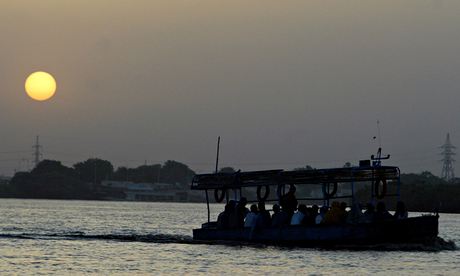
Sudanese villagers ride in their boat at the river Nile in Sudan's capital Khartoum
Villagers on the Nile in Khartoum. Ethiopia's Gerd dam may give Sudan greater water access than an agreement with Egypt allows. Photograph: Antony Njuguna/Reuters
The opening sentence of Egypt's new constitution describes the country as the river Nile's gift to Egyptians. It is a grand claim, but one that helps explain Egypt's indignation at the ongoing construction of a blockage on the Nile, thousands of miles upstream: the $4.7bn (£2.8bn) Grand Ethiopian Renaissance dam (Gerd).
Egyptians have long maintained that Ethiopia's dam project will dangerously deplete its water stocks – about 95% of which are derived from the world's longest river. A year ago, a former Egyptian water official boldly claimed that the Gerd might deprive Egypt of up to 10bn kilolitres, devastating roughly a million acres of farmland along the shores of the Nile.
"Then you might cross the Nile on the back of a camel," the former head of Egypt's National Water Research Centre said at the time, in what were highly contested claims.
Egyptian politicians have used such claims to portray the dam as a threat to national security, and have occasionally made ambiguous statements about the possibility of military action. For their part, the Ethiopian government sees the Gerd as a crucial developmental goal – a 6,000 megawatt source of surplus electricity that they could sell to foreign countries to boost their economy.
Last month, the saga took a fresh twist after the leak of a highly anticipated and hitherto suppressed report into the long-term effects of what would be Africa's largest hydroelectric dam. Written by two water experts from each of the three main countries concerned – Ethiopia, Egypt and Sudan – as well as international advisers, the report was seen as a much needed means of arbitration between the parties concerned.
But for nearly a year the report's contents were a mystery. After its submission last April, publication was suppressed at the request of one of the countries involved, enabling all concerned to make whatever claims they liked about its contents.
That should have changed at the end of March, when a leaked version (pdf) was finally published by the International Rivers Network (IRN), an independent group that campaigns against dams across the world. But rather than clarifying the dam's impact once and for all, the report has become the latest pawn in a war of words between Egypt and Ethiopia.
IRN said it showed that "big questions remain" and called for a halt to the dam's construction. But Ethiopian government spokesman Getachew Reda said the group was "absolutely biased", and "part of the smear campaign organised by Egypt". In the meantime, the dam's construction continues apace.
The report is nuanced and complex, and does not try to quantify exactly the likely downstream effect of the dam on Egypt's water supply. But its 48 pages nonetheless contain alarming findings. If the dam's reservoirs are filled during years of average or above-average rainfall, says the report, the hydroelectric capacity of Egypt's downstream Aswan High dam (Had) – which provides about 15% of Egypt's power – could face a temporary 6% decrease. But if filled during years of below-average rainfall, the Gerd may "significantly impact on water supply to Egypt and cause the loss of power generation at Had for extended periods".
Among other criticisms, the report warns that the dam's foundations may need further structural support to protect against sliding. It also says Ethiopia has done little to assess the Gerd's effect on local people, ecosystems and biodiversity. Based on these findings, the IRN concludes that the report "confirms Egypt's concerns that the project's impacts could be significant", and calls for construction to cease pending better analysis.
Not all independent analysts share this view, however. According to Dr Ana Cascão, a researcher at the Stockholm International Water Institute whose doctoral thesis analysed hydropolitics in the Nile basin, Egypt fought for the report to be kept secret. Cascão argues the study is largely optimistic about the Gerd's impacts – "and that's why Egypt was not happy for it to be released". It is critical about the dam's social and environmental impact, she says, "but otherwise – in terms of dam safety and even in terms of water going downstream – the report is quite positive".
This is because the Gerd may eventually help to reduce the build-up of sediment in downstream dams like the Had, increasing capacity. The Gerd will also help to keep the Nile's flow – which presently fluctuates according to the amount of rainfall, potentially causing problems for downstream farmers even in Egypt – constant throughout the year. In terms of structural safety, Sudan – the country most endangered by any catastrophe at the Gerd – is satisfied with its construction.
Egypt's interests may actually be aligned with Ethiopia's, since Ethiopia will ultimately want to see as much water flow through the Gerd as possible in order to maximise hydroelectric power. It is, says Cascão, Sudan's intentions that may instead cause the greatest long-term concern for Egypt. The Gerd would allow Sudan to siphon off more downstream water for farm irrigation, potentially allowing the republic to take more water from the Nile than allowed by an agreement signed with Egypt in 1959.
Sudan has achieved this leverage by engaging positively with the dam's construction; Egypt's only means of reaching a grand compromise may be through similar engagement.
But it may now be too late. According to the Ethiopian government, an army of 8,500 builders, working 24 hours a day, has already completed about 30% of the 1,800 sq km site.

A New Turn in the War on Whistleblowers & Journalism?


If Director of National Intelligence James Clapper thinks you need to know about US intelligence, he'll tell you.

A remarkable bit of news was made this week by Steven Aftergood of the Federation of American Scientists (Secrecy News4/21/14). And it sends an ominous message about how can journalism is practiced.
Aftergood writes:
The Director of National Intelligence has forbidden most intelligence community employees from discussing "intelligence-related information" with a reporter unless they have specific authorization to do so, according to an Intelligence Community Directive that was issued last month.
One might think–or want to think–that the new rules are intended to stem the flow of classified information. But, as Aftergood points out:
The new prohibition does not distinguish between classified and unclassified intelligence information. The "covered matters" that require prior authorization before an employee may discuss them with a reporter extend to any topic that is "related" to intelligence, irrespective of its classification status.
He adds:
Essentially, the Directive seeks to ensure that the only contacts that occur between intelligence community employees and the press are those that have been approved in advance. Henceforward, the only news about intelligence is to be authorized news.
It's hard to see how a move to criminalize routine discussions between government officials and members of the press is anything but an attempt to shut down such conversations. The story was since picked up by reporters like McClatchy's Jonathan Landay (4/21/14), who pointed out that the directive
includes a sweeping definition of who’s a journalist, which it asserts is "any person… engaged in the collection, production or dissemination to the public of information in any form related to topics of national security."

That would apply to a whole lot of people, every one of whom should be alarmed and outraged by this policy.

Source: fair.org

Saturday, April 26, 2014

Nile dam study fails to stem the tide of Egyptian indignation towards Ethiopia


Claim and counter-claim has attended the delayed publication of a report on the likely impact of the Grand Renaissance dam
Sudanese villagers ride in their boat at the river Nile in Sudan's capital Khartoum
Villagers on the Nile in Khartoum. Ethiopia's Gerd dam may give Sudan greater water access than an agreement with Egypt allows. Photograph: Antony Njuguna/Reuters
The opening sentence of Egypt's new constitution describes the country as the river Nile's gift to Egyptians. It is a grand claim, but one that helps explain Egypt's indignation at the ongoing construction of a blockage on the Nile, thousands of miles upstream: the $4.7bn (£2.8bn) Grand Ethiopian Renaissance dam (Gerd).
Egyptians have long maintained that Ethiopia's dam project will dangerously deplete its water stocks – about 95% of which are derived from the world's longest river. A year ago, a former Egyptian water official boldly claimed that the Gerd might deprive Egypt of up to 10bn kilolitres, devastating roughly a million acres of farmland along the shores of the Nile.
"Then you might cross the Nile on the back of a camel," the former head of Egypt's National Water Research Centre said at the time, in what were highly contested claims.
Egyptian politicians have used such claims to portray the dam as a threat to national security, and have occasionally made ambiguous statements about the possibility of military action. For their part, the Ethiopian government sees the Gerd as a crucial developmental goal – a 6,000 megawatt source of surplus electricity that they could sell to foreign countries to boost their economy.
Last month, the saga took a fresh twist after the leak of a highly anticipated and hitherto suppressed report into the long-term effects of what would be Africa's largest hydroelectric dam. Written by two water experts from each of the three main countries concerned – Ethiopia, Egypt and Sudan – as well as international advisers, the report was seen as a much needed means of arbitration between the parties concerned.
But for nearly a year the report's contents were a mystery. After its submission last April, publication was suppressed at the request of one of the countries involved, enabling all concerned to make whatever claims they liked about its contents.
That should have changed at the end of March, when a leaked version (pdf) was finally published by the International Rivers Network (IRN), an independent group that campaigns against dams across the world. But rather than clarifying the dam's impact once and for all, the report has become the latest pawn in a war of words between Egypt and Ethiopia.
IRN said it showed that "big questions remain" and called for a halt to the dam's construction. But Ethiopian government spokesman Getachew Reda said the group was "absolutely biased", and "part of the smear campaign organised by Egypt". In the meantime, the dam's construction continues apace.
The report is nuanced and complex, and does not try to quantify exactly the likely downstream effect of the dam on Egypt's water supply. But its 48 pages nonetheless contain alarming findings. If the dam's reservoirs are filled during years of average or above-average rainfall, says the report, the hydroelectric capacity of Egypt's downstream Aswan High dam (Had) – which provides about 15% of Egypt's power – could face a temporary 6% decrease. But if filled during years of below-average rainfall, the Gerd may "significantly impact on water supply to Egypt and cause the loss of power generation at Had for extended periods".
Among other criticisms, the report warns that the dam's foundations may need further structural support to protect against sliding. It also says Ethiopia has done little to assess the Gerd's effect on local people, ecosystems and biodiversity. Based on these findings, the IRN concludes that the report "confirms Egypt's concerns that the project's impacts could be significant", and calls for construction to cease pending better analysis.
Not all independent analysts share this view, however. According to Dr Ana Cascão, a researcher at the Stockholm International Water Institute whose doctoral thesis analysed hydropolitics in the Nile basin, Egypt fought for the report to be kept secret. Cascão argues the study is largely optimistic about the Gerd's impacts – "and that's why Egypt was not happy for it to be released". It is critical about the dam's social and environmental impact, she says, "but otherwise – in terms of dam safety and even in terms of water going downstream – the report is quite positive".
This is because the Gerd may eventually help to reduce the build-up of sediment in downstream dams like the Had, increasing capacity. The Gerd will also help to keep the Nile's flow – which presently fluctuates according to the amount of rainfall, potentially causing problems for downstream farmers even in Egypt – constant throughout the year. In terms of structural safety, Sudan – the country most endangered by any catastrophe at the Gerd – is satisfied with its construction.
Egypt's interests may actually be aligned with Ethiopia's, since Ethiopia will ultimately want to see as much water flow through the Gerd as possible in order to maximise hydroelectric power. It is, says Cascão, Sudan's intentions that may instead cause the greatest long-term concern for Egypt. The Gerd would allow Sudan to siphon off more downstream water for farm irrigation, potentially allowing the republic to take more water from the Nile than allowed by an agreement signed with Egypt in 1959.
Sudan has achieved this leverage by engaging positively with the dam's construction; Egypt's only means of reaching a grand compromise may be through similar engagement.
But it may now be too late. According to the Ethiopian government, an army of 8,500 builders, working 24 hours a day, has already completed about 30% of the 1,800 sq km site.

HISTORY OF Somaliland Protectorate from 1905 to 1913


Military activities in the Somaliland Protectorate from 1905 to 1907
(This should be read as a continuation of The Fourth Campaign article that can be read here )
Please open the map HERE
By March of 1905 the Mullah was in treaty agreement with the Italian authorities and had accepted the requirement to live a peaceful life with his followers in the vicinity of Illig.  The British had covertly supported Italian ambitions elsewhere in Somaliland by influencing the Zanzibari Sultan to concede the Benadir ports, and by recognising an Italian land claim near Kismayu.  The Somaliland Protectorate was now under new direction from London as in 1905 the Colonial Office took over responsibility from the Foreign Office.  The Mullah did keep to his side of the bargain for a couple of years until the grazing areas around Illig became exhausted and insufficient for his followers’ herds and flocks.

Meanwhile the British reorganised their defence force in the Somaliland Protectorate.  After some deliberation and changes 6th King’s African Rifles (6 KAR), the Somali-based battalion, was organised in 1906 as a unit of six rifle companies.  A local Somali Standing Militia, formed after the Fourth Campaign, had been disbanded after the bulk of its personnel were transferred into 6 KAR.  Four of the new rifle companies contained Somalis whilst the other two were composed of seconded Indian Army volunteers.  Of the four Somali companies ‘A’ and ‘B’ were pony-mounted, ‘C’ was mule-mounted and ‘D’ was a Camel Company.
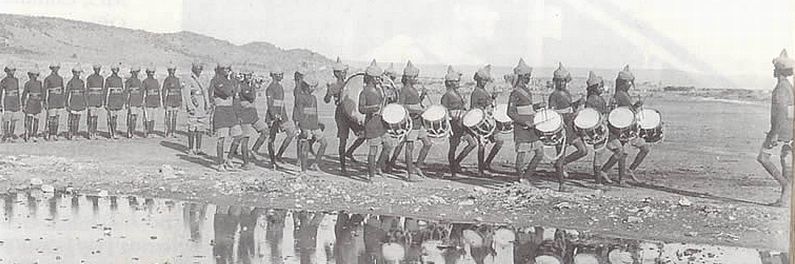
Above: Drummers and buglers of 6 KAR, with a detachment of recruits in the rear, circa 1906, when the 6 KAR was a mixed Indian/Somali unit. The men are all Somalis, including the officer.
One of the Indian companies was stationed in cantonments near the small Sheikh blockhouse, and the other in a mud fort at Burao.  The fort at Bohotle had been dismantled and those at Shimber Berris and Kirrit were unoccupied; the strong blockhouse at Las Dureh was garrisoned by a few tribal riflemen.  The Somali rifle companies occupied garrison posts along the caravan routes.  Thus the Protectorate troops were dissipated on outpost duty in locations that probably would not withstand a serious Dervish attack, and there was no military reserve to put into the field if such an attack was launched.
In October 1907 the British Under-Secretary of State for the Colonies, 33 year-old Winston S. Churchill, made a brief stop in Berbera and travelled inland to see the country.  He was not enthusiastic about what he saw, and recommended either a withdrawal to the coast or an occupation of the interior that, in an alliance with the Italians, would crush the Mullah.  He deplored the lack of a submarine communications cable between Berbera and Aden, which would be a small investment that could be used to quickly request reinforcements.  Back in London nobody was particularly interested in Churchill’s report, and it gathered dust whilst its author moved on to become President of the Board of Trade.

But the Mullah was not without his critics within Islam.  In 1908 he was denounced from Mecca by the head of the Salihiya Tariqa, Sheikh Salih, as a sinner against Allah and the Prophet, a veritable kaffir, an unbeliever and a madman.  Although this denunciation was widely circulated in the Protectorate the British failed to use it to advantage by obtaining the Turkish Grand Mufti’s comments on the matter, and the Mullah finally shrugged it off, brutally dealing with opponents who publicly mentioned it.

The 1908-1910 ‘Campaign’

By early 1908 complaints were pouring into Berbera from the interior stating that agitators were again proclaiming the right of the Mullah to be the leader of all the Somali inland tribes.  The last thing that the British wanted was the expense of another campaign but something had to be done, and a decision was made to send around 1,200 KAR Askari from other Protectorates into the Somaliland interior to uphold British prestige and rule, whilst 300 Indian Sepoys arrived from Aden.

First to arrive in January 1909 was Battalion Headquarters and 300 Askari of 1 KAR from Nyasaland, under Lieutenant Colonel H.A. Walker (Royal Fusiliers).  The battalion marched up to Wadamago where it performed mundane escort duties and fatigues for a year before returning to Nyasaland.

In February 1909 Battalion Headquarters and 450 Askari of 3 KAR, under Lieutenant Colonel J.D. McKay (Middlesex Regiment), arrived from Kenya and also performed security duties in the Wadamago region for a year.  Finally Lieutenant Colonel B.R. Graham (Corps of Guides, Indian Army), brought his 4 KAR Battalion Headquarters and 460 Askari for their 12-month stint in the Somaliland interior, returning to Uganda in February 1910.
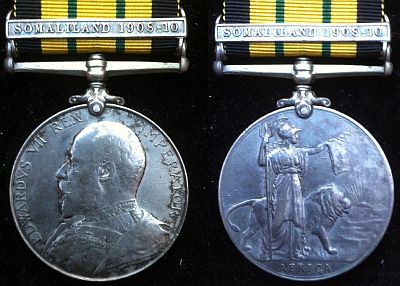
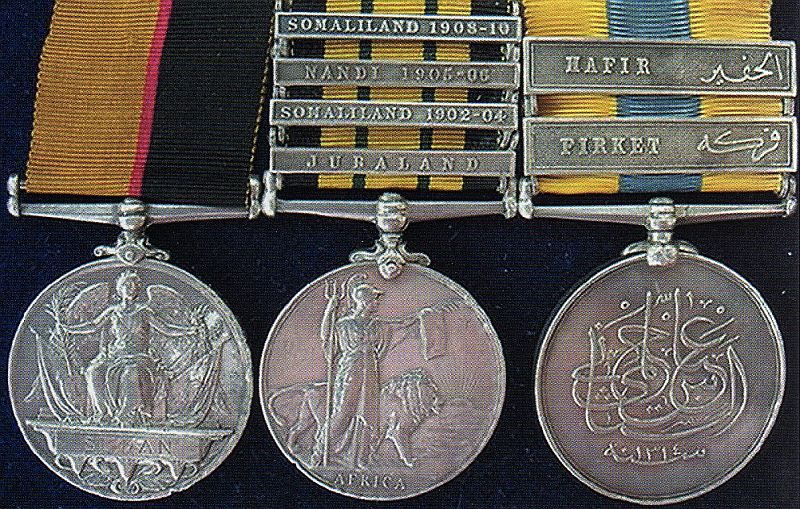
Despite not firing a shot in anger, all those troops who had served in Somaliland or off its coastline between August 1908 and January 1910 became eligible for the clasp SOMALILAND 1908-10 to the African General Service Medal.

Whilst the KAR Askari were marching thirstily up and down the dusty camel trails in the interior without gaining sight of an aggressive Dervish, Lieutenant General Sir Reginald Wingate, Governor General and Sirdar of the Sudan, had been attempting without success to negotiate with the Mullah.  Wingate’s partner in this mission was General Sir Rudolf (Baron) von Slatin, Inspector General of the Sudan.  The British administration had become adamant that it would not finance another campaign, and when Wingate’s & Slatin’s negotiations failed the decision was made to abandon the interior of the Protectorate.  Italy protested, as this withdrawal meant an end to the treaty with the Mullah, but Britain was determined to withdraw into what was termed the Coastal Concentration.

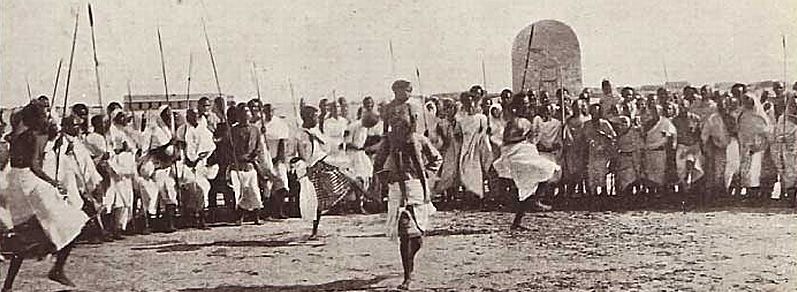
Above: Somali dance
Coastal Concentration

In March 1910 all Somali troops were back at Berbera where 6 KAR was disbanded, a coastal garrison being provided by the Indian Army contingent that was ordered not to move more than three miles inland.  A few local mounted police were retained.  Tribes in the interior who had sided with the British were extremely disgruntled and fearful for their own security, as the Dervishes were now openly coming out on the rampage.  These tribes were given rifles and ammunition which they promptly used to settle old scores between themselves, and to raid.  The Mullah raided everyone everywhere he could and brutal anarchy prevailed; thousands of men, women and children were killed and tens of thousands of head of stock changed hands.  Most tribes sided with the Mullah in order to survive.  Imported merchandise rotted in Berbera because camel-owners would not risk taking convoys inland.

The formation of the Somaliland Camel Constabulary

This disintegration of British rule in the Somaliland Protectorate was highlighted in February 1912 when Dervishes penetrated Berbera, causing panic and leaving a mysterious cabbalistic sign on trees and buildings.  The outskirts of Bulhar were also raided.  The Protectorate Commissioner, Horace Byatt, vigorously criticised the Coastal Concentration strategy and demanded a camel-mounted constabulary that could operate within an 80-kilometre radius of Berbera; the Bikaner Camel Corps that had seen much service in Somaliland was Byatt’s model.

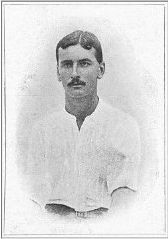
Right: Young Richard Corfield

Byatt’s arguments won the day and in September 1912 sanction was given for a Camel Constabulary of 150 Somalis to be raised.  The Constabulary was tasked to restore peace and order amongst the friendly tribes but it was not to be used on offensive operations against the Dervishes.  Meanwhile earlier in June that year two companies of the Indian Army 119th Infantry (The Mooltan Regiment) had arrived in Berbera from Aden to protect the coastal towns, they joined the 200 Sepoys who had remained in the Protectorate when 6 KAR had been disbanded.
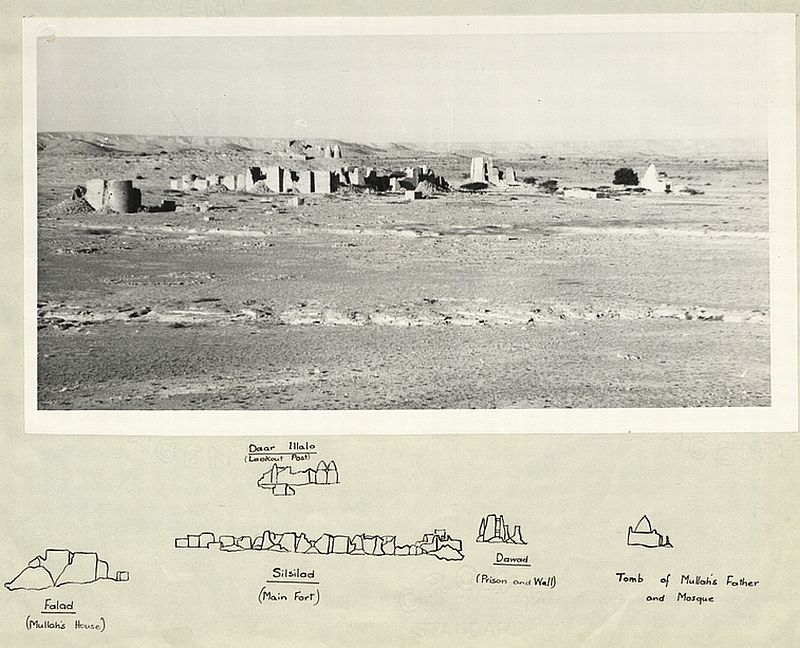
The Mullah observed this British military activity and thought it a preliminary to another campaign against himself and his followers.  He started one of his periodic bouts of flowery letter-writing with Byatt, expressing a desire for peace.  Byatt’s answer was to the point – the Mullah could prove his intentions by ending raids and ceasing exhortations to tribes ostensibly still under British protection to join the Dervishes in a jihad or holy war.  The Mullah’s correspondence ceased in 1912 as he entered into a period of building permanent stone forts at Laba Bari, Bohotle, Damer and Taleh - a magnificent fort that was his pride and joy.  Professional stone masons and fort-builders were recruited from Yemen to supervise the construction.  It is probable that at this stage in his life the Mullah was becoming more obese and immobile as a result of elephantiasis; his days as a swift-moving nomadic warrior were now just memories.
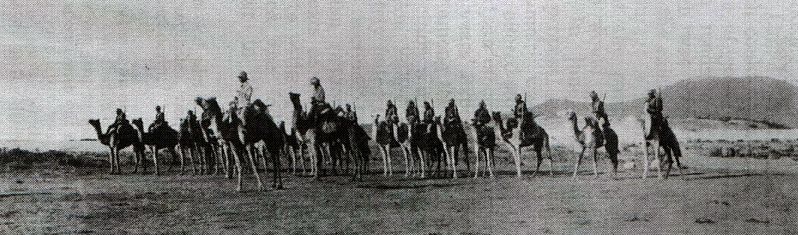
Above: Corfield and the Constabulary
The battle of Dul Madoba

Command of the Somaliland Camel Constabulary was given to a 30-year old Political Officer, Richard Conyngham Corfield, who had previous service in Somaliland, South Africa and Nigeria.  The two other officers appointed were Alan Gibb and Cecil de Sivrac Dunn.  Riding camels and saddlery were obtained from India and musketry training was conducted near Berbera.  By early December 1912 the Corps was based at Mandera, 68 kilometres south-west of Berbera and it went into the field to retrieve stolen stock from Sulagudub raiders.  The operation was successful and 1,282 camels, 11,300 sheep, 170 cows, 17 donkeys, 6 horses and 16 rifles were delivered to Adadleh where a post of the Indian 119th Infantry was located.  Thirtyeight of the raiders had been killed for no loss to Corfield’s command.  This type of low-level operation continued, to the satisfaction of the friendly tribes.
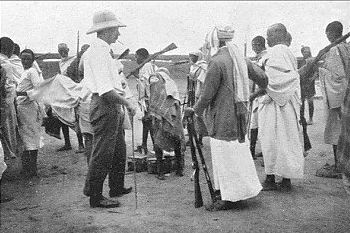
Left: Corfield distributing arms in Burao Fort.
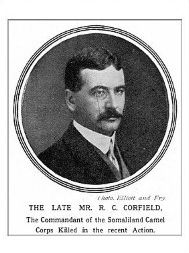
In January 1913 the Corps occupied Sheikh and then Burao, but was not permitted to advance further south although it did move west to settle disputes at Hargeisa.  But Corfield chafed at the bit and did move south to Idaweina to search for Dervish raiders.  This action resulted in a critical memorandum to Corfield written by the Acting Commissioner Geoffrey Francis Archer, who reminded Corfield that the Corps was to stay near Burao and was not to take offensive action.

Eight months later Archer visited Burao accompanied by Captain G.H. Summers, 26th (King George’s Own) Light Cavalry, Indian Army, who commanded the Indian Contingent in Somaliland.  Archer’s arrival was quickly followed by reports of Dervishes attacking friendly tribes between Idoweina, Burao and Ber.  The friendly tribes requested British protection, and in order to discover the facts Archer authorised Corfield to make a strong reconnaissance towards Ber; Summers was ordered to accompany Corfield as the military advisor.
On 8th August a 15-man pony section from the Constabulary was order to reconnoitre, and shortly afterwards Archer permitted Corfield with 119 camel-mounted men to follow up the reconnaissance and observe the situation.  The riflemen carried .303 Martini Henry rifles with 140 rounds in bandoliers plus a reserve of 60 rounds in their saddle bags.  Also one Maxim gun with 4,000 rounds of ammunition packed in cork-lined tin boxes was transported on camels. 

At 1900 hours that evening one of the pony reconnaissance party was met coming back to report.  He stated that a large force of Dervishes was driving many herds of looted stock towards Idoweina; the reconnaissance party had engaged the enemy, firing over 80 rounds each, and had hit several Dervishes who in retaliation had killed two ponies.  Corfield advanced for a couple of hours and then formed a zariba with the camels sat down in the centre.  The fires in the Dervish camp could be seen about eight kilometres distant.  The pony section returned with a Dervish strength estimate of 2,000 footmen and 150 mounted men, all armed with rifles.  The Dervish leader was Ow Yusuf Abdillah Hassan, a brother of the Mullah.  Local friendly Dolbahanta tribesmen assured Corfield that they would provide at least 300 men tomorrow, armed with rifles or spears, to assist in recovering their stolen stock.
Corfield expressed his intention of either attacking the Dervish camp that night or of intercepting the enemy during the next day, and he sought Summers’ opinion.  Summers was adamant that Corfield could not win a battle against such a strong Dervish force, and he urged him to stick to his orders and just reconnoitre.  But Corfield wanted a battle and he decided to intercept the Dervishes the next day.
Corfield moved his men out at dawn, tracking the Dervish line of march by the dust clouds that the herds threw up.  At 0645 hours near a location named Dul Mahoba (black hill) Corfield’s men were ordered into a skirmish line to face the left flank of the Dervish advance, with the Dolbahanta tribesmen positioned on the left flank.  Corfield attempted to advance his line through thick bush in order to reach more open ground ahead but the Dervish advance was too swift, catching Corfield in a totally unsound position where his men could not always see each other.  Summers urged Corfield to form a square, the safest formation to adopt as it could not be dangerously out-flanked as a line could, but Corfield wanted all his riflemen to fire at the same time, and so he left them floundering in a skirmish line without a reserve of troops or flank or rear protection.

The Dervishes scented victory and charged forward, firing as they ran; nearly all the Dolbahanta tribesmen immediately fled the scene.  The Constabulary line was quickly outflanked causing some of Corfield’s men to disperse to the rear.  The Maxim gun fired three belts but was then permanently put out of action by bullet strikes on the mechanism.  Richard Corfield, who had positioned himself near the gun, was shot and died instantly at about 0715 hours. 
Summers, who was hit three times and badly wounded, and Dunn rallied their surviving men and formed a protective zareba from the bodies of the dead camels and ponies that now littered the battlefield.  The wounded were brought into the zareba and a very few Somali officers and senior ranks began to exert fire discipline over the surviving riflemen.  Dervish attacks, which consisted of forward rushes that sometimes delivered warriors into the zareba, continued until 1100 hours when they began to tail away, and an hour later the Dervishes withdrew altogether with their captured herds as their stocks of ammunition were exhausted.  The Dolbahanta who had initially fled the scene now returned to loot the bodies on the battlefield.

Dunn, now the force commander, sent a report to Archer and cleared the battlefield whilst a reconnaissance patrol followed the Dervish movements.  Twenty six riflemen remained fit to fight, and 16 wounded needed evacuation on the surviving camels.  In his after-action report Summers praised Colour Sergeants Gaboba Ali and Jama Hersi and Sergeant Jama Said for the leadership and gallantry that they displayed during the battle.  He also commented on the extreme bravery of the Dervishes, and on their use of modern rifles that had been obtained from traders working out of Djibouti and Muscat.
Above: Taleh Fort
At around 1500 hours that afternoon, when the reconnaissance patrol had established that the Dervishes were not lying in wait, Dunn withdrew to Idoweina where foul but just-drinkable water was found, and then moved slowly through the night to meet up with Archer at Gombur Magag, 30 kilometres from Burao which was itself reached on the morning of 10th August.

As well as the death of Corfield and the wounding of Summers, 32 riflemen were killed and 15 wounded in the zareba.  A further 31 riflemen had gone missing from the zareba but most re-joined the column the next day.  The losses in mounts were 50 camels and 9 ponies; the Dervishes had seized four of these camels, the remainder being either killed in the battle or wounded and put down later.  The number of Dervish dead was estimated at between 200 and 600; many Dervish wounded later died of their wounds.  As the Mullah had ordered the ponies to be tied up away from the battlefield all the Dervish mounts survived.  Awards made for the action were Captain Gerald H. Summers appointed to be a Brevet Major and Captain Cecil de S. Dunn to receive the Police Medal.  During 1913 Geoffrey Archer was appointed a Companion of the Most Distinguished Order of Saint Michael and Saint George (CMG). 

Withdrawal from Burao

The Camel Constabulary needed re-organising and Archer withdrew it to the coast; the friendly tribes around Burao swiftly followed and were housed in a temporary camp near Berbera.  Britain again lost prestige in the interior and a further bout of anarchic raiding and looting ensued.  In September 1913 Alan Gibb returned to the Protectorate from overseas leave and took over command of the Camel Constabulary from Dunn.  Three months later Major A.S. Lawrance, 1st County of London Yeomanry and a former officer in 6 KAR, took over from Gibb.  The Somaliland Camel Corps, as it was soon to be titled, was authorised to recruit a total of 300 men.  Meanwhile in the interior the Mullah, who had written a dramatic popular poem about Corfield’s defeat, was advancing his influence by building strong masonry forts at Jidali, Urgai and even Shimber Berris – only 80 kilometres from Burao.
Above: Q SUD M,AGSM JUBA, SOMAL 02-04, NAN 05-06, SOMAL 08-10, K SUD M Hafir & Firket
(To be continued).

(An edited version of this article has appeared in a recent edition of the Journal of the Anglo-Somali Societyhttp://www.anglosomalisociety.org.uk/Home.php  ) 
SOURCES:

·        Moyse-Bartlett, H., The King’s African Rifles.  1956, Gale & Polden Ltd, Aldershot.  Reprinted by The Naval & Military Press Ltd.
·        Jardine, Douglas, The Mad Mullah of Somaliland.  1923, Herbert Jenkins Ltd., London. Downloadable here:https://archive.org/details/TheMadMullahOfSomaliland
·        Beachey, Ray.  Warrior Mullah. The Horn Aflame 1892-1920.  1990, Bellew Publishing, London.
·        Digest of History of Somaliland Camel Corps, KAR. (The National Archives reference: WO 106/272).
·        3rd Battalion King’s African Rifles Historical Record 1895-1928.  (The National Archives reference: WO 106/270).
·        Hayward, J., Birch, D., and Bishop, R., British Battles and Medals.  2006, Spink, London.
·        Despatches published in The London Gazette.
·        Magor, R.B., African General Service Medals.  1983, Naval & Military Press.

Plane stowaway 'wanted to return to Somalia'


An airline spokeswoman said the teenager was "exceptionally lucky" to have survived the flight

The father of a US teenager who stowed away in a wheel well on a flight to Hawaii has said his son was unhappy at school and trying to return to Somalia.
In an interview with US broadcaster Voice of America, Abdilahi Yusuf Abdi said "Allah had saved" his son.
The 16-year-old survived lack of oxygen and freezing temperatures on a five-hour flight from California to Hawaii.
Mr Abdi said his son, Yahya Abdi, would return to California after he finished health checks in Hawaii.
The teenager jumped over a fence at San Jose airport to get to the plane.
He reportedly told investigators he had been in an argument at home and then went to the airport, choosing the aircraft nearest to the fence,according to local media.
Dr Neil Spratt, senior lecturer in neurology at the University of Newcastle, Australia, told the BBC the young man would have likely not survived the lack of oxygen if he had not been exposed to such cold temperatures.
"We know that cold can protect the brain and other organs and it is used for that in various medical situations," Dr Spratt said.
A spokesman for Hawaiian Airlines said airline staff noticed the disorientated boy on the tarmac after the plane landed in Maui on Sunday morning.
He was questioned by the FBI and given a medical screening and was said to be in a stable condition.
A spokeswoman for Hawaiian Airlines said the boy was "exceptionally lucky to have survived".
Mr Abdi told the Voice of America he first heard of the news when Hawaiian police called him to tell him they had his son.
"When I watched the analysis about the extraordinary and dangerous trip of my son on local TVs and that Allah had saved him, I thanked God and I was very happy," he told the broadcaster.
Mr Abdi said his son was "always talking about going back to Africa" and since the family came to the US, the son had been bothered by "education problems".
"We want to go back [to Somalia], but due to the current living conditions we can't go back," the father said.
The 16-year-old transferred into a Santa Clara high school only five weeks ago, according to the school system.

Friday, April 25, 2014

Progress or Peril in Somalia? Nicholas Kay UN Representative for Somalai said that "Somaliland and Somalia is very different states"

Streamed live on Apr 22, 2014
Progress or Peril in Somalia? A Conversation with U.N. Special Representative for Somalia Nicholas Kay

The Special Representative of the U.N. Secretary-General for Somalia, Nicholas Kay, will discuss the United Nations Assistance Mission in Somalia's progress in executing key governance and security goals. This event has been rescheduled from the original event date of March 12, 2014.

For more information about this event, visit:


http://www.usip.org/events/progress-o...

Despite the optimism that surrounded President Hassan Sheikh Mohamud's inauguration in 2012, Somalia has struggled to achieve key governance and security goals. A recent cabinet reshuffle and intensified al-Shabab militant activity in Mogadishu have raised more concerns about Somalia's trajectory. With elections planned for 2016, rapid progress is required to bolster confidence in Somalia's government and leadership.

To address these issues, USIP is pleased to host a discussion with Nicholas Kay, the Special Representative of the U.N. Secretary-General for Somalia. As the head of the United Nations Assistance Mission in Somalia (UNSOM), Amb. Kay oversees a mission charged with providing policy advice to the federal government on a range of governance and security issues and coordinating international engagement. He will provide an update on recent developments and UNSOM's progress in executing its mandate and take questions from the audience.

If you RSVP'd for the previous scheduled event (March 12, 2014) it will be necessary for you to RSVP again.

Featured Speakers:

Ambassador Nicholas Kay
Special Representative of the Secretary General for Somalia

Ambassador Johnnie Carson, Moderator

Special Advisor to the President, U.S. Institute of Peace
Category

Nonprofits & Activism
License
Standard YouTube License