Hargeysa-(Qor)-Shirkadda Isgaadhsiinta SomCable oo qayb ka ah Companiga weyn ee IMCG oo uu Leeyahay ganacsadae Maxamed Aw Siciid ayaa kusoo bandhigtay Carwada ganacsiga Somaliland ee laga furay Hargeysa toddobaadkan hawsheeda dhinaca Isgaadhsiinta Kaybalka badda ee ay doonayso inay keento Somaliland.This is where you can follow the important socio-economic, geopolitical and security developments, going inside the Republic of Somaliland and Horn of Africa region
Search This Blog
Thursday, December 22, 2011
Shirkadda SomCable Oo Soo Bandhigaty Muuqaalo Muujinaya Halka Uu Marayo Mashruuca Isgaadhsiinta Ee Xadhiga Kaybalka Badda Ee Ay Doonayso Inay Somaliland Keento.
Hargeysa-(Qor)-Shirkadda Isgaadhsiinta SomCable oo qayb ka ah Companiga weyn ee IMCG oo uu Leeyahay ganacsadae Maxamed Aw Siciid ayaa kusoo bandhigtay Carwada ganacsiga Somaliland ee laga furay Hargeysa toddobaadkan hawsheeda dhinaca Isgaadhsiinta Kaybalka badda ee ay doonayso inay keento Somaliland.Ethiopian Court: 2 Swedish Reporters Guilty
The pair, who now face up to 15 years in prison at their sentencing next week, have said they were gathering news at the time of their arrest.
However, Judge Shemsu Sirgaga said that was “very unlikely,” accusing the Ogaden National Liberation Front of organizing the Swedes’ journey starting in London via Kenya and Somalia into Ethiopia. Outlawed groups in many countries frequently facilitate the travels of reporters in order to have their version of events told.
Ethiopian troops captured Johan Persson and Martin Schibbye six months ago during a clash with rebels in Ethiopia’s restive Somali region in the country’s east, a no-go area for reporters. Ethiopia considers the rebel group a terrorist organization, and it is very difficult for journalists to gain access to the region. Rights groups say that is so abuses there are not exposed.
The chairman of the Swedish Union of Journalists, Jonas Nordling, deplored the conviction, saying it is clearly aimed at deterring reporters from investigating alleged human rights abuses in the Ogaden region.
“They are two established reporters who have used accepted journalistic methods to enter the area,” he said, adding Ethiopian officials “absolutely do not want to see an open examination of what happens in the Ogaden area.”
Persson and Schibbye are both freelance contributors to the Sweden-based photojournalism agency Kontinent. Schibbye is also a writer. The two regularly had their work published in national newspapers in Sweden and Norway.
The pair said they had been gathering news about a Swedish oil company that is exploring the Ethiopia’s Somali region for oil. Sweden’s foreign minister Carl Bildt has close ties to the firm — Lundin Petrol. He was a former member of the company’s board of directors.
Shemsu said that “journalism demands impartiality and balance but doesn’t require violating the laws of a sovereign country.”
“The court finds the defendants guilty as charged in a unanimous vote,” he said.
The Swedes’ lawyers, their family and the Swedish ambassador to Ethiopia left the court without making any comments.
In Sweden, Prime Minister Fredrik Reinfeldt said the Swedish government will immediately contact high-level officials in the Ethiopian government.
“Our starting point is and remains that they have been in the country on a journalistic mission. They should be freed as soon as possible to be able to reunite with their families in Sweden,” Reinfeldt said.
Bildt, the country’s foreign minister, said on Twitter that Sweden expresses “grave concern” over the verdict. “We will continue to work to set them free,” he said.
Persson and Schibbye have acknowledged that they entered Ethiopia illegally.
“Your honor, I am a journalist and my job is to gather news. I am guilty of entering Ethiopia illegally, but I am not guilty of the other activities I am charged of,” Schibbye said during the case’s preliminary hearing in October.
“I entered the country illegally and nothing else,” Persson added.
The international community has closely followed the terror trial against the Swedes. Rights groups and diplomats say Ethiopia’s anti-terrorism proclamation restricts freedom of expression and is used as a tool to crack down on dissent.
The rights group Amnesty International said after the verdict that there was no evidence to suggest that the two Swedes were doing anything but carrying out work as reporters.
“We believe that these men are prisoners of conscience, prosecuted because of their legitimate work,” said Claire Beston, Amnesty International’s Ethiopia researcher. “The overly broad provisions of the Anti-Terrorism Proclamation allow the authorities to criminalize the exercise of freedom of expression.”
___
Associated Press writer Malin Rising in Stockholm contributed to this report.
Bradley Manning and the miscarriage of justice - Opinion - Al Jazeera English
![]() |
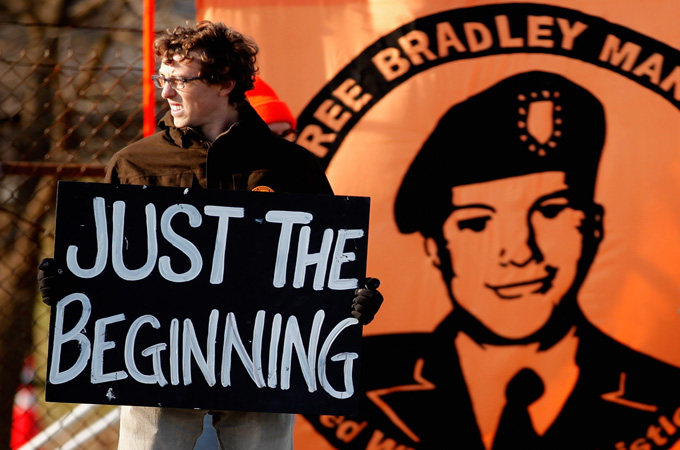
| President Obama has already made statements acting as if Manning had been proven guilty [GALLO/GETTY] |
Last week, after an astounding 567 days in prison, Bradley Manning - the US Army private accused of leaking the WikiLeaks documents - finally began his pre-trial hearing.
In the year and a half since he has been in jail, Manning has been severely mistreated by his jailers, has been assumed guilty by the president and now potentially faces life in jail. Yet the "crime" he is accused of is something many US officials do with regularity: leak classified information in the public interest to news organisations.
When Manning was held at Quantico military base earlier this year, he was shamefully subjected to extremely harsh, even torturous, conditions. He was forced to sit alone in his cell for 23 hours a day, was barred from exercise or socialising with other inmates, and stripped naked at night - all despite showing no behavioural problems.
Over 250 law professors, including President Obama's Constitutional law professor at Harvard Law School, Laurence Tribe, signed a letter calling the treatment of Manning illegal, unconstitutional and possibly torture. Former State Department spokesman PJ Crowley, the State Department's lead critic of WikiLeaks, was even forced to resign when he called the treatment of manning "ridiculous and counter-productive and stupid".
Around the same time President Obama was defending Manning's treatment, he was also publicly stating that Manning "broke the law" - despite not being convicted of any crime. Many legal observers found the remarks inappropriate and potentially "unlawful command influence". As Salon's Glenn Greenwald asked, "How can Manning possibly expect to receive a fair hearing from military officers when their Commander-in-Chief has already decreed his guilt?"
The government should have to answer for its statements and treatment of Manning in court no matter what his alleged crime, but the government's own assessments of the disclosures and similar acts makes its reaction that much worse.
According to Manning's lawyer, the White House, State Department, and Defence Department have each conducted secret reviews of the WikiLeaks disclosures. Each review found the disclosures did not damage national security. Reportedly, the reviews conclude the facts revealed in the WikiLeaks disclosures were "either dated, represented low-level opinions or [were] already known because of previous public disclosures". The government has so far refused to release the alleged studies, even though they could potentially impact Manning's case.
| "How can Manning possibly expect to receive a fair hearing from military officers when their Commander-in-Chief has already decreed his guilt?" - Glen Greenwald |
Of course, anyone who has been paying attention already knew that the government's hysteria over the disclosures has been wildly exaggerated from the beginning. Officials have quietly, but consistently, admitted they cannot point to single person who has died because of the WikiLeaks disclosures, despite constantly claiming WikiLeaks was putting "hundreds of lives at risk".
Misleading the public in order to shut down WikiLeaks
More than a year ago, when asked for the Pentagon's official response amidst calls for WikiLeaks to be labelled a terrorist organisation and the alleged leaker to be charged with treason, then-Secretary of Defence Robert Gates said the disclosures were "embarrassing" and "awkward", but downplayed any real damage.
When then-State Department spokesman PJ Crowley was publicly saying the disclosures created "substantial damage", State Department officials were privately admitting the disclosures were "embarrassing but not damaging". Reuters reported that "the administration felt compelled to say publicly that the revelations had seriously damaged American interests in order to bolster legal efforts to shut down the WikiLeaks website and bring charges against the leakers."
In other words, they were lying to help their case against Manning.
At the same time, the documents have provided the public a much-needed window into US affairs that is increasingly and ludicrously secret, and the most consequential foreign policy event that WikiLeaks did influence - the democratic revolution in Tunisia - was an event the US State Department applauded. Unfortunately, Manning's lawyer has been severely restricted in raising questions such as "Why is this information classified in the first place?" As Denver Nicks wrote in the Daily Beast, "By truncating the conversation, the state has robbed the public of a unique opportunity to learn about the secrecy system operating in its name and on its dime."
It's important to note that the regular leaking of classified information by high-ranking US officials has continued unabated - and unpunished - since Manning has been in jail. In the past year, US officials have leaked non-WikiLeaks related classified information to many of the US' most established news publications about Afghanistan, Pakistan, Russia, Yemen, Somalia, Libya, Iran, China and others. Much of the information is likely classified at a higher level than anything Manning is accused of leaking.
Just two weeks ago, "several US officials" anonymously leaked classified information to Bloomberg News about the drone - one of the most classified in the US arsenal - that crashed in Iran. US officials did the same for the Associated Press the day before.
The sole leak investigation involving a high-ranking official is that of former CIA general counsel John Rizzo, whose only mistake was apparently speaking on-the-record about the same drone program. But as National Journal reported, the investigation will most likely end not with life in prison, but "with some sort of formal reprimand, and possibly a financial penalty such as a decrease in his government pension".
It's clear the US has lost more because of its treatment of Manning - and the extreme double standard it has held him to - than because of any crime he allegedly committed.
Trevor Timm is an activist and blogger for the Electronic Frontier Foundation. He specialises in free speech issues and government transparency. The views expressed here are his own.
Bradley Manning and the miscarriage of justice - Opinion - Al Jazeera English
Monday, December 19, 2011
Wednesday, December 14, 2011
Al-Shabab is currently Somalia’s only hope for peace, stability and order.
To end the war and famine ravaging Somalia the West must deal with men it regards as dangerous extremists, urges Welsh foreign affairs expert Grant Dawson
WHO can bring peace to Somalia after two decades of destructive civil war and cope with its worst famine in 60 years?
Could it be that Somalia’s only hope are the people we have been told to despise – the terrorists?
It won’t be US troops and experts with support of the Canadians and Europeans, that’s for sure.
There is no confidence in Washington that military intervention could rescue the 750,000 at immediate risk of starvation over the next few months, no mood in the US, Canada, and Europe for another intervention to solve Somalia’s serious problems.
The same follows for security sector reconstruction. The government of Somalia has asked Canada and other countries to deploy police and army trainers in Somalia. However, only the European Union has agreed and it only trains army personnel outside the country.
The West has been so stand-offish and mindful of its limitations for two reasons.
The first relates to Al-Shabab, the Islamist insurgency with al-Qaida links. Frustration over Al-Shabab’s obstruction of humanitarian relief is tempered by the knowledge that the famine is not about them but a disintegrated collapsed state awash in guns and misery.
That wasn’t clear back in 1992. When famine struck that year, shocking Western publics and governments, a US-led coalition intervened to protect UN and NGO deliveries of food and medicine. The coalition withdrew as planned months later, and was not supposed to focus on the wider issues.
The second is that the US priority in East Africa is the war on terrorism. It is able to wage and indeed escalate this war from outside Somalia. Drone aircraft have done surveillance missions, but now the US is deploying an armed model equipped with bombs and missiles.
The US is also relying on private contractors to train African troops to fight the Al-Shabab.
In addition to the legal issues and troubling implications for global order, notably whether states should be sending robotic devices over borders to kill perceived enemies, the war on terror is a blatant example of the West subordinating Somalia’s interests to its own.
It is small wonder, then, that the yield from the West’s and the UN’s political and military interventions in Somalia has been so meager.
Somalis want law, order and justice for their communities. They rallied in 2006 to the banner of the Union of Islamic Courts, the predecessor to the Al-Shabab, because it ended the petty corruption, criminality and hated ad hoc checkpoints of the warlords and roaming gunmen.
None of the many central governments brokered by the UN (14 in total so far) have been able to fulfil these basic needs. This includes the current Transitional Federal Government, installed after the US and Ethiopia destroyed the Courts movement because of suspected terrorist links.
The Transitional Federal Government took power in Mogadishu. It is allied with the US in the war against terrorism, but it is corrupt and propped up by African Union troops.
It is too weak to provide law and order. Often civilians are better off outside the capital, where Al-Shabab is in control.
Indeed, Al-Shabab is currently Somalia’s only hope for peace, stability and order.
The West must recognise that Al-Shabab is the only actor capable of setting up a system of governance and basic infrastructure in Somalia. The Al-Shabab are supportive of global and regional order, they ought to be seen as state-builders rather than as a group of terrorist extremists.
The media presents the Al-Shabab as a problem because they threaten Western foreign policies.
Kenya’s incursion to protect its tourist industry from Somali kidnappers is presented this way.
This is stupid. The terrorist label just de-legitimises and invalidates the Al-Shabab.
Use of this label hampers Somalia’s recovery and global order more than it helps.
To understand why this is so we have to look at the human behind the terrorist label. The Al-Shabab has not been allowed to participate in Somalia’s political process. Terrorist attacks like suicide truck bombings and recent Al-Shabab audiotape calling for attacks on the US, Canada, and other countries are the only tactics available to them to effect change and insert themselves into the debate about the future of their country.
The Transitional Federal Government has said it wants to negotiate with the Al-Shabab. It knows it cannot compete.
Like the Courts movement, Al-Shabab has the local contacts, support of the civil elites, grassroots leaders and bottom-up approach that Somalis respect and trust.
Turning to the Al-Shabab is not an ideal solution. But Somalia’s mixture of famine, conflict and state collapse is far from an ideal situation.
Al-Shabab will be able to provide peace and stability, and in a calmer and less confrontational atmosphere famine relief from outside should be acceptable.
Dr Grant Dawson is deputy director of the David Davies Memorial Institute of International Studies at the Department of International Politics of Aberystwyth University
Tuesday, December 13, 2011
Ethiopia proposed ‘semi-recognition’ for Somaliland
Created – 2009-02-02 14:31
Released – 2011-08-30 01:44
Classification – CONFIDENTIAL
Origin – Embassy Addis Ababa
VZCZCXRO0925
OO RUEHDE RUEHROV RUEHTRO
DE RUEHDS #0260 0331431
ZNY CCCCC ZZH
O 021431Z FEB 09
FM AMEMBASSY ADDIS ABABA
TO RUEHC/SECSTATE WASHDC IMMEDIATE 3588
INFO RUCNSOM/SOMALIA COLLECTIVE PRIORITY
RUZEFAA/HQ USAFRICOM STUTTGART GE PRIORITY
RUEAIIA/CIA WASHINGTON DC PRIORITY
RUEPADJ/CJTF HOA PRIORITY
RUEKDIA/DIA WASHINGTON DC PRIORITY
RUEKJCS/JOINT STAFF WASHINGTON DC PRIORITY
RHEHAAA/NSC WASHDC PRIORITY
RUEKJCS/SECDEF WASHINGTON DC PRIORITY
C O N F I D E N T I A L ADDIS ABABA 000260
SIPDIS
E.O. 12958: DECL: 01/30/2018
TAGS: PREL PGOV SO ET
Classified By: Ambassador Donald Yamamoto for reasons 1.4 (b) and (d).
**************************************
THE ASSOCIATION OF AFRO-ASIAN STATES SHARING INDIAN OCEAN are seriously concerned immediate diplomatic recognition to the Republic of Somaliland
Bengaluru Declaration
India’s External Affairs Minister S.M. Krishna inaugurated the meeting after taking the chair for the next two years from Yemen, the previous chairman. While releasing the Bengaluru communique, he aptly cited India's first prime minister, Jawaharlal Nehru, who had envisioned a grouping of countries bordering the Indian Ocean that could help one another in tackling common challenges. In his concluding remarks, Krishna stated that the 19 countries from three continents have decided to work together to realize the full potential of Indian Ocean Rim-related institutions that have been established over the years. Bengaluru declaration, however, focused seriously on the issue of maritime security keeping in view the challenges posed to international shipping and commerce by the ruthless pirates from Somalia. The group discussed ways and means to consolidate cooperation in areas such as maritime security, combating piracy, natural disaster management, education, fisheries and marine resources management, trade and investment promotion, capacity building and tourism.
Tourism, Travel & Hospitality Industry:
As the regional countries are getting more prosperous economically, and the middle classes are expanding with more disposable incomes and extra cash to spare, travel and tourism in these countries are increasing tremendously. The Bengaluru declaration explores the intra-regional tourism potential and suggests that the relevant authorities of member countries should specifically target this sector for growth to realize the enormous potential of multilateral cooperation to the fuller extent. In this respect, this group must emulate the examples set by the ASEAN with provisions of analogous facilities for visa on arrival, ASEAN tourism association, and ASEAN specific passport scheme. The Indian Ocean Tourism Organization has observer status with the IOR-ARC; therefore, it should be natural for the block to promote intra-regional tourism on a priority basis. Member countries need to promote conventions and conferences intra-regionally to tap the potential of high-end western travelers.
Sustainable Developmental Agenda:
The Indian Ocean Rim is rich in strategic and precious minerals, metals and other natural resources, marine resources and energy, all of which can be sourced from Exclusive Economic Zones (EEZ), continental shelves and the deep seabed. The group focuses on sustainable development while harvesting the natural resources provided by the Indian Ocean. Conservation and sustainable harvesting are vital for the security of the marine food resources. Though technology and rising cost of natural resources makes harvest of new resources from the sea beds economically viable, sustainability of economic development in the ecologically challenged world requires efficient and harmonious management of the shared seas. The member-nations underscored the importance of cooperation among them, including in the management and sustainable harvesting of fish stocks and combating illegal fishing and damaging fishing techniques.
Economic & Trade issues:
The Indian Ocean is the world's third largest Ocean. It carries half of the world's container ships, one third of the bulk cargo traffic, two-thirds of the world's oil shipments. It is a lifeline of international trade and economy. The region is linked by trade routes and controls some of the world's busiest sea-lanes. The key east-west arteries of international trade, especially in commodities and energy sources sail through the Indian Ocean. The Indian Ocean Rim constitutes between a quarter and a third of the world's population (more than two billion people). The objectives of IOR-ARC are threefold; mainly to promote sustainable growth and balanced development of the region and Member States; to focus on those areas of economic cooperation which provide maximum opportunities for development, shared interest and mutual benefits and to promote liberalization, remove impediments and lower barriers towards a freer and enhanced flow of goods, services, investment, and technology within the Indian Ocean rim. The group disseminates information on trade & investment regimes, with a view to helping the region's business community better understand and tackle the intra-regional impediments to trade & investment. The information exchanges have been intended to serve as a base to expand intra-regional trade and economic growth.
Expressing concern over the limited growth of intra-regional trade due to poor connectivity, market complexities and inadequate trade facilitation, the Bengaluru communique’ called for rectifying the situation by increasing intra-regional investment flows. Though the intra-regional investment flows are currently modest, many of the member economies do attract substantial foreign direct investment from outside the region. Mr. Krishna called for improving and modernizing the maritime trade infrastructure including the ports and customs authorities. Besides governments, the merchant shipping firms have to modernize the transport & hospitality services infrastructure and connectivity in order to promote intra-regional trade.
Maritime Security:
The Bengaluru Declaration shared concern over the prevailing situation regarding maritime security in the Indian Ocean, particularly at the increasing level of piracy off the Horn of Africa, which posed a threat to international and regional navigation, maritime commerce and the safety of sea farers. The declaration fully supported the international efforts at the UN and the several initiatives at the regional level as well as the Contact Group on piracy of the coast off Somalia, which is coordinating anti-piracy efforts. It pledged to jointly combat the menace through sharing of information and technical assistance. Maritime security impacts strategic security of the nations in the region.Noting that Indian Ocean Rim maritime domain is at the crossroads of commerce and its busy energy trade routes pass through vulnerable points, the Bengaluru Communique said the menace of piracy has assumed alarming proportions in recent years.
The menace of piracy is increasing the cost of trade directly and higher insurance premia and human cost indirectly to the shipping industry. The group needs to build upon existing national, regional and multilateral measures to enhance coordination to combat piracy. To enhance the security in the Indian ocean, India advocated building functional relationships between navies and coast guards.
Diplomatic & Security Challenges:
Security and diplomacy go hand in hand. Diplomacy is the ultimate weapon in the search for security. The group noted that stabilization of Somalia will contribute to dealing with piracy in the region. As members take practical steps consistent with international law to combat piracy, IOR-RIM could serve as an effective vehicle for sharing information, experience and best practices. However, in order to combat piracy in the Indian Ocean region, this grouping should seriously deal with the Somalia piracy issue by immediate diplomatic recognition to the Republic of Somaliland and promote the democratically elected government of Somaliland. Strengthening the democratic government of the Republic of Somaliland will promote regional peace in the horn of Africa. It will bring enormous trade, economic and developmental benefits to the country and will discourage other tribes in the south and central Somalia from fratricidal ware-fare. To follow peaceful developmental agenda instead of allying with the Al Shabab and al Qaeda may ultimately become goal for Somalia.
It is an important co-incidence that the same day this regional meeting was held in Bengaluru, British Prime Minister David Cameron announced an international conference to deal with piracy in Indian Ocean as the UK considers it a core issue for that former super-power. The piracy problem in Indian Ocean should not be hijacked by super-powers and former super-powers to fulfill their geo-political agenda. We suggest that IOR-ARC should take a regional piracy containment multi-lateral initiative in which the Republic of Somaliland is an equal partner along with the law-less Somalia. While a dysfunctional Somalia is part of the problem, international recognition of the Republic of Somaliland is part of the solution of the piracy problem. If Southern Sudan could be recognized internationally as a new nation to prevent genocide in Africa, so should be the Republic of Somaliland. It would be strategically naïve, and indeed, myopic to continue to insist on territorial sovereignty of the failed state of Somalia that has already imploded more than twenty years ago.
Need for a New Name:
The current name (IOR-ARC) of this regional grouping is very un-wieldy, mouthful, impractical and without a mellifluous & pronounce-able acronym. Member nations in this trans-continental grouping are essentially Afro-Asian nations. Since the essence of this regional group is the spirit of sharing the Indian Ocean, the name should reflect the reality. We take the challenge thrown by the Bengaluru meeting and suggest a catchy new name for this regional grouping with a lot of future economic and trade potential. We suggest a “sexy” new name: The Association of Afro-Asian States Sharing Indian Ocean (AASSIO). The newly suggested name reflects the solidarity among the African and Asian countries that are willing to share the economic and natural resources of the Indian Ocean in a peaceful and harmonious manner without raising contentious hegemonic issues of total or absolute sovereignty or suzerainty unlike the regional and multi-lateral disputes in the South China Sea.
Future Challenges and Opportunities:
We hope that with the newly proposed name and with a new spirit of economic dynamism, AASIO will give run for money to other regional trade groups including the APEC (Asia-Pacific Economic Conference), ASEAN plus 3, EAC (East Asian community) and the US led TPP (Trans Pacific Partnership). The AASSIO has potential to develop into a free trade area (FTA) or even into an economic community if the member states have determination to promote regional cooperation without bringing hegemonic ambitions to this grouping. Since neither the US, nor China, and indeed not even Russia or Japan are members of the AASIO, the focus would not be on zero sum geo-political games with economic exploitation as the hidden agenda.
Perhaps, AASIO will also work with the UN and the African Union (AU) countries to recognize the Republic of Somaliland, stabilize the remaining tribal war-torn portions of the southern and Central Somalia while containing and ultimately eliminating the terrorist groups like Al Shabab and al Qaeda in the horn of Africa. Such an approach will tackle the piracy in the Indian Ocean region eventually. Negotiating an extradition treaty among member nations to check piracy would be an important step for future. Similarly, there is a need for establishing a criminal court for expeditiously trying the pirates caught on high seas. The group also must evolve common criteria for arming the civilian crew of merchant shipping firms. International Legal protections will have to be given to the civilian crews if their defensive actions lead to loss of life of suspected pirates. We also hope that the AASSIO would invite the Republic of Somaliland to join the grouping as its 20th member state in its 12th meeting when the name change goes into effect de jure.
Dr. Adityanjee is the President, The Council for Strategic Affairs, New Delhi, India
Adityancsa@gmail.com