Search This Blog

Sunday, December 30, 2012

SomCable, Bluwan to Expand Fast Wireless Service From Somalia


SomCable, a broadband operator in Somalia, has chosen wireless technology company Bluwan SA to help introduce a high-speed wireless Internet service in the sparsely populated and predominately rural Somaliland region.

“We can do this Fibre Through the Air project at one-10th of the price of a fixed-line fiber connection,” Mike Cothill, chief executive officer of SomCable, said in a phone interview. “To run a cable to a home, you have to dig up people’s properties and management of the network is pretty expensive.”

Globecomm Systems Inc. (GCOM), a New York-based provider of satellite services, will deliver and integrate the system, according to an e-mailed statement from the companies. The goal is 1 million subscribers by 2015. Paris-based Bluwan will initially deploy hubs in Hargeisa, the capital, with a 5- kilometer (3.1-mile) range offering links fast enough for video and audio.

The network will expand to Burco, Borama and Berbera, and then across the border to Djibouti, which is connected to underseas fibre-optic cables. It may then extend to Ethiopia, Rwanda, Uganda and South Sudan, the companies said.


Somaliland, a former British colony, declared independence from Somalia in 1991, after the fall of dictator Mohammed Siad Barre. No country officially recognizes its independence.

Users will connect to the wireless service via an outdoor antenna and the deal is worth at least $3 million for Bluwan, according to today’s statement. Each Bluwan hub will offer constant speeds of 2 megabits per second and peak speeds of 100 megabits per second to thousands of customers.

Standard access costs $5 a month and doesn’t allow downloads of video such as YouTube, SomCable said in a separate e-mail. A premium service at a minimum of $20 a month is “open completely to the Internet.”

Remittances from overseas workers account for an estimated 80 percent of Somaliland’s $500 million annual gross domestic product, while the sale of livestock mainly to buyers in the Middle East is its biggest generator of export income.

Internet connection speeds have improved and costs have fallen since 2009 in the region as at least four undersea cables began operating off Africa’s Indian Ocean coast, replacing more expensive satellite links.

Africa has fewer than five mobile-broadband subscriptions per 100 inhabitants, compared with more than 10 percent in all other regions of the world, according to the International Telecommunications Union, a Geneva-based industry group.

- BLOOMBERG

Angered India demands change after gang rape exposes a society in crisis

Six men may face the death penalty after a student was attacked on a bus. Her death may be a turning point in the nation's attitude to women, reports Jason Burke in Delhi
The Observer,
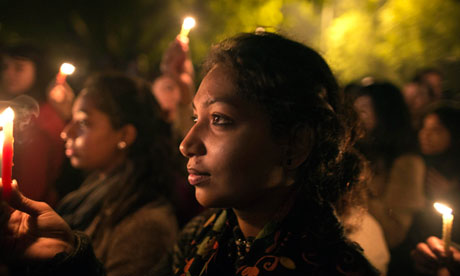
Vigil for Indian victim of gang rape 
 
Protesters and mourners attend a vigil in Delhi as a student’s death galvanises Indians to demand greater protection for women. Photograph: Ahmad Masood/Reuters
 
At seven o'clock on Saturday night, they lit the candles – on Juhu Beach, where Mumbai meets the Indian Ocean; in the centre of the bustling southern cities of Hyderabad and Bengaluru (formerly Bangalore); at the statue of Mahatma Gandhi in chaotic, poverty-stricken Lucknow, 1,000 miles to the north.

Simultaneously, thousands of people across this vast nation remembered a still anonymous 23-year-old medical student who, late on Friday night, died of injuries sustained when she was raped and brutalised with an iron bar by six men on a moving bus in Delhi two weeks ago.

In Delhi itself, a city full of temples, mosques and churches, scores gathered at a shrine set up at the bus stop where, tired of waiting for the rare public buses after a trip to see the film Life of Pi, the young woman and her male friend had accepted a lift from the men who would rape her. Whether those in the crowd were mourners, protesters or both was unclear. Under the hastily printed posters reading "You Inspired Us All" and "No to Violence to Women", they too lit their candles. "We are feeling very sad. We are feeling very angry. Now we hope our lives will change," said Archana Balodi, a 24-year-old student.

The six men who are accused of the attack were charged on Saturday with murder, an offence which can be punished by death in India. Even this would be insufficent, said some demonstrators. "Hanging them is not enough. They should be tortured like she was," said Srishdi Kumar, 16. "Then maybe there will be a change. Why not?"

The victim died of organ failure after internal injuries sustained during an assault that lasted for more than an hour. She and her male friend were thrown from the moving bus.

Few now doubt that India, and particularly Delhi, has a problem with rape and sexual violence against women. In recent weeks the issue has changed from being "a privately accepted fact" to a "public cause", said the local Indian Express newspaper. Now many are talking about a turning point.

"In legal terms, it can be [a turning point] if there is the political will. But more broadly it could be a turning point for young women in India. They have seen and sensed the power of their united voice and their resistance, and that is critical," Brinda Karat, a veteran activist and Communist MP, told the Observer.

Many have been angered by the response of the authorities since the incident. While leading figures of the beleaguered ruling Congress party pledged action and spoke of their deep sadness on Saturday, a huge security operation was under way in the capital city to prevent demonstrators reaching parliament, the India Gate war memorial or their own official residences.

Protests last weekend turned violent with water cannon, teargas and baton charges used to disperse demonstrators. But there appeared to be no such threat on Saturday and the massed ranks of police looked like an over-reaction rooted in the paranoia and aloofness of India's political elite.

In a rare televised address, Sonia Gandhi, president of the Congress party, said that she spoke as "a mother and a woman", and called for efforts to counter "shameful social attitudes and mindsets that allow men to rape with such impunity".

Sexual harassment – known locally as "Eve-teasing" – is endemic in India. The belief that women are responsible for sexual assault is widespread. This year a series of rapes in rural areas in the state of Haryana, which is adjacent to Delhi, led to suggestions from politicians and community leaders that much sexual violence was consensual.

Investigations have revealed similar attitudes among the police. Women who report rapes are repeatedly ignored or even harassed themselves.

In the wake of the most recent incident, dozens of other rapes, often by multiple assailants, have been reported by the media across India. More than 24,000 rape cases were registered with the authorities in 2011, a 9% increase on the previous year.

In one incident reported last week, police took 14 days to register a complaint from a 17-year-old in Patiala, in the north-western state of Punjab, who attempted to report a gang rape. She later took her own life. Two officers have been sacked and one suspended.

The government has set up two committees to recommend new measures to combat sexual violence against women. One is likely to be the publication on the internet of a register of sex offenders; others include fast-track courts and a higher proportion of female police officers.

But the events of the past week have also revealed a growing gulf between young Indians and the ageing political class. The prime minister, Manmohan Singh, an 80-year-old former economist, encountered derision when he described the "emotions and energies this incident has generated" as "perfectly understandable reactions from a young India and an India that genuinely desires change".

Sheila Dikshit, the chief minister of Delhi – an otherwise popular figure who said she felt ashamed "not just as [chief minister], but as a citizen of India" – was booed when she tried to visit one of the protests in the city on Saturday . Few among the overwhelmingly youthful protesters had much confidence in their leaders. Many asked why they should trust political parties who in the last five years have fielded candidates for state elections that included 27 charged with rape and scores more under investigation for harassment and assault.
Brinda Karat said some good might yet come out of the tragedy – but at a high cost. "There has been a critical shift," she said. "But how many young lives and how many young women have to be sacrificed for change to happen?"

Six-year-old abduction girl, Atiya, back in Britain

A six-year-old girl returns to Britain more than three years after she was snatched and taken to Pakistan. The abduction, by her father, could influence her whole life, an expert tells Channel 4 News.

Atiya Anjum-Wilkinson was last seen in the UK in 2009

Atiya Anjum-Wilkinson arrived back at Manchester airport on Friday after vanishing in November 2009 when she went to stay with her father, Razwan Ali Anjum. The former insurance salesman said he was taking Atiya to Southport. Instead he took her to Lahore, Pakistan, and told Gemma Wilkinson - Atiya's mother - that she was "never going to see Atiya again".

Anjum is currently serving a prison sentence in the UK for refusing to reveal his daughter's whereabouts, despite a court order. Just last month Gemma Wilkinson, 32, from Ashton-under-Lyne, Greater Manchester, launched a fresh appeal for information on her daughter's whereabouts. Ms Wilkinson has described her daughter's homecoming as "the best Christmas present ever".

'Something they never get over'

Alison Shalaby is from the charity Reunite International, which offers support to those affected by parental child abduction. Her own daughter was snatched by her Egyptian father. I asked her about what difficulties mother and child face after so long apart.

She told Channel 4 News: "There are going to be challenges because the little girl has been through this twice now - first the abduction from England to Paksitan, and everything that goes with that in her life.
We have spoken with adults who were abducted as a child - they say it's something they never get over. It influences their whole life. Alison Shalaby
"Now she's got a huge change again in her life. But hopefully with a mother's love and the assistance of the immediate family, and help from professionals, they'll be able to form a bond again.
"We have spoken with adults who were abducted as a child - they say it's something they never get over. It influences their whole life."

Jail term

Mr Anjum was handed a fourth consecutive jail term by a high court judge in April after he refused to reveal where his daughter was. Mr Justice Moor imposed a 12-month prison sentence after he found him in contempt of an order instructing him to disclose Atiya's whereabouts.
He said Anjum, who is in his late 20s, would not be eligible for release until he had served at least six months. Judges have previously imposed jail terms of two years, 12 months and another 12 months in the hope that Anjum would provide information. Judges re-jailed Anjum as each sentence neared its end.
Ms Wilkinson, a former charity worker, took legal action in an attempt to force Anjum to reveal the crucial details.
Anjum, who represented himself at the latest court hearing, indicated that Atiya was in Pakistan or Iran but said he did not know her exact whereabouts. Mr Justice Moor said he was sure Anjum was lying.
The judge said: "I am certain that he is in contempt. It is absolutely absurd for him to suggest that he does not know the whereabouts of his daughter and he cannot contact her. I am certain he is lying."
Another judge has previously said the case was "as bad a case of child abduction as I have encountered".

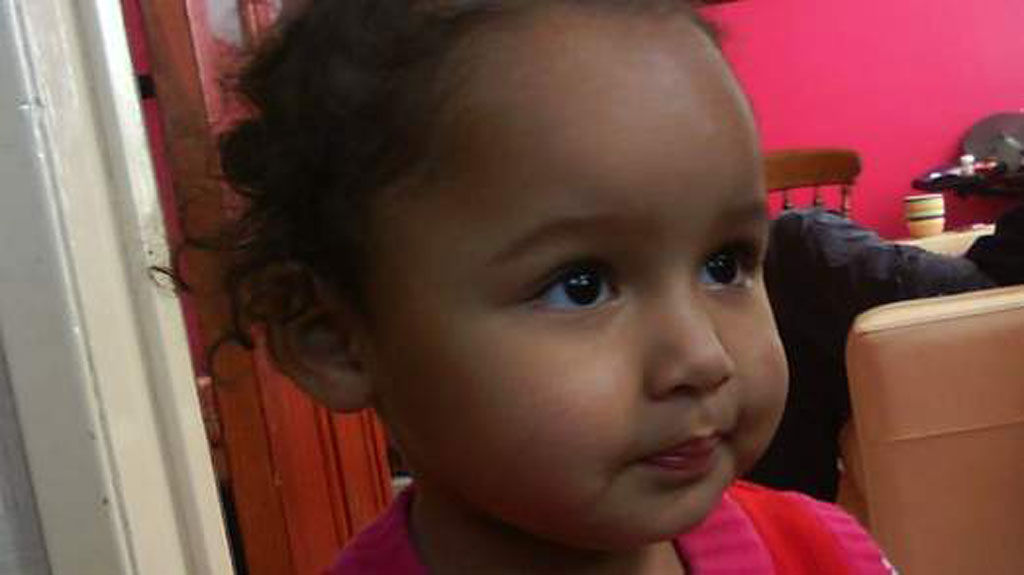
Atiya e-fit image

It is thought Atiya was found after police published a computer-generated e-fit image of what Atiya would look like now - a day before her sixth birthday in November.

Ms Wilkinson said:"It's been an absolute nightmare. As to her whereabouts we know nothing. We've had no contact. I'm worrying every day, every single day. Everything is affected by it. When I close my eyes I see her.

"I say goodnight to her every night before bed. I pray she's okay. We don't have any proof that she's okay, there is no proof she is still alive. It's been discussed that she could have been sold, but I don't want to believe it.

"She was so funny. She was a little bundle of joy. She loved her lipgloss and handbags - as soon as she got hold of my make-up bag, everything in it was hers. We just want her home."

Her "on-off" relationship with Anjum ended in 2008. "He's not prepared to back down - he's not prepared to work with the police," she said at the time.

Somaliland: Stop Misuse of Public Media

A wrong is a wrong. Yes, it is not something right.

They say two wrongs do not make a right. Yes, true it is.

But when a wrong is righted by a wrong, and another and another, thus infinite wrongs are “justified” to right on original wrong, what can that situation be?

Of course as nationalists we abhor, decry and condemn in the strongest terms possible the use (or is it misuse) of tribal chords struck to play clannish whims for ill-motives.

Worse of all is the trend of allowing such innuendoes to be aired or printed for dissemination through the public media.

By the way, the licensing means that have resulted in the off-shooting of numerous electronic “journals” or “radios” need to be reviewed, or were they in the place ever licensed at all?

To listen to a local “electronic” radio” giving audience to a local “poet” who enters a vociferous, voluble and fire-spitting rhetoric whose vehemence carries all the abilities of war-mongering is not only dangerous but so inconvenient  that we wonder who ever licensed such “freedom”.

To listen to war-mongering in song or poetic disguise only remind us of the Rwanda mass massacre that were not only catalyzed, but indeed, ignited and caused by radio stations.

For such a wrong to be countered in the same spirit by another wrongful move only compounds the situation even further and is only to fuel the fire hence the hog-wash would erupt into fire-balls.

So too would other “members” of other “communities” who feel “touched” do the same.

Before the media misuse is allowed to blend and integrate into our culture becoming a “normal in-thing” we should nip it at the bud now.

To the contrary, what we should see in the media should be positive trends. It is quite sad that the Guurti or parliament have forgotten what they are paid for.

Worthy Somalilanders should come fast to our aid and preach goodwill. Cabinet, Guurti, Parliament and traditional leaders should immediately see the dangerous route that the stirring up of tribal emotions may take hence should counter it immediately by disseminating the needful.

We should be responsible and know what is good and what is right. We should know what we are supposed and obliged to do. The media should not consciously nor unconsciously take part to misinform, disinform or equally take part in propagating ill-will through war-mongering propaganda.

The information department should review how local websites and blogs operate for we can no longer discern their agendas any more.

By MA EGGE

Somali woman gets 8 years in prison on ‘terrorism’ charge for her humanitarian work

By Staff |
December 13, 2012
 
San Diego, CA - A young Somali woman and well-known community activist, Nima Ali Yusuf, was sentenced to eight years in prison, here on Dec.11, for conspiracy to provide material support to a terrorist organization. Yusuf, a volunteer at the Humanitarian African Relief Organization was accused of sending a small sum of money - $1450 - to members of Somali resistance organization al-Shabab.
At issue was the accusation that Yusuf helped out friends in Somalia, who were also said to be members of al-Shabab. 

The courtroom was packed with family, friends and supporters when Judge Barry Ted Moskowitz handed down the sentence.

A statement from Yusef’s defense committee refers to her as a hero and notes, “Nimo Yusuf is a daughter with great heart. She will go beyond her ability to help others. She is highly beloved in the Somali Community. She has touched the lives of so many of us here in the twin cities. She translated, provided transportation, cared for the sick and the widows. She loved her faith and followed its commandments of giving, helping, and caring. She carried the burden of others, solved their problems, counseled the youth, cried and cared for many of us who are struggling and adjusting to the new life in America.”

The FBI made use of wiretaps against Yusuf and, according to court records, intercepted and recorded 35,000 calls made by her.

Mick Kelly, of the Committee to Stop Repression, states, “A good person who did good things is being sent to prison for a very long time. The government wants to criminalize people who support a Somalia that is independent of foreign domination. She should be released at once.”

U.S. ‘terror’ and gun laws extended to Somalia - Somalis face New York City trial

By Mick Kelly |
December 28, 2012
 
Brooklyn, NY - Three men from Somalia, Ali Yasin Ahmed, Madhi Hashi and Mohamed Yusuf, appeared in Federal District Court here, Dec. 21, on charges of violating U.S. “material support for terrorism” and gun laws. What makes this case different from the dozens of U.S. cases involving Somali men and women in Minnesota, California and other states is that there is no indication the men are U.S. residents or citizens, or that they have ever traveled to the U.S.

The conspiracy to provide “material support to a foreign terrorist organization” stems from their alleged membership in the Somali resistance organization, al Shabaab. Al Shabaab is an Islamic political movement that is fighting the U.S.-backed foreign intervention in Somalia.

The gun charge, according to a Dec. 21 press release form the New York Eastern District U.S. Attorney’s Office, involves the “unlawful use of machine guns” in Somalia.

The case against the three men rests on the dubious legal theory that U.S. laws can be applied anywhere in the world. The New York Times states, “Court documents show no connection between the alleged crimes and the United States.”

Two of the men, Mohamed Yusuf and Ali Yasin Ahmed, lived in Sweden for a time. Madhi Hashi was born in Somalia and grew up in England. The British newspaper, The Independent reported on Dec. 23 that when Hashi lived in London, he was one of a group of young people who said they were pressured by the UK intelligence agency, MI5, to become informants. After his return to Somalia, Hashi’s UK citizenship was revoked.

The Independent says of Hashi, “His family had no idea where he was for five months until he appeared in a New York court on Friday accused of terrorism. Last night, his British lawyer, Saghir Hussain, said: ‘This has all the hallmarks of rendition. It appears the withdrawal of citizenship and the kidnapping by the Americans may have been co-ordinated.’”

The U.S. Attorney’s Office claims, “In early August 2012, the defendants were apprehended in Africa by local authorities while on their way to Yemen.” On Oct. 18, 2012, a grand jury in the Eastern District of New York returned a sealed indictment against the defendants. On Nov. 14, 2012, the Federal Bureau of Investigation took custody of the defendants and brought them to the Eastern District of New York.”

The Independent quotes Hashi’s father, Mohamed, “’We are not some slaves who can be passed around from one owner to another,’ he said. ‘Why was our son sent to the U.S.? He has been a British citizen for 15 years but then his citizenship was taken away suddenly and now we find out that he's in New York? Our family had to find out this news from public news sources as no one has contacted us until now. We are very worried about his condition as we have no information. The U.S. have not given our son any rights – we don't know where he's being held, how to contact him or how he's being treated. It is shocking that something like this can be done to someone based on accusations and suspicion only.’”

Among those who announced the charges against the three men Dec. 21 was Raymond Kelly, the Commissioner of New York City Police Department. The NYPD has built a massive intelligence network that spys on Arabs and Muslims around the U.S. It is also setting up satellite offices in other countries.

One year after killing of our two colleagues in Somalia

29 December 2012 

It is with great sadness that the international medical humanitarian organisation Médecins Sans Frontières (MSF) marks one year since our two colleagues, Philippe Havet and Andrias Karel Keiluhu ("Kace"), were brutally murdered in Mogadishu.

Philippe, a 53-year-old emergency coordinator from Belgium, and Kace, a 44-year-old medical doctor from Indonesia, were working with MSF teams to provide emergency medical assistance to displaced and resident populations affected by the conflict in Somalia.

"Philippe and Kace are greatly missed and today we extend our heartfelt sympathy and condolences to their families and friends," said MSF general director Christopher Stokes.

Following their tragic murders, MSF decided to close two large medical centres in the Somali capital. However, MSF continues to operate 10 projects throughout Somalia and provides medical and humanitarian aid to thousands of Somali refugees in camps across the border in Ethiopia and Kenya.

Today, two other MSF employees, Blanca Thiebaut and Montserrat Serra, remain held against their will in Somalia after they were abducted from the Dadaab refugee camp in Kenya, on 13th October 2011. MSF once again condemns this act of violence and demands their immediate release.

Saturday, December 29, 2012

An Eritrean scholar gets two international recognitions on his work in Remote Sensing

 By Prof. Dr. Embaie Ferrow | On Monday, 29 October 2012, during the biennial African Association of Remote Sensing of the Environment (AARSE) conference in Eljadida, Morocco, P

Prof. Tsehaie Woldai was honored with two awards: the AARSE-AFRICA highest Achievement Award for his work as founder, immediate past President and for turning the association into a political force shaping Africa’s Space programs.


AARSE, sine Prof. Tsehaie founded it in 1992, is a composition of over 1800 members, including 32 national associations and societies, 5 space agencies in Africa and over 200 international organizations from Asia, Australia and the America involved in satellite remote sensing and space activities. It is by far the largest association
of its kind in Africa. Its conference attracts an average of 650 participants and over 60 exhibitors and more than 20 sponsors (gold, platinum and silver).

The second award, given on the same day, was the ESRI ‘Making a Difference in Africa’ award. The ESRI award is given once a year to distinguished personalities from various continents during its user conference in San Diego, USA. The conference attracts over 15,000 participants from all over the world. This is the 26nd award in a row so far received.

A Brief Resume of Dr. T. (Tsehaie) Woldai

Dr. Tsehaie Woldai holds an MSc degree from the International Institute for Geo‐Information Science and Earth Observation (ITC), Enschede, The Netherlands (1976) and a PhD degree of the Open Universit.

Tsehaie Woldai worked with the Geological Survey and the Water Resources Authority of Ethiopia including: Gulf Oil Company in Ethiopia, Leiden University and the Netherlands Institute for Higher Scientific Research (ZWO) before he joined permanently ITC as an Assistant Professor in 1982. In 1997, he was appointed to the position of Associate Professor and beginning 2008 he holds the position of Portfolio Manager for Marketing and Project Services within the Department of Earth Systems Analysis at ITC.
-----------
Dr. Tsehaie Woldai is a Fellow of the Geological Society of Africa (GSAF); Founder and the current President of the African Association of Remote Sensing of the Environment (AARSE), an Association with more than more than 1200 members in 29 African countries and around 100 institutional members representing 31 countries outside the continent. He is also AARSE leading Official delegate to “Group on Earth Observation (GEO)”; Advisory Member for GEO task US‐09‐01a on Disasters Societal Benefit Areas; Commission VI Secretary of the International Society of Photogrammetry & Remote Sensing (ISPRS); Evaluator of the European Union FP7 Framework Research on “Environment”; Associate Editor for African Affairs, IEEE Geoscience and Remote Sensing Society Newsletter; Editorial Board
Member, International Journal of Digital Earth; Coordinator of the University Network for Disaster Risk Reduction in Africa (UNEDRA) and Guest Editor, Supplement Issue on “Remote Sensing For Africa”, International Journal of Applied Earth Observation and Geoinformation, Vol.1, 2010.


Green and Inclusive Project to Benefit the Horn of Africa

The Board of Directors of the African Development Group has approved US $125 million in funding for the first phase of a drought resilience project and provision of long-lasting means of subsistence to populations in the Horn of Africa.

Three countries, Djibouti, Ethiopia and Kenya, as well as the Secretariat of the Intergovernmental Authority on Development are involved in the first phase of this regional project funded by way of loans and grants provided by the African Development Fund (ADF) beginning in 2013.

The African Development Fund grants amount to US $15 million for Djibouti, and US $7 million for the IGAD Secretariat. The ADF loans of US $46 million and US $56 million to Ethiopia and Kenya, respectively, will go to support activities aimed at restoring the means of subsistence of the populations through investments in natural resources management, land management, restoration and protection of the ecosystem, as well as agriculture and livestock infrastructure.

The project will equally contribute to the improvement of storage, marketing and transportation facilities, including the upgrade of rural roads. The objective is to focus on the deeper causes of the region’s vulnerability in order to build resilience in the face of medium- and long-term drought periods, consolidate peace and promote the equitable use of limited natural resources.

Certain drought-prone regions are concerned by the project, namely: Beyya Dader, Gaggade-Derela and Weimar in Djibouti; Afar and Somali in Ethiopia; and Baringo, Isiolo, Marsabit, Samburu, Turkana and West Pokot – six arid and semi-arid regions in Kenya. According to estimates, the project will benefit 12 million people, 98 million cattle, and 173 million sheep and goats that are victims to drought.

The implementation of the inclusive green program will have a deep-rooted environmental and socio-economic impact in these regions

Electric Inter-connectivity Reinforcing Relations in Horn of Africa


Friday, 28 December 2012

Spokesperson of Foreign Ministry Ambassador Dina Mufti said Ethiopia’s power sale to neighboring countries is playing a crucial role in reinforcing the country’s relations within the sub-region. 
Ethiopia  Foreign Ministry Ambassador Dina Mufti
Ambassador Dina explained the power deals Ethiopia is making with neighboring countries contribute to the African Union’s efforts of continental integration. 

Mihret Debebe, Chief Executive Officer of the Ethiopian Electric Power Corporation said the power inter-connectivities are happening after thorough studies of financial feasibility and of environmental impact assessments.

Ethiopia, which is seen as a power hub for the East Africa-wide power grid connection, is now connecting with Djibouti, Kenya and Sudan.

Jewish Home Surges in Polls: Israeli Politics Heads Even More Rightward Likud-Beiteinu Struggling to Hold Off Challenges


new round of polls shows the Jewish Home (Habayit Hayehudi) continuing to surge as an even farther-right alternative to the Likud-Beiteinu list, and leaving little doubt that Israel’s already far-right voter base is continuing to shift.


The surge in Jewish Home is led in no small part by former Netanyahu aide Naftali Bennett, who is scoring big both as a multi-millionaire business mogul and as a religious far-right ideologue who condemns the notion of Palestinian statehood on general principle in favor of a Greater Israel.

This is problematic for Netanyahu on a number of fronts, as he has already alienated the religious right by throwing his lot in with Avigdor Lieberman, whose star is falling as his legal troubles mount, and is struggling to keep the joint list just barely palatable to the international community while facing accusations of being “soft” for not taking as sociopathic of a hard-line as his newfound rivals.

Likud-Beiteinu has scrapped any endorsement of a two-state solution in its platform, but with “moderate” Likudniks already uneasy about their alliance with Lieberman and with the expulsion of their more moderate MPs, it will be difficult for them to go a step farther and scorn the idea of peace the way Bennett’s bloc is. This is costing them the extreme hawkish vote in the polls, while Home is scooping up votes from the fashionable religious right as well as the fringe.

This should leave them a force to be reckoned with after the election, but leaves the path to majority government even less clear, as Likud-Beiteinu seems unlikely to partner with them or the center-left, and the really-far-right doesn’t appear to have enough seats to govern without Lieberman and Netanyahu.

Guiletto Chiesa presents at the 9/11 Revisited conference in Kuala Lumpur


9/11 Revisited: The Unjustifiable Launch of Endless War

by grtv
 
Guiletto Chiesa, former MEP and producer of the 9/11 documentary, "Zero," presents at the 9/11 Revisited: Seeking the Truth conference in Kuala Lumpur on November 19, 2012.
Produced by James Corbett


US-NATO-Israeli Agenda: Syria to be Subdivided into “Three Weaker States”

Global Research, December 28, 2012
 
Egyptian media pundit Tawfik Okasha, owner of the Egyptian opposition TV channel  al-Fara’een, blamed the Mainstream Media of being complicit with the Muslim Brotherhood in feeding the Egyptian people lies about the Syrian crisis. 


He calls for all free Syrians to back President Bashar al-Assad as the issue is not about him but goes beyond to include the destruction of Syria and its transformation into three weaker states incapable of confronting Israel. 

Transcript of  Tawfik Okasha’s statement

Bashar Al Assad’s war is with Al Qaeda and the Muslim Brotherhood.

The issue is not about Bashar it is about the destruction of Syria and its transformation into three states
It is about Syria being owned by the muslim Brotherhood and its Security Apparatus being destroyed and replaced by that of the Muslim Bportherhood. There’s a deal being struck between Israel, Turkey and the EU to transform Syria into three states, so that the issue of the Golan Heightsa as well as Syria. So there won’t be any state that will have armed forces capable of confronting Israel.

 The issue is about the destruction of the Syrian Army asnd the destruction of the Syrian leadership and the Syrian Armed Forces

You liars, you who tell the Egyptian people lies upon lies, You tell them that Bashar al Assad is slaughtering  people. Bashar al Assad’s war is with Al Qaeda and the Muslim Brotherhood, It is with those people sent in by Turkey, the US and Israel,
 

US Special Forces Accused of Raping Afghan Women During Raid

Special forces of the US army raided houses of villagers and separated the men and women of 15 families living in this village. They then raped a number of these women.

According to a report in the political section of the Afghanpaper, authentic reports given by the people state that special US forces raped a number of women in a village of Afghanistan, after attacking it.

US Special forces based in Afghanistan, raided a village in Chahar Bolak area of Balkh province at night, some days back (we apologize for not naming the village for certain reasons), and committed a horrendous crime. They raided houses of villagers and separated the men and women of 15 families living in this village. They then raped a number of these women.

The commander of the US soldiers warned the people of the village that this crime will be repeated should they complain to the authorities.

Since the occupation of our country by US forces in 2001, reports of the raping of Afghan women and girls by US soldiers has been reported by the media several times, but unfortunately no legal action has been taken by the government in any of the cases.

Some time back it was revealed that in several isolated provinces, forces under US supervision, mainly the US soldiers, took the money and belongings of the people without reason or explanation.

Till now, several reports have been sent about foreign forces forcefully taking away the money and personal belongings of Afghan residents with no explanation, and no one is ready to stand up to them. Many of these people faced violations and complained to government organizations, but the officials have refrained from taking any action against the US soldiers and NATO forces.

Indifference of authorities, bullying and rogue acts of foreign soldiers on the one hand, and the invasion of privacy by the Taliban on the other, has led to the deterioration of security in this isolated province and extremely worried the people.

What has the government done about these heinous acts? Like always, nothing! Most of the media outlets do not dare to report these crimes from fear of judicial officials and hunt by foreigners.

However, this hardly comes as a surprise from a government supported by the west, which is sitting silently in the face of raping and bullying by US forces and its creations, the Taliban.

Now you decide: these innocent suffering people are raped by foreign forces, what is sacred to them is insulted, they are bullied, they are threatened by the Taliban as well, and they see no good from the government, what should they do?

Originally published on Dec. 2, 2012
Click here to read the story on RAWA News

Hidden US-Israeli Military Agenda: “Break Syria into Pieces”


Global Research, December 28, 2012
 
A timely article in the Jerusalem Post in June brings to the forefront the unspoken objective of US foreign policy, namely the breaking up of Syria as a sovereign nation state –along ethnic and religious lines– into several separate and “independent” political entities. The article also confirms the role of Israel in the process of political destabilization of  Syria.  The JP article is titled: “Veteran Kurdish politician calls on Israel to support the break-up of Syria‘ (by Jonathan Spyer) (The Jerusalem Post (May 16, 2012)

The objective of the US sponsored armed insurgency is –with the help of Israel– to “Break Syria into Pieces”. 

The “balkanisation of the Syrian Arab Republic” is to be carried out by fostering sectarian divisions, which will eventually lead to a “civil war” modelled on the former Yugoslavia. Last month, Syrian “opposition militants” were dispatched to Kosovo to organize training sessions using the “terrorist expertise” of the US sponsored Kosovo Liberation Army (KLA) in fighting the Yugoslav armed forces.

Sherkoh Abbas, President of the US based Kurdistan National Assembly of Syria (KNA)  has “called on Israel  to support the break-up of Syria into a series of federal structures based on the country’s various ethnicities.” (Ibid)

One possible ”break-up scenario” pertaining to Syria, which constitutes a secular multi-ethnic society, would be the formation of separate and  “independent” Sunni, Alawite-Shiite, Kurdish and Druze states:   “We need to break Syria into pieces,” Abbas said. (Quoted in JP, op. cit., emphasis added).
“The Syrian Kurdish dissident argued that a federal Syria, separated into four or five regions on an ethnic basis, would also serve as a natural “buffer” for Israel against both Sunni and Shi’ite Islamist forces.” (Ibid.).
Ironically, while Islamist forces are said to constitute the main threat to the Jewish State, Tel Aviv is providing covert support to the Islamist Free Syrian Army (FSA).
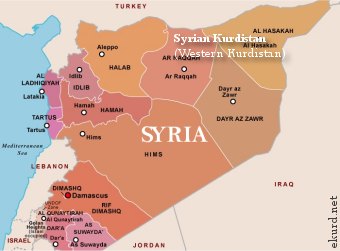
Map 1
Meeting behind Closed Doors at the US State Department

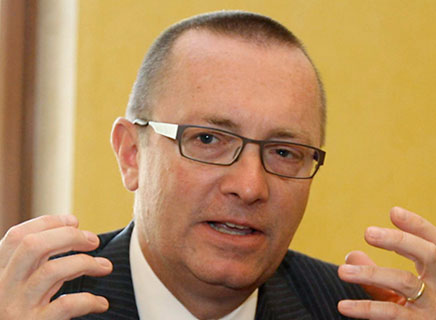
A top level US State Department meeting was held in May with members of the Syrian Kurdish opposition. In attendance were representatives of the Kurdish National Council (KNC),  Robert Stephen Ford, the outgoing US ambassador to Syria (who has played a key role in channelling support to the rebels) as well as Frederic C. Hof, a former business partner of Richard Armitage, who currently serves as the administration’s “special coordinator on Syria”. (Ibid). The delegation also met with Assistant Secretary of State for Near Eastern Affairs Jeffrey Feltman.

Frederic C. Hof, Robert Stephen Ford and Jeffrey Feltman are the State Department’s key Syria policy-makers, with close links to the Syrian Free Army (SFA) and the Syrian National Council (SNC).


Assistant Secretary of State for Near Eastern Affairs Jeffrey Feltman


Frederic C. Hof, The Administration’s “special coordinator on Syria”


Robert S. Ford, outgoing US Ambassador to Syria

The public statements of KNA leader Sherkoh Abbas in the wake of the State Department meeting suggest that the political fracturing of the Syrian Arab Republic along ethnic and religious lines as well as the creation of an “independent Kurdistan” were discussed. “State Department Deputy Spokesman Mark Toner described [the meeting's] purpose as part of ‘ongoing efforts… to help the Syrian [Kurdish] opposition build a more cohesive opposition to Assad.’”  (Ibid).

The KNA leader called upon Washington to support the creation of a separate Kurdish State consisting of  “an autonomous region in Syria; joining the Kurdistan Regional Government in Iraq – which borders the Kurdish region in Syria; or perhaps an even larger Kurdish state” [Greater Kurdistan].

“The Kurdish people, in all parts of Kurdistan, seek the right to form an independent Kurdish state. We can only achieve this cherished goal with the help of the western democracies, and first and foremost the U.S.” said Sherkoh Abbas. (Syria: An Alternative, Choice, Ekurd.net, May 22, 2012)

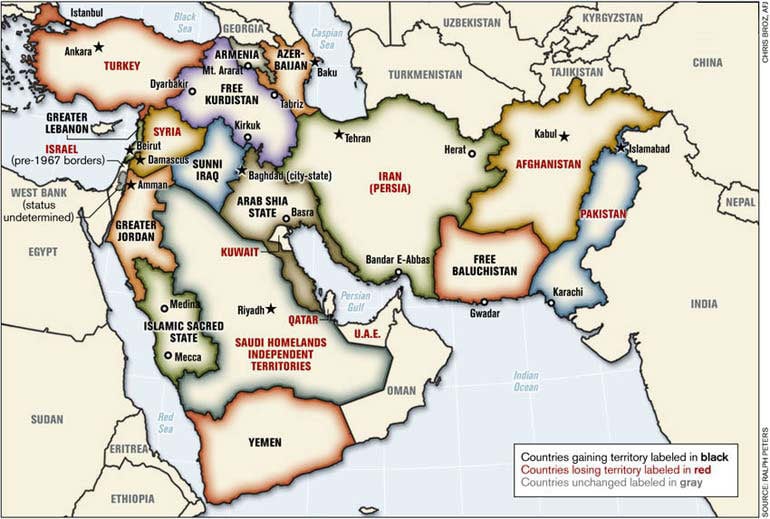
It is worth noting, in this regard, that the creation of a “Greater Kurdistan” has been envisaged for several years by the Pentagon as part of a broader “Plan for Redrawing the Middle East”.(See map 2 below)
This option, which appears unlikely in the near future, would go against the interests of Turkey, a staunch ally of both the US and Israel. Another scenario, which is contemplated by Ankara would consist in the annexation to Turkey of parts of Syrian Kurdistan. (See map above).

“Greater Kurdistan” would include portions of Iran, Syria, Iraq and Turkey as conveyed in Coronel  Ralph Peters (ret) celebrated map of “The New Middle East” (see below). (For Further details see Mahdi Nazemroaya’s November 2006 Global Research article).

Colonel Peters taught at the US Military Academy.

Detailed analysis on Syria.
Over 30 chapters, available from Global Research at no charge
SYRIA: NATO’s Next “Humanitarian” War?

ONLINE INTERACTIVE I-BOOK
- by Prof. Michel Chossudovsky – 2012-07-15
Plans for Redrawing the Middle East: The Project for a “New Middle East”

- by Mahdi Darius Nazemroaya – 2006-11-18
Towards the balkanization (division) and finlandization (pacification) of the Middle East

Map 2. The New Middle East


The following map was prepared by Lieutenant-Colonel Ralph Peters. It was published in the Armed Forces Journal in June 2006,

Peters is a retired colonel of the U.S. National War Academy. (Map Copyright Lieutenant-Colonel Ralph Peters 2006).

Although the map does not officially reflect Pentagon doctrine, it has been used in a training program at NATO’s Defense College for senior military officers.

This map, as well as other similar maps, has most probably been used at the National War Academy as well as in military planning circles.

Scrambling for Africa’s Resources,


by Stephen Lendman

It’s more than about oil, stupid. It’s for vast African riches. Resource/mineral wars define America’s agenda.

On December 15, 2006, the United States Africa Command (AFRICOM) was authorized. On February 6, 2007, it was announced.

On October 1, 2007, it was established. On October 1, 2008, it became operational. It’s mission is controlling Africa’s riches.

They’re vast. They’re some of the world’s largest and richest. Potential new deposits await to be found. Others known about await development. Modern exploration methods enable global exploitation. Virtually nothing escapes discovery.

Africa’s rich in oil, gas, gold, silver, diamonds, uranium, iron, copper, tin, lead, nickel, coal, cobalt, bauxite, wood, coltan, manganese, chromium, vanadium-bearing titanium, and much more.

Continental agricultural lands are valued. So is offshore fishing.

Congo, Southern Sudan’s Darfur region, Gulf of Guinea, Libya, Nigeria, and Niger, among other areas, hold special interest.

So does Mali. Last October, Reuters headlined “Mali war plan to be ready within weeks: AU,” saying:

Military intervention is planned to reclaim territory seized by “Islamist militants.” On March 22, an army coup toppled President Amadou Toumani Toure.

At the time, France signaled readiness to intervene. Malian junior officers revolted. They control northern areas. Obama officials call Mali a “powder keg.” Conditions threaten regional destabilization, they say.

Reasons are invented to intervene. Obama wants congressional funding. He prioritizes wars. He’s eager to begin term two with new ones. Permanent ones define his agenda.

NATO/EU partners are pressured to go along. Last October, the Security Council approved an international military mission to Mali. Ban Ki-moon was enlisted to help develop military intervention plans. Finalizing them was planned for end of November.

France drafted the UN resolution. It was Washington’s lead attack dog on Libya. It may have the same role on Mali. US special forces and drone attacks may be planned.

They’re already involved. Covert ops and surveillance began months ago. They’re prelude for what’s planned. Operations may replicate Somalia, Yemen, or Libya 2.0 with less sustained air support.

Reuters called Mali “paralyzed by twin crises.” Leadership is divided. Last June, reports said African Union officials asked for Security Council intervention authority.

On December 20, it came unanimously. Timing was left unaddressed. Authorization signaled Washington’s intention to intervene. Obama already has. Greater invention is planned.

Security Council members voted days after Malian Prime Minister Cheick Modibo Diarra’s resignation.

Coup members arrested him. They forced him out. He strongly supports intervention.

Django Cissoko replaced him. He’s silent so far on favoring it. Malian Foreign Minister Tieman Hubert Coulibaly called authorization “historic.” His government supports it.

It asked Ban Ki-moon to “confirm in advance the council’s satisfaction with the planned military offensive operation.”

Ban’s a reliable imperial ally. He’s replicated the worst of Kofi Annan’s failures and betrayal.

Both men abhor peace. They support Washington’s wars and occupations. They ignore Israel’s worst crimes. They’re indifferent to human suffering. They call aggressive wars liberating ones.

They endorse America’s agenda. Mali’s in line to be attacked, destroyed and controlled. Ban’s comfortable with more African bloodshed. The entire Sahel region and beyond are threatened.

The Security Council resolution authorized an unspecified troop strength African-led International Support Mission (AFISMA). An initial one-year period was called for.

The Economic Community of West African States (ECOWAS) wants 3,300 troops in Mali. They’ll be US/Western proxies. Nigerian forces appear designated to lead them.

They’ll conduct ground operations. US, French, and other NATO logistical, air, and intelligence operations will support them.

Timing remains undecided. Tactics are being planned. Clarity may come post-holidays. Perhaps after Obama’s January 21 inauguration.

UN peacekeeping head, Herve Ladsous, suggested that logistical planning may delay intervention until September or October.

France’s UN ambassador, Gerard Araud, called it premature to say when military operations will begin. African and Malian troops must be trained, he said. Much depends on political considerations.

Extreme weather may intervene. In late March, monsoon season begins. It lasts months.

Timbuktu’s Mayor Halle Cisse asked for “rapid military action to liberate our cities.”

“There is no school. There is no work and no money,” he added. “We are fed up with this situation.” Timbuktu depends on tourism. Conflict keeps people away.

Media scoundrel fear mongering said Islamists imposed sharia law. Managed news misreporting made lurid claims. Propaganda substitutes for truth. Claims about banned public male/female socializing were featured.

Other accounts stressed attacking bars selling alcohol, recruiting child fighters, stonings, whippings, beheadings, amputations, and other punishments against non-believers.

Public sentiment is being prepared for intervention. US-style responsibility to protect (R2P) perhaps plans Libya 2.0 light.

For months, France and Washington held secret intervention talks. Rousting “Islamist militants” is pretext. So is waging war on terror. Resource control is policy.

Thursday’s resolution welcomed ECOWAS troop pledges. It called for member states’ help. Chad, Mauritania and Niger were asked to contribute. Their troops have desert warfare experience.

Resolution language stressed two-track planning. Political and military were called for.

US and French special forces operate in Mali. They’re active in other regional countries. They conduct covert operations. They’re training Malian forces. Stepped up efforts are planned.

AFRICOM head General Carter Ham called Malian and other regional conditions “vastly different than they were previously. There are now non-Al Qaeda associated (militant) groups that present significant threats to the United States.”

Al Qaeda in the Islamic Maghreb (AQIM) raises most concern, he said. It’s also called “the Salafist Group for Call and Combat.” Other regional groups include “the Movement for Unity and Jihad in West Africa.”

“It is clear to me they aspire to conduct events more broadly across the region, and eventually to the United States,” claimed Ham.

“That is the ideology. That is the campaign plan. Establish the caliphate and spread the ideology. Attack Western interests. Attack democrat forms of government. We are certainly seeing it.”

America creates pretexts to intervene. When enemies don’t exist they’re invented. Imperial strategy prioritizes it.

Algiers University Professor Ahmed Adhimi believes Afghanistanizing the Sahel region looms.

Military intervention will attract “adventurers, terrorists, and all those who want to fight the Crusaders” like flower-containing pollen and nectar draw bees to produce honey.

Cross-border conflict may follow. Algeria may become Africa’s Pakistan. Washington may drag Algiers into a war it doesn’t want. It’ll end up victimized like other US targets. Obama perhaps plans it.

A Final Comment

CIA elements operate covertly virtually everywhere. So do US special forces in 120 or more countries.

Fifty-four nations comprise Africa. In 2013, the Pentagon plans sending “small teams” to over 35 of them. Perhaps they’re already in most of the other 19.

Reports about their role limited to training and equipping efforts don’t wash. US forces everywhere are combat trained and ready.

Special forces are assassins. They specialize in search and destroy, extrajudicial assassinations, and other lawless acts.

Washington wants unchallenged African dominance. AFRICOM was established to rape the continent’s riches.

Proxy and direct wars are prioritized. Expect much more in resource-rich areas.

Stephen Lendman lives in Chicago and can be reached at lendmanstephen@sbcglobal.net.

His new book is titled “Banker Occupation: Waging Financial War on Humanity.”

http://www.claritypress.com/LendmanII.html

Visit his blog site at sjlendman.blogspot.com and listen to cutting-edge discussions with distinguished guests on the Progressive Radio News Hour on the Progressive Radio Network Thursdays at 10AM US Central time and Saturdays and Sundays at noon. All programs are archived for easy listening.

http://www.progressiveradionetwork.com/the-progressive-news-hour

http://www.dailycensored.com/scrambling-for-africas-resources/

Somalia: Muslims murder Christian for leaving Islam

NAIROBI, Kenya (Morning Star News) – Gunmen in central Somalia on Saturday (Dec. 8) killed an underground Christian who had been receiving death threats for leaving Islam, area sources said.

Two unidentified masked men shot Mursal Isse Siad, 55, outside his home in Beledweyne, 206 miles (332 kilometers) north of Mogadishu, for leaving Islam, Muslim and Christian sources told Morning Star News. The assailants fled immediately after the murder.

Siad’s oldest daughter (name withheld), 15, said her father was killed “because he failed to attend the mosque for prayers and used to pray at home. He used to share with us about Jesus.” She said that he had received messages on his mobile phone stating, “We know what you are doing, and you must stop, otherwise you risk your life.”

Siad’s 42-year-old wife (name withheld), three daughters and two sons have fled the area, fearing for their lives.

A Christian source in Mogadishu confirmed the killing, and a Muslim resident of the Beledweyne area also said Siad was killed for leaving Islam.

“Siad deserved to die because he was not committed to the Islamic religion,” the resident said....

AFRICOM helps with C. African Republic evacs

By Lolita C. Baldor - The Associated Press
Posted : Thursday Dec 28, 2012
WASHINGTON — The State Department has closed its embassy in the Central African Republic and ordered the ambassador and his diplomatic team to leave the country as rebels there continue to advance and violence escalates, U.S. officials said Thursday.


A Pentagon spokesman, Army Lt. Col. Todd Breasseale, said that at the State Department’s request, Defense Secretary Leon Panetta had directed U.S. Africa Command to evacuate U.S. citizens and designated foreign nationals from the U.S. Embassy in Bangui “to safe havens in the region.”

State Department spokesman Patrick Ventrell said the U.S. Embassy had temporarily suspended operations, but not diplomatic relations with the country.

“This decision is solely due to concerns about the security of our personnel and has no relation to our continuing and long-standing diplomatic relations” with the Central African Republic, Ventrell said in a statement.

Shortly after announcing the evacuation Thursday, the State Department warned U.S. citizens against travel to the Central African Republic, saying it could not “provide protection or routine consular services to U.S. citizens” and urging Americans who have decided to stay to “review their personal security situation and seriously consider departing” on commercial flights. Four days earlier, the State Department had issued a warning recommending against travel to the country and authorizing its non-emergency personnel in Bangui to leave.

U.S. officials said about 40 people were evacuated on an U.S. Air Force plane bound for Kenya. The officials spoke on condition of anonymity because they weren’t authorized to discuss the details of the operation.

The departure of Ambassador Laurence Wohlers and his staff comes as the president of the Central African Republic on Thursday urgently called on France and other foreign powers to help his government fend off rebels who are quickly seizing territory and approaching this capital city, but French officials declined to offer any military assistance.

Rebels have seized at least 10 towns across the sparsely populated north, and residents in the capital of 600,000 people fear insurgents could attack at any time.

The developments suggest the Central African Republic could be on the brink of another violent change in government, something not new to the impoverished country. The current president, Francois Bozize, himself came to power nearly a decade ago in the wake of a rebellion.

Speaking to crowds in Bangui, Bozize pleaded with foreign powers to do what they could. He pointed in particular to France, Central African Republic’s former colonial ruler.
About 200 French soldiers are already in the country, providing technical support and helping to train the local army, according to the French defense ministry.

French President Francois Hollande said Thursday that France wants to protect its interests in Central African Republic and not Bozize’s government. Paris is encouraging peace talks between the government and the rebels.

President Obama late last year sent about 100 U.S. special operations forces to the region — including Central African Republic — to assist in the hunt for Joseph Kony, the fugitive rebel leader of the notorious Lord’s Resistance Army. Forces have been hunting the elusive warlord in Central African Republic, South Sudan and Congo.

Associated Press writer Matthew Lee contributed to this report.

Maxaabiista Xabsiga Dhexe Ee Hargeysa Oo La Barayo Xirfado Lagu Dhaqan-celinayo


Taliska guud ee Ciidamada Asluubta Somaliland, ayaa markii u horreysay hirgeliyey qorshe Xirfado kala duwan lagu barayo boqolaaal ka mid ah Maxaabiista kujirta Jeelka dhexe ee Magaalada Hargeysa, kuwaas oo ay ka mid yihiin Maxaabisti Budh-cad badeeda ee dibadda lagaga soo waariday dalka.
Xabsiga Dhexe ee Hargeisa

Taliyaha Ciidamada Asluubta Axmed Xuseen Faarax iyo Taliyaha Xabsiga Dhexe ee Hargeysa Cumar Siciid oo shalay warbaahinta ugu waramayay Gudaha Xabsiga Casimadda, ayaa war bixiyey qorshaha xirfadaha kala duwan loogu sameeyey maxaabiista ay gacanta ku hayaan.

Taliyaha Xabsiga Dhexe Cumar Siciid oo ugu horayn halkaas ka hadlay, ayaa faahfaahin ka bixiyey ujeeddada xirfadaha loo abuuray maxaabiita. “waxaanu ku talo-galay in Dadkan (Maxaabiista) dhaqan celin loo sameeyo oo inta Nolosha toosan ka leexatay  loo soo leexiyo waddada toosan ayaanu arrintan ugu talo galnay. Maxaabiistan halkan ka shaqaynaysa waxay is-kugu jiraan Maxaabiistii Kiiska madaniga ah ee sameeyay gacan dhaafka, sida tuugta iyo waxyabahaas oo kale iyo Budh-cad Badeeddii  laga keenay dalka Sishiles, kuwaas oo wax la barayo oo ay jeelka uga baxaan sidii ay noloshooda ugu dabari lahaayeen,”ayuu yidhi Taliyaha Xabsiga dhexe ee Hargeysa Cumar Siciid

Taliyaha Ciidanka Asluubta Gen. Maxamed Xuseen Faarax oo isaguna halkaas ka hadlay, waxaanu yidhi, “Waxa weeye in Maxbuusku baxo isaga oo aqoon leh ama ha barto baadhista ama sida loo sameeyo Jaajuurka ama Nijaarnimada ama dhisida guryaha

Mid ka mid ah Maxaabiista u xidhan falalka budhcad-badeednimo ee Jeelka weyn ee Magaalada Hargeysa ku jirta, ayaa ka warbixiyey xaaladooda nololeed, waxaanu yidhi, “Waxaan salaamayaa dadkaygii oo dhan. Waxaan ahay maxbuus ku xidhan Somaliland, kuna eedaysan Budh-cad badeed, macaan ayaa igu dhacay dabadeed qoladayadii waxa naloo sameeyay shaqo. Wax dhibaato ah oo nalagu hayaa majirto oo waxaanu ka mid nahay Maxaabiista jeelka ku jirta ee dalka u dhalatay oo kale. Wax wacan ayaa lana baray oo waxaanu hadda baranay xirfad.  Markaa waxaanu doonaynaa markaanu baxno inaanu ku shaqaysano xirfada nalabaray,”sidaas ayuu yidhi maxbuuskan ku xidhan falalka budhcad-badeednimo oo dawladda Sychelles ku soo wareejisay Somaliland ka dib markii lagu xukumay dalkaas

Maxbuus kale oo ku xidhan xabsiga Dhexe ee Hargeysa, una xidhan falal budhcad-badeednimo, ayaa farriin u diray Qoyskiisa, isaga oo sidoo kale ka warramay xaaladdiisa nololeed, “Waxaan salaamayaa Eheladayda iyo qaraabadaydii. waxaanu ku xidhan nahay  Jeelka Hargeysa, Noloshayadu aad ayay u wannaagsan tahay, waxaana layga soo beddelay Xabsi kuyaala Sishilis, xaaladaydu way wacan tahay oo waan shaqeynayaa, wixii danbi ah ee nalagu soo xidhay maanta waxaanu ku beddelanay hawlo aad iyo aad u wacan oo waxaanu gacanta ku haynaa xirfad aan rajeynayo inaan mustaqbalka ku shaqaysan doono,” ayuu yidhi Maxbuuskani


http://ogaalnews.net/?p=18768